Chapter 1: The Moving Truck
The morning after my eighteenth birthday, I woke to the sound of tires grinding over gravel.
At first, I thought it was the delivery man. The cabin sat far enough up the Smoky Mountain road that every engine sounded louder than it should. On foggy mornings, noise traveled strangely through the pines, bouncing off the ridges before reaching the porch.
Then I heard my father’s voice.
“Careful backing up. There’s not much room near the steps.”
I sat up in bed.
For one second, I forgot where I was. The quilt around my legs smelled faintly of cedar and smoke, the way every blanket in my grandparents’ cabin had smelled since I was a child. Through the window, pale mountain fog hung low in the valley, and beyond it, the first gold of morning touched the tops of the trees.
Then another voice cut through the quiet.
My younger brother, Sawyer.
“Start with the heavy stuff first,” he called. “The dining table, the rocker, whatever’s worth keeping.”
My heart began to pound.
I crossed the room, pulled the curtain back, and looked down at the front yard.
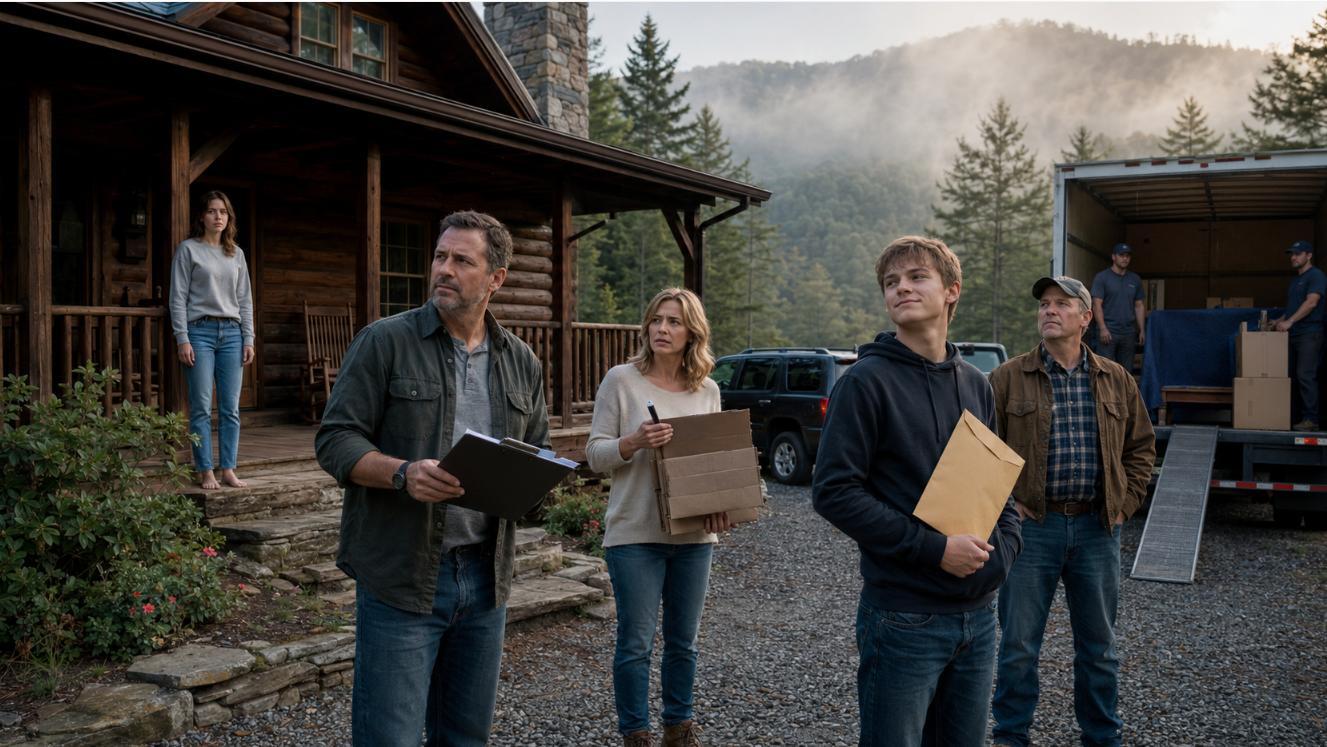
A moving truck sat in the gravel drive.
Behind it were my parents’ SUV, my Uncle Victor’s pickup, and Sawyer’s beat-up blue car. Two men in work gloves stood near the porch steps, waiting for instructions. My mother was unloading empty boxes from the back of the SUV, writing labels on them with a black marker. My father stood with a clipboard, pointing toward the cabin windows like he owned every board in the walls.
Sawyer held a thick envelope against his chest.
He looked proud.
Too proud.
I pulled on jeans and a sweatshirt, moving quietly even though my hands were shaking. I did not run downstairs. I did not throw the door open and scream. Something my grandfather had taught me came back as clearly as if he were standing beside me.
When the roof leaks, don’t curse the rain. Find the hole.
So I opened the front door slowly.
The porch boards creaked beneath my bare feet.
Everyone looked up.
My father smiled first.
Not warmly.
Confidently.
“Good, you’re awake,” he said. “We’ve got everything sorted.”
My mother gave me a tight, nervous smile and kept folding a cardboard box into shape.
Sawyer walked toward the porch, waving the envelope.
“The paperwork’s done,” he said. “The cabin belongs to the family now.”
I looked at him.
“Does it?”
He frowned, as if my calm annoyed him.
“Don’t start, Autumn. This is better for everyone.”
Uncle Victor came around from the truck, his tool belt hanging low on his hip even though nobody had asked him to repair anything. He had the worn face of a man who had spent years blaming bad luck for decisions he made with both eyes open.
“This place is too much for one kid,” he said. “Your grandparents should’ve known better.”
That sentence touched something deep in me.
My grandparents.
Lloyd and Ruby Henderson.
The two people who had known me better than anyone living in my parents’ house ever had.
I looked past them all, down the driveway.
And that was when Sawyer’s grin disappeared.
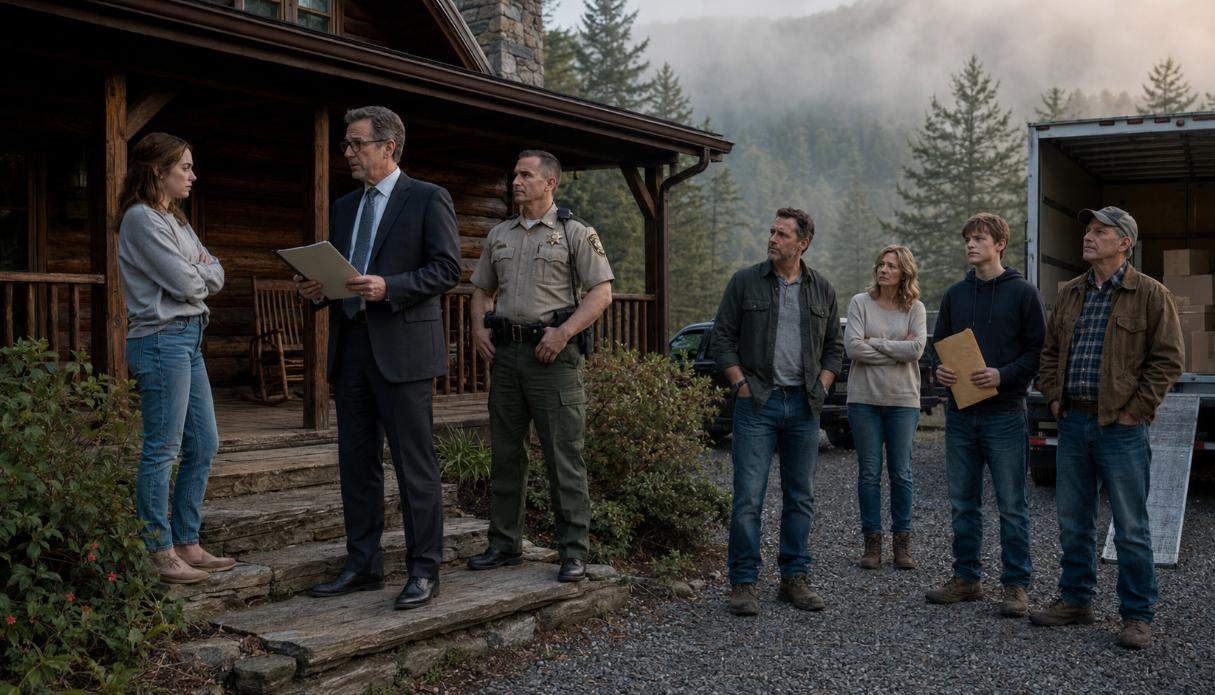
At the edge of the porch, beside the stone steps, stood Jonathan Rice, my grandparents’ estate attorney.
He wore a dark suit, polished shoes, and the calm expression of a man who had expected exactly this. Beside him stood a Sevier County sheriff’s deputy holding an official folder.
My father’s clipboard lowered slowly.
My mother stopped writing.
Uncle Victor took one step back.
Jonathan adjusted his glasses and looked at my family.
“Before anyone removes a single item from this property,” he said, “we need to discuss what you attempted to file yesterday.”
The fog moved between the trees like a curtain being drawn open.
And for the first time that morning, no one in my family looked sure of themselves.
Chapter 2: The Grandchild They Forgot to See
My name is Autumn Henderson.
For most of my childhood, I was the good kid.
That sounds harmless until you understand what it really means in some families. The good kid is not celebrated. The good kid is useful. The good kid brings home good grades, remembers permission slips, keeps her room clean, and does not cause trouble. The good kid learns early that praise comes quietly, if at all, while everyone else’s emergencies take up the room.
My younger brother Sawyer was not the bad kid.
That would be too simple.
He was charming, loud, athletic, restless, and forever forgiven. When he got suspended for fighting in middle school, my parents called the principal, hired a tutor, and took him out for burgers because “he’d had a hard week.” When I won a full scholarship to a private high school in Knoxville, my mother glanced at the letter and said, “That’s wonderful, honey,” before returning to a phone call about Sawyer’s football schedule.
I framed the scholarship letter myself.
It hung in my bedroom for four years, not as decoration, but as proof.
Proof that something good could happen to me even if no one stopped dinner to notice.
The cabin changed that.
My grandparents lived in the Smoky Mountains, about ninety minutes from Knoxville, at the end of a gravel drive that curved through pines and mountain laurel. Their cabin was not fancy. It had a wide porch, a stone fireplace, a roof that complained during storms, and a kitchen that always smelled like woodsmoke, stew, and coffee.
To me, it was the only place where I was not background noise.
My grandfather, Lloyd, taught me how to fix things. He showed me how to patch shingles, stack firewood, sharpen tools, and split logs along the grain instead of fighting the wood. He never gave speeches about character. He simply handed me a hammer and said, “Do it clean the first time, and you won’t have to do it angry the second.”
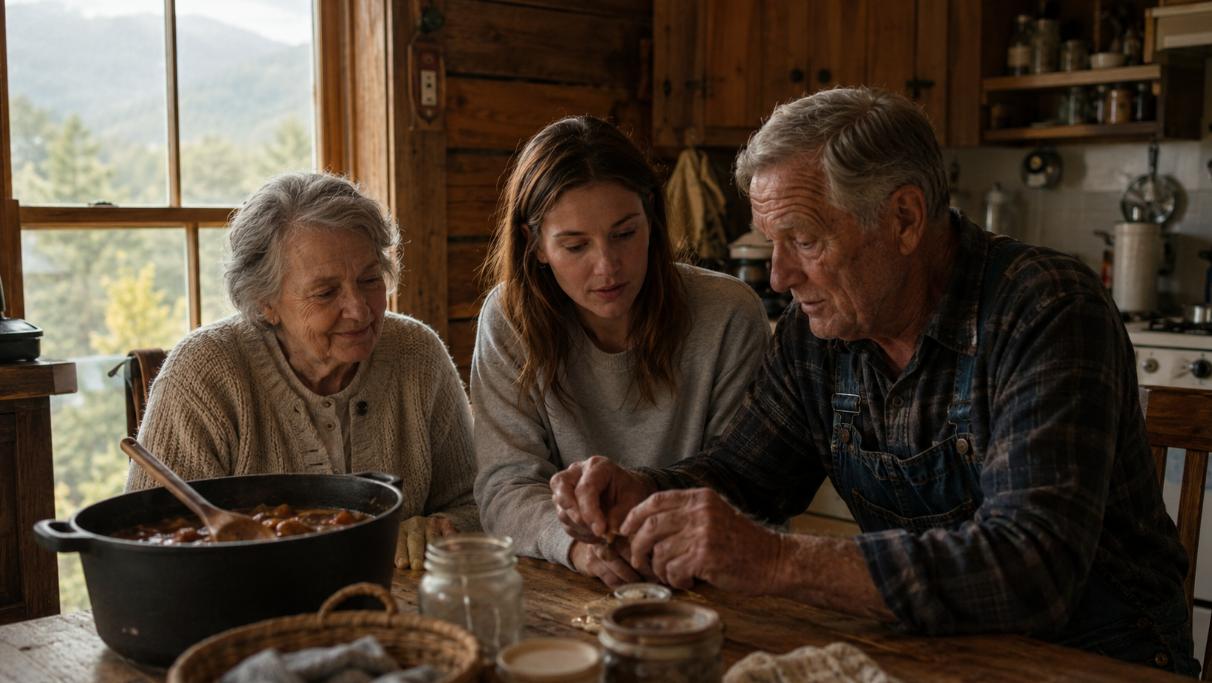
My grandmother, Ruby, taught me the other kind of strength. The quiet kind. In her kitchen, I learned how to knead dough, simmer venison stew, can tomatoes, and sit beside someone without filling every silence. She asked questions my parents never asked.
How are you really doing?
What do you want for yourself?
Who makes you feel small?
I never answered all at once. But she always waited.
As their health declined, I spent more weekends at the cabin. I drove them to doctor appointments, read mail aloud when my grandmother’s eyes grew weak, carried groceries up the steep path, and sat through long hospital nights when machines hummed softly beside their beds.
They never made me feel like I owed them care.
That was the difference.
In my parents’ house, responsibility felt like something assigned to me because I was convenient. At the cabin, love felt like something we gave each other freely.
One evening, about a year before my grandfather died, he called me into the living room. The fire was low. My grandmother had gone to bed early. Rain tapped against the windows.
He sat in his worn leather chair with a wool blanket over his knees.
“I need to tell you something,” he said.
I sat on the hearth.
He stared at the fire for a long time before speaking.
“Your grandmother and I have made decisions about this place.”
My stomach tightened.
“What kind of decisions?”
“The cabin. The land. The accounts we saved over the years.” He turned his head toward me. “They’re going to you.”
I remember the exact sound the fireplace made then. One sharp pop from a burning log.
“Me?”
“Yes.”
“What about Mom and Dad?”
His face did not change.
“They’ll be angry.”
That was not an answer, but it was more honest than one.
He looked back at the fire.
“I’ve watched your father chase money he didn’t earn and your uncle chase deals he didn’t understand. I’ve watched Sawyer get handed chances he never learned to respect.” His voice softened. “And I’ve watched you care for things that could not repay you.”
I swallowed hard.
“Grandpa, I don’t know if I can handle something this big.”
He smiled faintly.
“That’s why we chose you.”
Then he said the line I would carry long after he was gone.
“Family is blood. Trust is behavior. Don’t confuse the two.”
At the time, I thought he was warning me about someday.
I didn’t know someday was already on its way.
Chapter 3: The Cabin Became a Number
After my grandparents died, the cabin changed in my family’s eyes.
Not immediately.
At first, everyone behaved properly. My mother cried at the service. My father shook hands with neighbors. Sawyer looked uncomfortable in his suit. Uncle Victor told stories about Grandfather teaching him to fish, though I had never once seen him visit without asking about property values.
The will was read in Jonathan Rice’s office two weeks later.
Everything came to me.
The cabin, the surrounding acres, a modest investment portfolio that had quietly grown over decades, and the savings my grandparents had protected with the same patience they used for everything else.
My mother’s face went pale.
My father stared at the wall.
Victor laughed once, not because anything was funny, but because he needed a sound to cover his anger.
Sawyer whispered, “All of it?”
I said nothing.
There are moments when silence is safer than explaining yourself to people who have already decided you stole something by receiving it.
For a while, the pressure came gently.
My father talked about maintenance costs. Property taxes. Insurance. Roof repairs. “It’s a lot for someone your age,” he said, always in the same careful tone. My mother suggested that selling might be “cleaner.” Victor sent listings from nearby Gatlinburg and Pigeon Forge, where vacation cabins were selling for more than anyone expected.
Then tourism news started spreading. New developments. Better access roads. Investors looking for mountain property. Suddenly the cabin was no longer a place where my grandmother had baked bread or my grandfather had stacked firewood.
It was acreage.
Market timing.
Rental potential.
“Think about the family,” Victor said one afternoon, pacing the porch with a notebook in hand. “If we sell at the right moment, everybody gets a fresh start.”
“Everybody?” I asked.
He smiled too quickly.
“Well, you know what I mean.”
I did.
My parents began showing up more often. Sawyer came with them, scrolling real estate listings on his phone. He talked about turning the place into an Airbnb, adding a hot tub, installing better Wi-Fi, upgrading the kitchen, expanding the loft. He had ideas for everything except preserving what my grandparents loved.
At dinner one night, my father did math out loud.
“If the land sold high enough, Sawyer’s college would be covered. Victor could clear some debt. Your mother and I could finally update the house in Knoxville. You’d still have plenty left.”
I looked around the table.
Nobody looked ashamed.
Not even a little.
That was when I understood what my grandfather had seen coming.
They didn’t think the inheritance was mine.
They thought I was holding it for them.
A few weeks before my eighteenth birthday, I called Jonathan Rice and asked for a meeting.
He did not sound surprised.
When I sat across from him in his Knoxville office, he already had a folder prepared. He explained the trust carefully. Once I turned eighteen, I could transfer the cabin, land, and accounts into an irrevocable trust. I would be the sole trustee. It would protect the property from pressure, claims, manipulation, or sudden “family agreements” made without my consent.
“It is legal,” he said. “It is strong. And it is permanent.”
Permanent.
That word sat between us.
He folded his hands.
“Autumn, I have to ask. Are you ready for what this may cost you?”
I looked down at the papers.
I thought about Christmas mornings when my parents almost seemed proud of me. I thought about Sawyer sharing earbuds with me on road trips when we were younger. I thought about my mother helping me finish a school project at midnight once, cutting poster board with tired hands.
Families are rarely only one thing.
That is what makes leaving their expectations so painful.
“I don’t want to lose them,” I said.
Jonathan’s voice was gentle.
“Protecting yourself may show you whether they were willing to keep you.”
I signed the papers two days after my birthday party began.
The party was at the cabin. My parents insisted on it. “It’s what your grandparents would’ve wanted,” my mother said, though lately everyone seemed very comfortable speaking for the dead.
People toasted my future. My father gave a speech about family. Victor raised a glass and said, “Big things ahead for this place.” Sawyer joked that he should be “property manager.”
I smiled when I had to.
Then, while everyone was laughing near the fireplace, I stepped into my grandmother’s old pantry, opened my phone, and completed the final digital signature Jonathan had prepared.
One tap.
That was all.
The cabin, land, and accounts moved into the trust.
No turning back.
I stood in the pantry for a moment, surrounded by jars of dried beans and handwritten labels in my grandmother’s script.
I expected to feel powerful.
Instead, I felt sad.
Because deep down, I knew I had just protected my grandparents’ legacy from the people who should have helped me protect it.
Chapter 4: The Papers They Brought
Now, on the morning after my birthday, my family stood in the yard with a moving truck and a stack of papers.
Jonathan Rice walked down the porch steps slowly. Deputy Harland followed, one hand resting near his belt, not threatening, simply present.
My father recovered first.
“This is a misunderstanding,” he said. “We’re family.”
Jonathan looked at him over the rim of his glasses.
“Family status does not transfer property.”
Sawyer stepped forward, holding out the envelope.
“We have documents.”
“I can see that.”
“They’re signed.”
Jonathan accepted the papers and flipped through them with the calm patience of someone examining a bad lie. Page by page, his expression did not change.
Victor shifted his weight.
My mother’s hand tightened around the marker she was holding.
Finally, Jonathan looked up.
“These filings are invalid.”
Sawyer’s face flushed.
“No, they’re not. We did everything online. The forms said—”
“The forms,” Jonathan interrupted, “appear to include forged signatures and unauthorized notary stamps.”
The two movers looked at each other.
My father’s mouth opened slightly.
Victor said, “Now hold on.”
Deputy Harland spoke for the first time.
“Attempting to transfer title using fraudulent documents can carry serious consequences.”
My mother’s voice went thin.
“We weren’t trying to commit a crime.”
Jonathan looked at her.
“What were you trying to do?”
No one answered.
That silence was the most honest thing my family had given me in years.
My father stepped toward me.
“Autumn, this has gone too far. We were trying to make things fair.”
Fair.
The word almost made me laugh.
Fair had not shown up when I framed my own scholarship letter. Fair had not shown up when Sawyer’s mistakes became family emergencies and my achievements became expectations. Fair had not shown up when my grandparents’ will named me clearly and everyone started calculating what they could get anyway.
“This cabin was left to me,” I said.
“You’re eighteen,” my father snapped. “You don’t understand what you’re sitting on.”
“I understand exactly what I’m sitting on.”
I looked at the porch, the stone chimney, the roof my grandfather and I patched together, the kitchen window where my grandmother used to wave me inside.
“I’m sitting on the only place where I was loved without being useful.”
My mother looked away.
That hurt more than if she had argued.
Jonathan opened another folder.
“As of last night, this property and associated assets are held in an irrevocable trust. Autumn Henderson is the sole trustee. Any attempt to remove property, interfere with the trust, or access the land without permission will be documented.”
Sawyer stared at me.
“You did this last night?”
“Yes.”
“At your party?”
I met his eyes.
“You brought a moving truck the next morning.”
The words landed hard.
Not loud.
Hard.
Victor muttered something under his breath and turned away. My father rubbed his forehead. My mother sank onto one of the boxes she had brought for my grandmother’s dishes.
Sawyer looked younger suddenly. Sixteen, not brave, not powerful, just a boy who had been handed adult confidence by people who should have protected him from consequences.
“I only signed what Dad told me to,” he whispered.
Deputy Harland made a note.
My father’s head snapped toward him.
“Don’t write that down.”
The deputy looked up.
“I write down what I hear.”
The moving crew began backing away from the porch.
One of them raised both hands.
“We’re not touching anything.”
Jonathan nodded.
“Good decision.”
For a moment, nobody moved. The wind shifted through the trees, carrying the smell of damp pine and dust from the truck tires. My family stood in the yard surrounded by empty boxes, useless papers, and the sudden understanding that the cabin had never been theirs to take.
My father tried one last time.
“Autumn, please. We can talk about this.”
I wanted, for one dangerous second, to believe him.
Then I looked at the moving truck.
“No,” I said. “You already told me what you came here to do.”
Deputy Harland gave formal notice that they were to leave the property. Jonathan handed my father copies of the trust summary and a cease-and-desist notice. My mother cried quietly as she climbed into the SUV. Victor slammed his truck door. Sawyer sat in his car for several minutes before leaving, staring through the windshield with both hands on the wheel.
When the last vehicle disappeared down the gravel road, the fog had nearly lifted.
Jonathan turned to me.
“You handled that well.”
I looked at the empty boxes left in the grass.
“I don’t feel like I did.”
He softened.
“Doing the right thing rarely feels clean while you’re doing it.”
After he and the deputy left, I sat on the porch steps until noon.
The cabin was quiet again.
But it was not the same quiet as before.
This quiet had a boundary around it.
And for the first time, so did I.
Chapter 5: What Remained
The legal aftermath took months.
Jonathan filed the necessary documents to block any further fraudulent claims and recover legal costs. Discovery revealed emails, online forms, notary stamp irregularities, and messages showing Victor had pushed the plan harder than anyone admitted. My parents claimed they misunderstood. Victor claimed he was helping. Sawyer claimed he thought adults had handled everything correctly.
The court was not impressed.
There were no dramatic arrests. No screaming in a courtroom. Real consequences are often quieter than fiction. Legal fees. Penalties. Debt. A formal ruling that confirmed what my grandparents had already made clear: the cabin, the land, and the accounts were protected. The trust stood.
My family stopped calling.
At first, the silence hurt so badly I would check my phone and hate myself for hoping. No apology came. No birthday message. No Christmas card. Nothing from my mother except one short text months later that said, I hope you’re happy with your choices.
I stared at it for a long time.
Then I deleted it.
Because the truth was, I was not always happy.
But I was safe.
There is a difference, and I had learned to value the second one first.
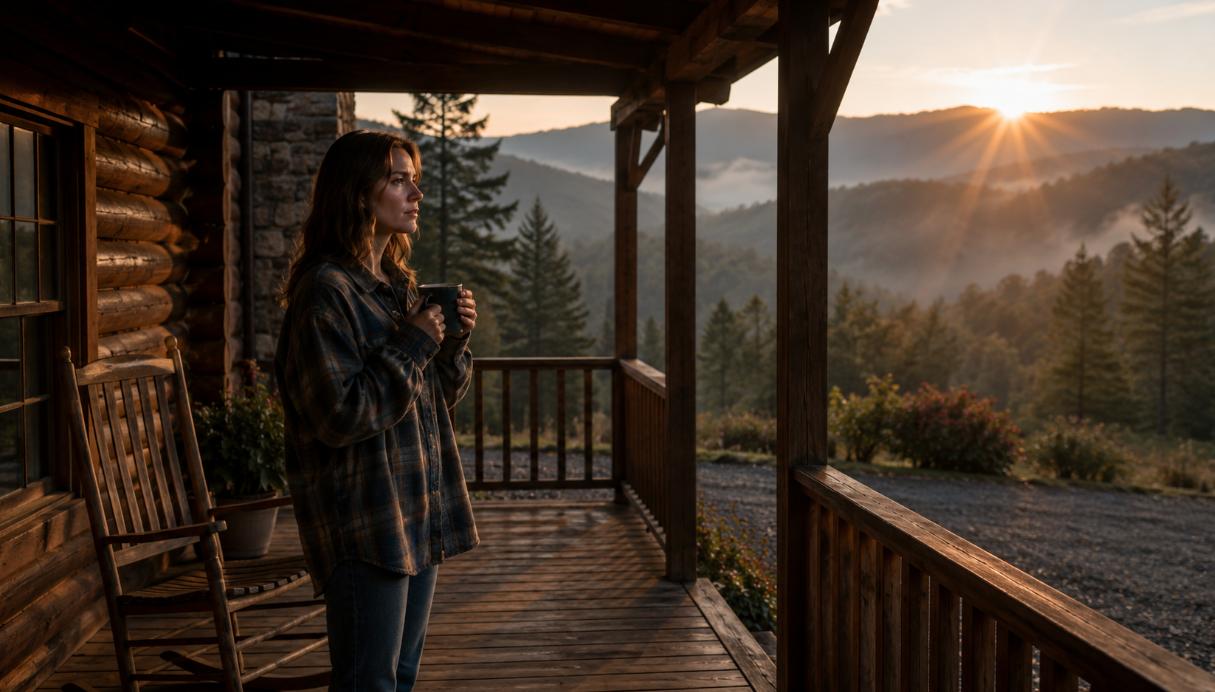
Life at the cabin became my own slowly. Not all at once. Some mornings I woke up expecting grief to sit on my chest. Other mornings I stepped onto the porch with coffee and felt something close to peace.
I repaired the section of roof my grandfather had once patched temporarily. I planted my grandmother’s heirloom tomato seeds in the garden behind the kitchen. I split firewood badly at first, then better. I cleaned out the shed, labeled tools, paid taxes, reviewed trust records, and learned that stewardship is not a word. It is a thousand ordinary choices repeated when no one is watching.
One evening in late autumn, I made my grandmother’s venison stew for the first time alone. I chopped onions at the counter where she used to stand, tied herbs in cheesecloth the way she taught me, and let the pot simmer for hours. The cabin filled with the smell of home.
I set one bowl at the scarred oak table.
Just one.
For a moment, that hurt.
Then I looked around.
The fireplace glowed. The windows reflected lamplight. The shelves held my grandfather’s books. The quilt on the sofa still carried my grandmother’s careful stitches. Outside, the mountains rose dark and steady beneath the moon.
I was alone.
But I was not abandoned.
That was when I finally understood what my grandparents had given me.
Not money.
Not land.
Not even the cabin.
They had given me a place where I could stop proving I deserved to exist.
Months later, I stood on the wide porch at sunrise, wrapped in my grandfather’s old flannel jacket. Mist lifted from the valley below, revealing the ridges one by one. Birds called from the pines. The gravel drive was empty.
For the first time in my life, an empty driveway did not feel like loss.
It felt like permission.
My family had taught me that blood could demand.
My grandparents taught me that love protects.
And the cabin taught me the rest.
Sometimes protecting what was left to you means losing people who only loved what they thought they could take.
That is not cruelty.
That is inheritance too.