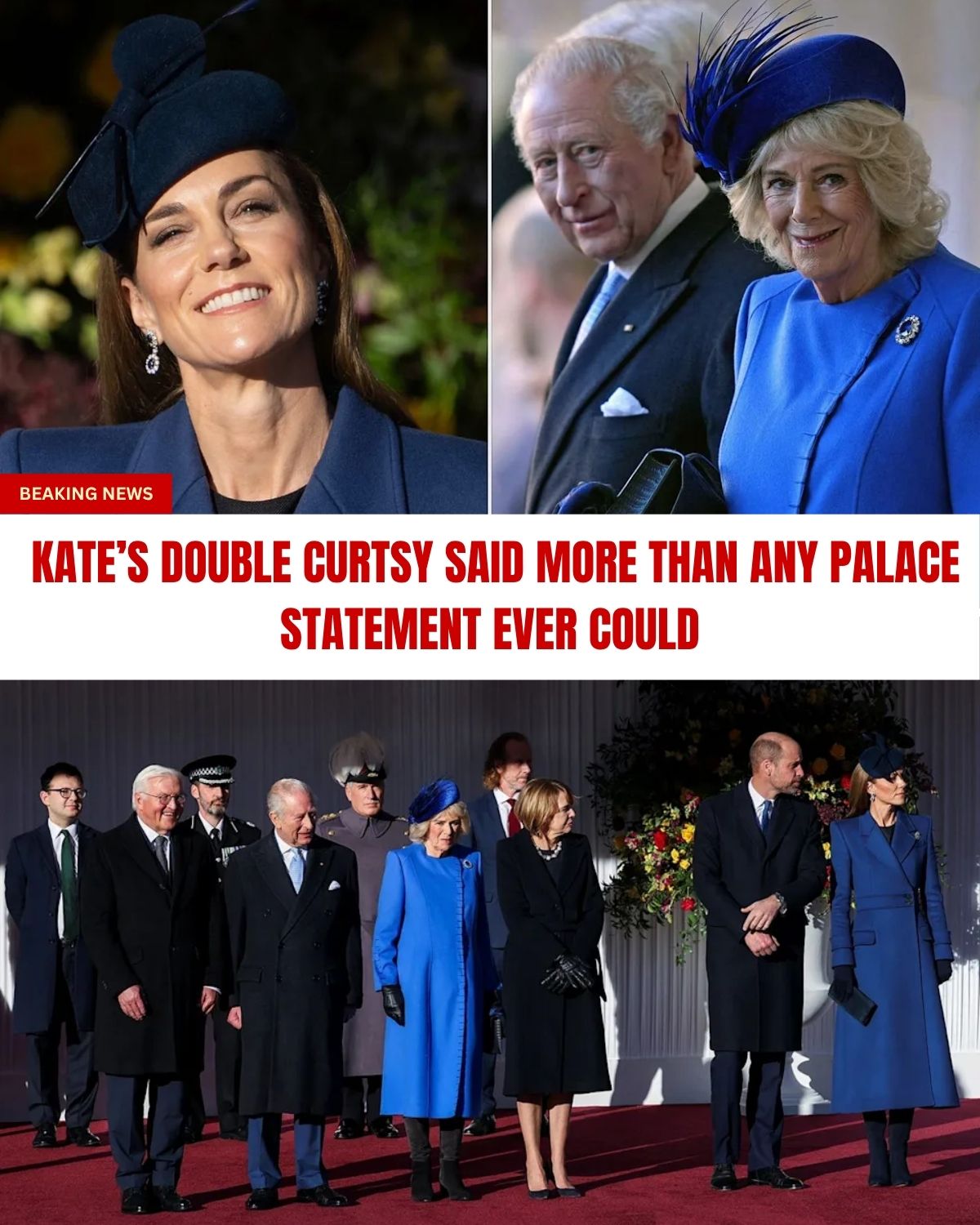
It was a small gesture. No speech. No interview. No carefully worded statement. Just the Princess of Wales lowering herself into a curtsy as King Charles and Queen Camilla passed during one of the monarchy’s most ancient ceremonies.
But in royal life, small gestures are rarely small.
At the annual Order of the Garter service at Windsor Castle, Kate Middleton was seen curtsying not once, but twice, to the King and Queen. First, as the monarch and his wife passed during the formal procession. Then again, after the service, as their carriage departed before Kate and Prince William climbed into their own horse-drawn carriage.
To casual observers, it was simply a polished royal moment.
To royal watchers, it was something more revealing: a public display of discipline, hierarchy and respect from the woman who will one day become Queen.
And at a time when the monarchy is still haunted by accusations, rebellion and public family fracture, Kate’s quiet gesture carried a message louder than many people realised.
The Future Queen Still Bows to the Crown
Kate is not an outsider anymore.
She is the Princess of Wales. She is married to Prince William, the future King. She is the mother of Prince George, another future monarch. Her place inside the royal structure is not temporary, symbolic or uncertain. It is central to the future of the Crown.
And yet, there she was, curtsying.
That is the point.
Kate’s curtsy was not about weakness. It was about order. It was about understanding that the monarchy survives through visible respect for rank, even among those who stand closest to the throne.
In ordinary celebrity culture, status is often performed through defiance. The bigger the name, the more freedom one appears to claim. But royal life works differently. The closer one gets to the Crown, the more carefully every gesture is watched.
Kate seems to understand that instinctively.
She does not need to announce loyalty. She performs it.
Why This Moment Stood Out
The Order of the Garter is one of the most traditional events in the royal calendar. Its medieval robes, plumed hats, chapel procession and horse-drawn carriages are not merely pageantry. They are a reminder that monarchy is built on continuity.
Kate’s presence at Garter Day has always carried extra weight.
She made one of her early appearances at the event in 2008, when she was still Prince William’s girlfriend and he was invested into the Order. Long before an engagement ring appeared, her attendance signalled that she was being drawn into the royal fold.
Eighteen years later, the meaning has changed.
Kate is no longer the young woman being quietly introduced to the institution. She is now one of its most important public figures. Her return to such ceremonial visibility, especially after a period in which her health kept her away from many duties, has only intensified public attention around her every appearance.
That is why the double curtsy resonated.
It showed Kate not as a celebrity royal, but as a constitutional royal — someone who knows that image, restraint and ritual matter.
The Contrast No One Can Ignore
This is where the Sussex comparison inevitably enters the conversation.
Harry and Meghan’s royal story has been defined by complaint, rupture and public explanation. They have repeatedly argued that the institution was cold, unfair and unwilling to protect them. Their version of royal life is emotional, personal and accusatory.
Kate’s image is built on the opposite language.
She rarely explains. She rarely complains. She does not turn private discomfort into public drama. Instead, she appears, performs the role and lets the visual speak.
That does not mean Kate has had an easy royal life. She has faced intense scrutiny, family pressure, public speculation and the heavy burden of preparing to become Queen. But her response has been almost entirely different from the Sussex approach.
Harry and Meghan have tried to control the narrative by telling their side.
Kate controls the narrative by refusing to give the public a spectacle.
And that difference is precisely why many royal supporters respond to her so strongly.
A Curtsy Became a Symbol of Duty

The visual was simple: Kate standing near other senior royals, waiting as King Charles and Queen Camilla passed, then dipping into a practiced curtsy.
But the symbolism was powerful.
Here was the future Queen acknowledging the current King.
Here was a woman of immense future status showing that she still accepts the hierarchy above her.
Here was a senior royal demonstrating that rank inside the monarchy is not merely about what one is owed, but what one is willing to observe.
That is the difference between royal privilege and royal duty.
Privilege asks: why should I bow?
Duty understands: because the Crown is bigger than me.
For many critics of Harry and Meghan, this is the exact contrast that has defined the post-Sussex monarchy. The Waleses appear to accept the burden of hierarchy. The Sussexes, in their critics’ view, wanted the prestige of royal life without accepting the limits that came with it.
Whether one agrees with that criticism or not, Kate’s public gestures make the argument easy for royal supporters to see.
Kate’s Power Is in Restraint
Kate’s greatest strength has never been theatrical drama. It has been restraint.
That restraint can sometimes make her appear distant to critics. But inside the royal system, it is a form of power. The monarchy does not reward emotional excess. It rewards consistency, patience and symbolic discipline.
Kate has spent years building exactly that image.
She dresses carefully. She chooses moments carefully. She rarely gives the public enough friction to turn into scandal. Even when she becomes the subject of intense public attention, she tends to reappear through the language of duty rather than explanation.
That is why a curtsy can do more for her image than a long interview might do for someone else.
It reassures traditional royal audiences. It shows continuity with Queen Elizabeth II’s model of service. It positions Kate as someone who understands that the monarchy’s survival depends not on self-expression, but on self-control.
William and Kate’s Carriage Ride Added Another Layer
After the King and Queen departed, William and Kate climbed into their own horse-drawn carriage and waved to the crowds gathered outside Windsor Castle.
It was a classic royal image: the heir and his wife, composed and united, moving through ceremony with the quiet confidence of people who know exactly what role they are expected to play.
For royal watchers, this matters.
William and Kate are no longer simply a popular royal couple. They are the monarchy’s next chapter. Every public appearance now carries a future-facing meaning. Every gesture is read as preparation.
The carriage ride was romantic enough for lifestyle coverage, formal enough for royal tradition and symbolic enough for constitutional storytelling.
That combination is exactly why the Wales brand remains so effective.
It gives the public emotion without chaos.
Why This Will Irritate Sussex Supporters
For Meghan’s supporters, this kind of coverage can feel unfair.
Kate is praised for silence. Meghan was often criticised for speaking.
Kate is celebrated for tradition. Meghan was scrutinised for challenging it.
Kate’s gestures are read as dignity. Meghan’s explanations are often read as grievance.
That imbalance is one of the reasons the royal divide remains so bitter.
But royal audiences do not judge these women in a vacuum. They judge them against what they believe the monarchy requires.
To supporters of the Crown, Kate’s double curtsy is not submission. It is evidence that she understands the institution she married into.
To critics of the Sussexes, Meghan never fully accepted that royal status comes with public limits, ceremonial discipline and a hierarchy that does not bend easily to personal emotion.
That is why the visual of Kate curtsying twice is so useful to Palace-friendly audiences.
It tells a whole story without mentioning Meghan once.
The Monarchy Needed This Image
King Charles’ reign has not been easy. Health concerns, family fractures and the ongoing estrangement from Harry have created a sense of instability around the royal household.
In that context, images of continuity matter.
Kate’s appearance at Garter Day offered exactly that: tradition, hierarchy, family order and a glimpse of the monarchy’s future standing respectfully beside its present.
It was not a dramatic moment. But it was a stabilising one.
And after years of royal accusations, interviews and emotional detonations from across the Atlantic, stability itself has become a message.
Kate’s double curtsy reminded the public of something the Palace rarely says out loud: the monarchy does not survive because everyone feels equally seen. It survives because those inside it agree to serve something larger than themselves.
The Gesture That Said Everything
In another world, Kate’s double curtsy might have been a minor detail from a ceremonial day.
But in the current royal climate, it became something bigger.
It was a reminder of why Kate remains so valuable to the institution. She does not need to dominate the conversation. She understands how to embody the message.
The King passes.
The future Queen curtsies.
The order remains intact.
And perhaps that is why the moment matters so much.
Because while Harry and Meghan continue to define their royal story through what they believe they were denied, Kate continues to build hers through what she is willing to do.
No accusation.
No complaint.
No public war.
Just one future Queen lowering herself before the Crown — and reminding everyone why the Palace sees her as one of its greatest assets.