The bell above the diner door rang at 6:47 a.m.
Nora Ellis didn’t have to look up to know who it was.
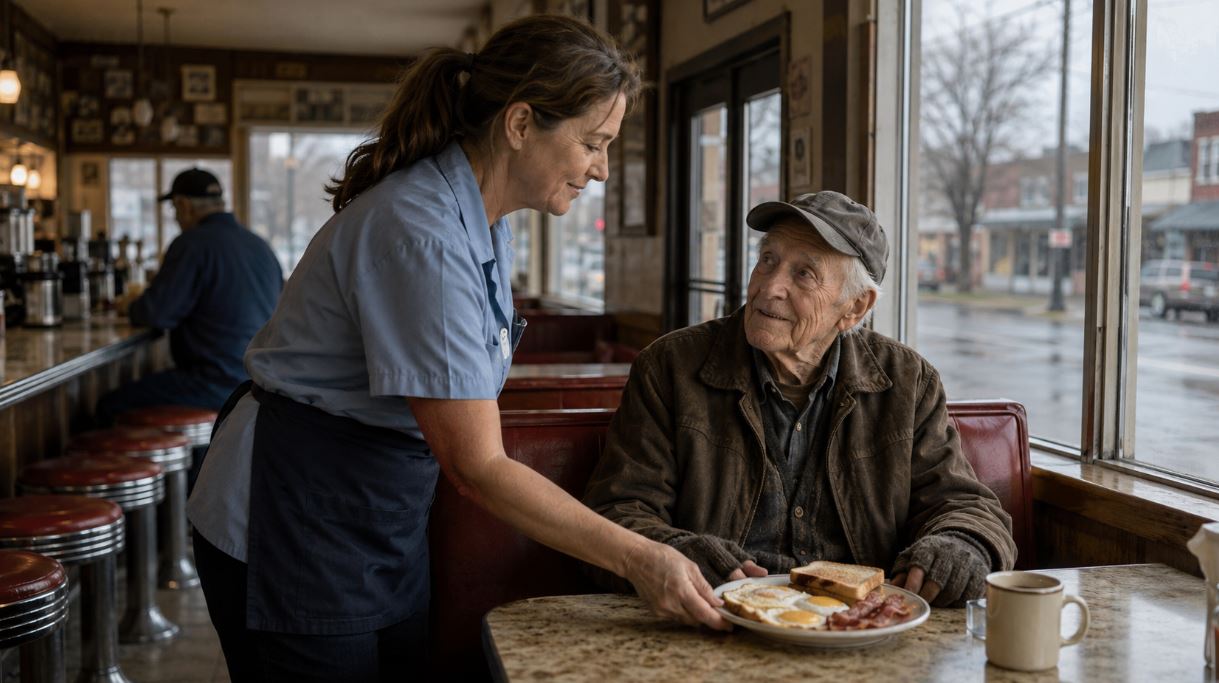
Every Tuesday morning, at almost the exact same time, the old man came in.
Same worn brown coat.
Same gray cap.
Same slow walk.
Same booth by the front window.
Nora was wiping down the counter when she smiled and called out, “Morning, Mr. Whitaker. Coffee and the usual?”
The old man lifted one hand.
“If it’s not too much trouble, sweetheart.”
“It’s never trouble.”
His name was Arthur Whitaker.
At least, that was the name he had given her.
He was somewhere in his late seventies, maybe older. He had a thin face, silver hair, and eyes that looked tired in a way sleep couldn’t fix. His coat was too light for November in Ohio. The cuffs were frayed. One of his gloves had a hole near the thumb.
Most people barely noticed him.
Nora did.
She poured his coffee herself.
Two sugars.
No cream.
Then she walked to the kitchen window and called, “Sam, one eggs-and-toast plate. Add bacon.”
Sam looked up from the grill.
“Is he paying today?”
Nora gave him a look.
Sam sighed. “Nora.”
“Just cook the eggs.”
“You know Ed’s going to complain if he sees another comped meal.”
“Then don’t tell Ed.”
Sam shook his head, but he cracked the eggs anyway.
Nora carried the coffee to Arthur’s booth.
He sat carefully, like his bones had to negotiate with the chair first.
“You’re spoiling me,” he said.
“No, I’m feeding you.”
“There’s a difference?”
“There is when you’re too stubborn to ask for help.”
Arthur smiled faintly.
That was one thing Nora liked about him.
He never pushed too hard.
He never begged.
He never made a scene.
He came in, ordered quietly, ate slowly, and always thanked her like she had done something much bigger than bring him breakfast.
When the food came, he folded his hands for a moment before eating.
Nora had noticed that too.
He prayed silently.
Not loudly, not for attention.
Just a small pause, a habit from another life.
She slid into the seat across from him for a minute. The diner was still mostly empty. A trucker sat at the counter with coffee. Two nurses from the night shift were sharing pancakes near the back.
Arthur cut into his eggs.
“You look tired today,” he said.
Nora laughed. “That’s a polite way of saying I look terrible.”
“I said tired.”
“Then yes. I’m tired.”
“Double shift?”
“Yesterday and today.”
“Rent again?”
Nora looked out the window.
“That obvious?”
Arthur did not answer right away.
Outside, a pickup truck rolled past on the wet road. The sky was the color of dishwater. It had rained all night, and the parking lot was full of shallow puddles reflecting the diner’s red sign.
“How far behind?” he asked.
“Mr. Whitaker.”
“How far?”
She rubbed her forehead. “Three weeks.”
He set down his fork.
“Family can’t help?”
Nora almost smiled.
Not because it was funny.
Because it was such a clean question for such a messy answer.
“My mother died when I was nineteen,” she said. “My father remarried and moved to Arizona. We talk on birthdays if he remembers.”
Arthur’s face softened.
“I’m sorry.”
“It was a long time ago.”
“That doesn’t always matter.”
No, Nora thought.
It didn’t.
She stood up before the conversation got too heavy.
“I have tables.”
Arthur nodded.
“Thank you for breakfast, Nora.”
“You’re welcome.”
As she walked away, he said what he always said.
“Kindness has a long memory.”
She turned around.
“You tell me that every Tuesday.”
“And every Tuesday it’s still true.”
She rolled her eyes, but she smiled.
Arthur had been coming into Miller’s Diner for almost two years.
The first time was on a cold February morning.
He had stood by the register, counting coins with shaking fingers. He had enough for coffee, but not enough for food. Nora saw him glance at the menu, then at the change in his palm.
She had told him the kitchen made an extra plate by mistake.
He knew she was lying.
She knew he knew.
But he accepted the meal anyway.
After that, he kept coming back.
At first, he paid when he could.
Sometimes he left two dollars.
Sometimes seventy-five cents.
Sometimes nothing but a thank-you written on a napkin.
Nora saved the napkins in a drawer at home.
She didn’t know why.
Maybe because they made her feel like the world was not all bad.
Her life had not gone the way she planned.
At forty-one, she was still waiting tables in the same town where she had once promised herself she would not stay. She lived in a small apartment above a laundromat. Her car needed brakes. Her phone bill was past due. Her feet hurt every night.
But she had a rule.
If someone came into the diner hungry, and she could do something about it, she did.
Not because she was rich.
Because she knew what it felt like to be one bad week away from losing everything.
That Tuesday, Arthur finished his breakfast slowly.
Before leaving, he placed a folded napkin beside his empty plate.
Nora picked it up after he left.
Written in careful blue ink were five words:
You have a good heart.
She tucked it into her apron pocket.
She did not know it would be the last note he ever left her.
The next Tuesday, Arthur did not come.
At 6:47, the bell rang, but it was only a delivery driver.
Nora looked toward the door anyway.
At 7:10, she poured fresh coffee and kept glancing at the booth.
At 7:30, Sam leaned through the kitchen window.
“He’s late?”
Nora nodded.
“Maybe the rain kept him away.”
“It’s not raining.”
“Then maybe he slept in.”
“Arthur doesn’t sleep in.”
Sam gave her a look.
“You don’t actually know that.”
But she felt like she did.
Arthur was a man of patterns.
Same time.
Same booth.
Same coffee.
Same quiet thank-you.
By 8:15, the breakfast rush had started. Nora didn’t have time to worry. She refilled cups, carried plates, smiled at people who snapped their fingers, and apologized for toast she didn’t burn.
Still, every time the bell rang, she looked up.
Arthur never came.
The next Tuesday, he was absent again.
This time, Nora felt it in her chest.
After her shift, she drove to the senior center two blocks away. No one recognized his name.
She stopped by the small church on Linden Avenue. The secretary said there were several older Arthurs in the county, but no Arthur Whitaker in the congregation.
She checked the public library because he had once mentioned liking the newspaper room.
Nothing.
“You sure he gave you his real name?” Sam asked the next morning.
Nora didn’t answer.
That was the thing.
She wasn’t sure.
She realized she had fed a man for two years and didn’t know where he lived, whether he had children, or who would notice if he disappeared.
That thought stayed with her all night.
The following Friday, Nora was cleaning table six when a dark sedan pulled into the diner parking lot.
It was not a fancy car, but it was clean. Too clean for the gravel and slush outside.
A man in a navy overcoat stepped out.
He was about sixty, with silver-rimmed glasses and a leather folder tucked under one arm.
He came inside and paused near the door.
The bell rang above him.
Nora looked up.
“Table for one?”
The man removed his gloves.
“I’m looking for Nora Ellis.”
Sam glanced out from the kitchen.
Nora straightened.
“That’s me.”
The man’s expression softened in a way that made her stomach drop.
“My name is Thomas Keller. I’m an attorney. I was asked to speak with you.”
Nora gripped the edge of the table.
“Is this about Arthur?”
He paused.
“Yes.”
Her throat tightened.
“Is he okay?”
“I’m very sorry,” Mr. Keller said. “Arthur Whitaker passed away last week.”
The diner noise seemed to fall away.
The clink of forks.
The hiss of the grill.
The murmur of morning customers.
All of it went distant.
Nora stood very still.
“How?” she asked.
“Heart failure. Peacefully, at home.”
“At home,” she repeated.
“Yes.”
“So he had a home?”
Mr. Keller looked toward the booths, then back at her.
“Is there somewhere private we can sit?”
The owner, Ed Miller, had been listening from behind the register. He was a narrow man with a nervous habit of tapping his pen against the counter.
“You can use my office,” Ed said quickly.
Nora followed the lawyer down the short hallway.
The office was small and smelled like old coffee, printer ink, and ketchup boxes. Ed’s desk was covered in receipts and supplier invoices.
Mr. Keller closed the door halfway, not all the way.
A kindness, Nora thought later.
He didn’t want her to feel trapped.
They sat.
He opened his leather folder and removed a cream-colored envelope.
Her name was written on the front in shaky handwriting.
Nora Ellis.
She knew the writing.
It was the same handwriting from the napkins.
Her eyes filled before she even opened it.
Mr. Keller said gently, “He wanted you to read this first.”
Nora slid one finger under the flap.
The letter was two pages.
She unfolded it carefully.
Dear Nora,
If Mr. Keller is giving this to you, then I have gone where old men eventually go.
Please don’t be angry that I didn’t tell you I was sick. You would have fussed over me, and I liked being treated like an ordinary customer.
That may sound strange, but ordinary was a gift to me.
You probably guessed some things about me. Some were true. Some were not.
I was not homeless. Not exactly.
I had a house. I had money enough to keep the heat on. I had a doctor, a lawyer, and a stack of unopened mail.
What I did not have was someone who looked happy to see me.
After my wife, Ruth, died, my house became very quiet. My son lives in Chicago. We speak at Christmas if his wife reminds him. My daughter has not visited in eight years. I do not say this to shame them. Life makes people busy. Pride makes old men silent.
But loneliness is a strange thing, Nora.
It can make a man feel invisible while he is still standing in the room.
The first morning I came into Miller’s Diner, I had left my wallet at home. That is the truth. I was embarrassed. I was cold. I was tired. I was ready to walk back out.
You saw me counting coins.
You did not make me feel small.
You said the kitchen had made an extra plate.
We both knew that wasn’t true.
But you gave me my dignity with my breakfast.
So I came back the next week.
Then the week after that.
Then Tuesday became the day I felt expected.
You remembered my coffee. You remembered I liked the booth by the window. You called me Mr. Whitaker until I asked you to call me Arthur. You sat with me when the diner was slow. You never asked what I had. You only noticed what I needed.
That is rarer than money.
I am not leaving you millions. I never had millions. I am sorry if this disappoints the part of you that deserves a miracle.
But I am leaving you what I can.
My house on Maple Ridge Road is paid for. It is small, but it is warm. There is a garden Ruth loved. There is a porch that gets good morning sun. I want you to have it.
I have also left enough money to pay the taxes, make repairs, and give you some breathing room. Mr. Keller will explain the details.
There is one more thing.
In the front room of the house, on the bookshelf, there is a blue recipe box. Ruth kept her pie recipes in it. At the bottom, you will find a key to a small safe.
Inside are my wife’s wedding ring, some savings bonds, and a notebook.
The notebook is for you.
Not because you fed me.
Because you saw me.
Kindness has a long memory.
Please let it live longer than I did.
With gratitude,
Arthur
By the time Nora finished, the words had blurred.
She pressed the letter to her chest and tried to breathe.
“He had children?” she whispered.
Mr. Keller nodded.
“Yes.”
“They didn’t know he came here?”
“I don’t believe so.”
“Do they know about the house?”
The lawyer hesitated.
“They know now.”
Nora looked at him.
“They’re angry.”
He folded his hands.
“They are surprised.”
“That’s lawyer talk for angry.”
A small smile touched his face.
“Yes.”
Nora wiped her cheeks with the back of her hand.
“I can’t take his house.”
“Arthur expected you to say that.”
“I mean it. He had children.”
“He also had a will.”
“But they’re his blood.”
Mr. Keller’s expression grew serious.
“Miss Ellis, Arthur was very clear. He did not disinherit his children. He left them each something. Not the house, but something. He said the house should go to the person who made him feel at home in his final years.”
Nora looked down at the letter.
The office felt too small.
Her apron suddenly felt too tight around her waist.
“How much money?” she asked quietly.
“After final expenses, approximately one hundred eighty thousand dollars in savings and bonds. Most of it is designated for property taxes, repairs, and your discretion.”
Nora stared at him.
That was not fourteen million dollars.
It was not a company.
It was not a private jet or a miracle from a fairy tale.
But to Nora, it might as well have been the moon.
A paid-off house.
A little money.
Breathing room.
No landlord pounding on the door.
No choosing between brakes and rent.
No lying awake at 2:00 a.m. counting bills in her head.
She covered her mouth.
“I don’t know what to say.”
Mr. Keller slid a second sheet across the desk.
“He left instructions. You don’t have to decide anything today.”
“What if his children contest it?”
“They may.”
“Can they win?”
“I can’t promise outcomes. But Arthur made his decisions while of sound mind. There are letters, medical records, and witnesses. He planned carefully.”
Nora almost laughed through her tears.
“That sounds like him.”
“He was a careful man.”
“He was a lonely man.”
The lawyer looked at her for a moment.
“Yes,” he said. “He was.”
A knock came at the office door.
Ed opened it before anyone answered.
“Everything okay in here?”
Nora folded the letter quickly.
Mr. Keller turned.
“We’re almost finished.”
Ed’s eyes moved to the envelope, then to Nora’s face.
“Is this about the old guy?”
Nora stood.
“His name was Arthur.”
Ed blinked.
“Right. Arthur.”
She walked past him into the diner.
The booth by the window was empty.
For two years, she had seen him there so often that the empty seat looked wrong, like a missing tooth.
She picked up the coffee pot and refilled a customer’s cup because her hands needed something normal to do.
Sam leaned through the kitchen window.
“Nora?”
She looked at him.
“He died,” she said.
Sam’s face changed.
The tough grill cook, who complained about every free plate, went quiet.
“I’m sorry.”
Nora nodded.
“He left me something.”
Sam waited.
“A house.”
His mouth opened.
Then closed.
Then he said, “A house?”
Nora almost smiled.
“That’s what I said.”
Ed came out of the hallway, suddenly very interested.
“What kind of house?”
Nora turned toward him.
“The kind with walls and a roof.”
Sam snorted.
Ed frowned.
“I just meant—”
“I know what you meant.”
The breakfast rush carried on because life is rude that way.
People still needed coffee.
Toast still burned.
Someone still complained their hash browns were too crisp.
Nora worked the rest of her shift.
Mr. Keller stayed in the corner booth with a cup of coffee, waiting until she had a break. He did not rush her.
At two o’clock, after the lunch crowd thinned, Nora sat across from him.
“I need to finish the week,” she said.
“You don’t need my permission.”
“I know. I just… Arthur would hate it if I left Sam alone on a Friday rush.”
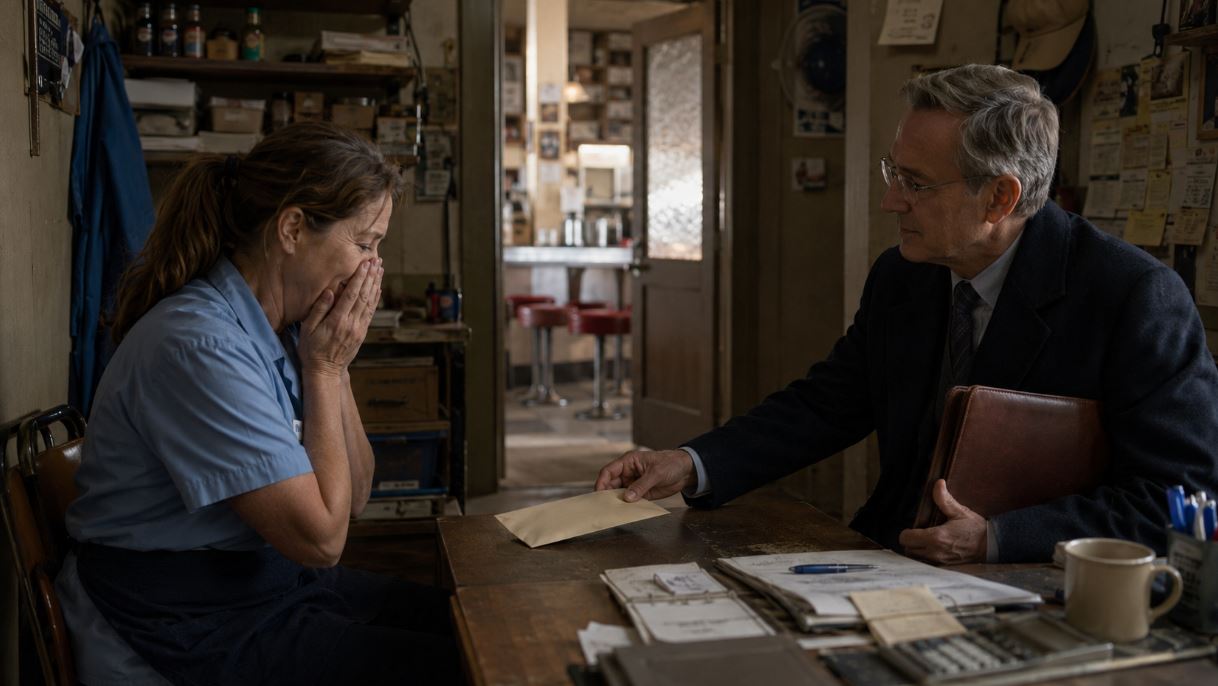
Mr. Keller smiled.
“He mentioned your loyalty.”
“He mentioned me?”
“Often.”
That undid her again.
Not loudly.
Just a quiet tear slipping down her cheek before she could stop it.
“When can I see the house?” she asked.
“Whenever you’re ready.”
Nora was not ready.
But she went the next morning.
Maple Ridge Road was fifteen minutes outside town, lined with bare trees and modest homes set back from the road. Arthur’s house was pale yellow with white trim. The paint was peeling in places. The porch sagged a little on one side. There were dead flower stalks in the garden beds, tied back with twine.
It was not grand.
It was not rich-looking.
It was a small old house that had been loved once and then left too quiet.
Nora stood in the driveway for a long time.
Mr. Keller waited beside her.
“You okay?”
She nodded, though she wasn’t sure.
Inside, the house smelled faintly of cedar, dust, and lemon soap.
There were photographs everywhere.
Arthur as a young man in uniform.
Arthur beside a woman with laughing eyes. Ruth, Nora guessed.
Arthur holding two children in front of a Christmas tree.
Then later pictures.
Graduations.
Weddings.
Grandchildren.
But the newest photo on the mantel was at least ten years old.
Nora touched the edge of the frame.
“He had a whole life,” she said.
“Yes.”
“And I only knew the last little piece of it.”
“Sometimes the last piece matters most.”
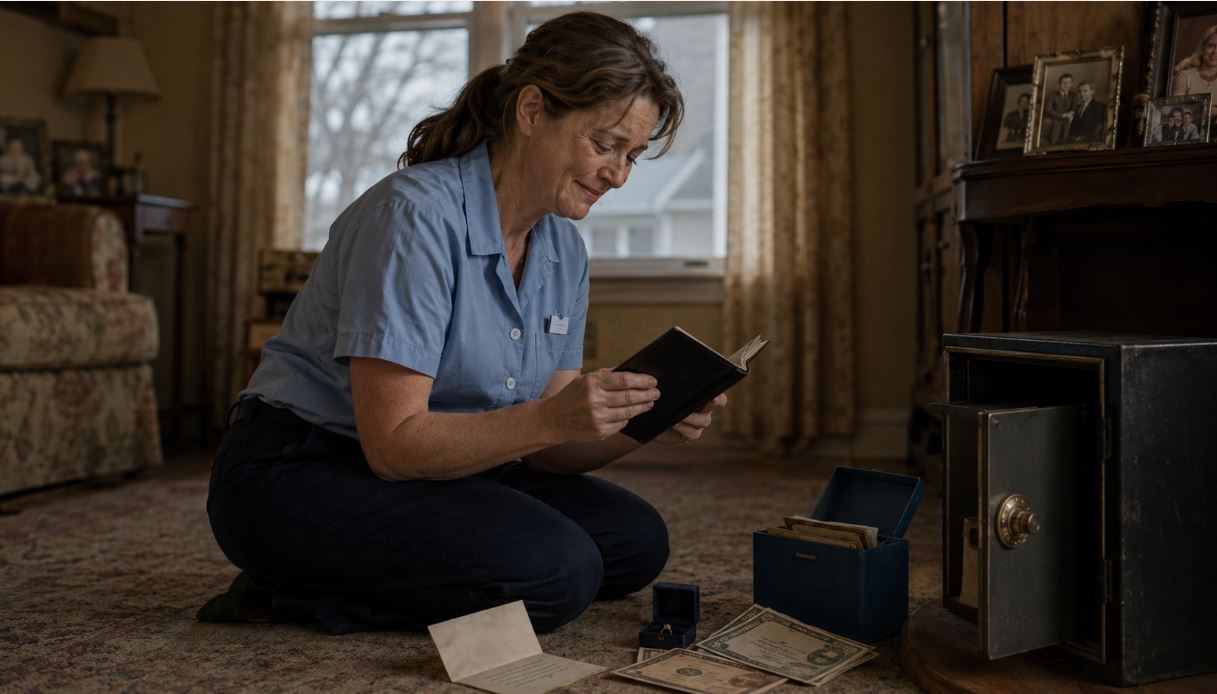
In the front room, she found the blue recipe box exactly where Arthur said it would be.
Inside were handwritten cards.
Apple pie.
Chicken and dumplings.
Sunday rolls.
At the bottom was a small brass key.
Nora’s hand trembled as she picked it up.
The safe was in the hall closet.
Inside, there was a small velvet ring box, a stack of savings bonds, several folders, and a black notebook.
Nora opened the notebook.
The first page said:
For Nora, if she wants to understand.
She sat on the floor beside the safe and began to read.
It was not a diary exactly.
More like notes.
Short entries.
Tuesday. Nora remembered no cream again. I don’t know why this comforts me.
Tuesday. She paid for my breakfast. I saw her slip the bill into her apron. She thinks I don’t notice.
Tuesday. She looks thinner. I worry she feeds others better than herself.
Tuesday. She laughed today. Good sound.
Tuesday. Pain bad this morning. Went anyway. Booth was warm. Coffee ready.
Tuesday. She called me Arthur without thinking. I liked it.
Nora covered her face.
There were pages and pages.
Two years of Tuesdays.
Two years of small observations.
Two years of proof that something she barely thought about had mattered deeply to someone else.
At the back of the notebook, Arthur had tucked one final napkin.
On it, he had written:
You gave me a place to be expected.
That was when Nora finally broke.
She sat on the floor of a house she had not earned in any legal sense, but had somehow been trusted with, and cried for the old man who had spent his last years sitting in booth seven with coffee and eggs.
A week later, Arthur’s son called.
Nora almost didn’t answer.
Mr. Keller advised her not to meet anyone alone, but she took the call.
His name was David.
His voice was tight.
“You’re the waitress?”
Nora closed her eyes.
“My name is Nora.”
“My father left you his house.”
“Yes.”
“You understand how that looks.”
“I understand how it feels.”
“You don’t know anything about our family.”
“No,” Nora said. “I don’t.”
“He was difficult.”
“I believe that.”
“He pushed people away.”
“Maybe.”
“You took advantage of an old man.”
That one hurt.
Nora sat down at her small kitchen table above the laundromat.
The same table where she had counted late rent more times than she could remember.
“I gave him breakfast,” she said.
“You gave him attention because you knew he had money.”
“I didn’t know he had a house until your lawyer told me.”
David was quiet.
Then he said, “He should have left it to his grandchildren.”
“Maybe he should have.”
That seemed to surprise him.
Nora continued.
“But he didn’t. And I’m sorry that hurts you. I really am.”
David’s voice softened for the first time.
“He never told us he was sick.”
“He didn’t tell me either.”
Another silence.
Then David said, “Did he suffer?”
“No,” Nora said, though she didn’t fully know. “Mr. Keller said it was peaceful.”
David breathed out.
“My mother loved that house.”
“Ruth?”
“You knew her name?”
“Arthur talked about her sometimes.”
David’s voice changed.
“He did?”
“Yes.”
Nora looked at the notebook on the table.
“He said she made the best apple pie in Ohio.”
David laughed once, unexpectedly.
“She did.”
For a moment, Nora heard not an angry son, but a boy who had lost his father and didn’t know where to put the guilt.
“I don’t want to fight you,” Nora said.
“I don’t know what I want,” David admitted.
That was the most honest thing anyone had said all week.
In the end, David did not sue.
His sister threatened to, but Mr. Keller handled it.
Arthur’s will stood.
Nora did not quit the diner immediately.
That surprised everyone.
Ed most of all.
“You own a house now,” he said one morning. “Why are you still here?”
Nora tied her apron.
“Because bills still exist.”
“But you have money.”
“I have responsibility.”
Sam grinned from the grill.
“That’s a very Nora answer.”
The house needed work.
A new furnace.
Porch repairs.
Plumbing.
Roof patches.
The money Arthur left was enough to help, but not enough to make her careless.
So Nora kept working.
But things changed.
She paid her rent.
Then she gave notice properly.
She fixed her car.
She bought good shoes for work, the kind waitresses talk about like treasure.
She visited Arthur’s house on Sundays and pulled weeds from Ruth’s garden.
In the spring, she planted tomatoes.
Then marigolds.
Then lavender by the porch steps.
One Tuesday morning, a man came into the diner with a little girl.
He counted coins at the register.
Nora saw him glance at the menu.
Then at the child.
Then at the coins.
She felt something move through her chest.
A memory.
A bell at 6:47.
A worn brown coat.
A voice saying, Kindness has a long memory.
She walked over with two menus.
“Booth by the window?” she asked.
The man looked embarrassed.
“I’m sorry. I think we only have enough for coffee and maybe toast for her.”
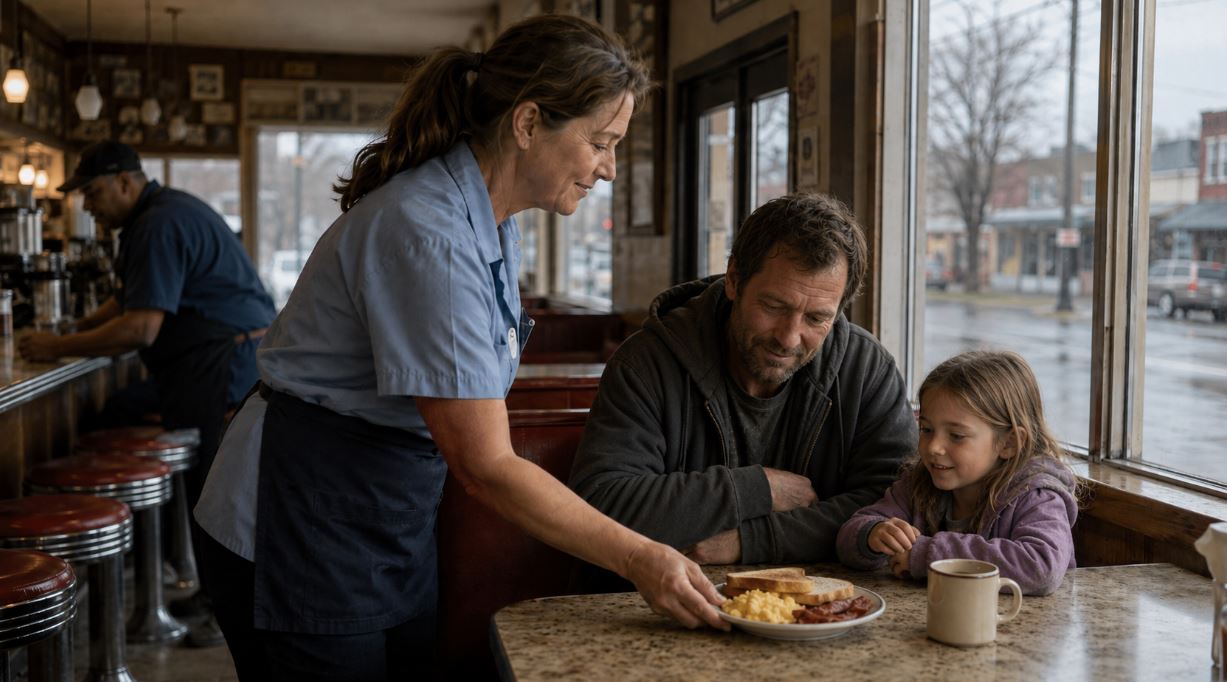
Nora smiled.
“Kitchen made an extra breakfast.”
Sam heard from the grill.
He didn’t argue this time.
He just cracked the eggs.
The man’s eyes filled.
The little girl climbed into the booth.
Nora brought coffee for him, milk for the child, eggs, toast, and bacon.
When she set the plates down, the man whispered, “I don’t know how to thank you.”
Nora looked at the empty space across from him, where Arthur had once sat every Tuesday.
“Yes, you do,” she said. “Just remember.”
That afternoon, she taped a small handwritten sign beside the register.
Not big.
Not dramatic.
Just black ink on white paper.
If you are hungry and cannot pay, please tell us. Someone once helped us too.
Ed complained.
“This is a business, Nora.”
Nora looked at him.
“So was Arthur’s life. He still made room for kindness.”
The sign stayed.
At first, Nora paid for the meals herself.
Then Sam started covering some.
Then one of the nurses left a twenty and said, “For the sign.”
Then a trucker left fifty.
Then a retired teacher mailed a check after reading about it in the local paper.
Within six months, there was a little jar near the register labeled:
Arthur’s Table.
No one got rich from it.
No one’s life changed overnight.
But people ate.
Quietly.
With dignity.
That would have mattered to Arthur.
One year after his death, Nora stood on the porch of the yellow house on Maple Ridge Road.
The porch no longer sagged.
The flower beds were alive again.
The morning sun touched the steps exactly the way Arthur had promised in his letter.
She held his notebook in her hands.
She had read it so many times the spine had softened.
Inside the house, coffee brewed.
On the kitchen counter sat Ruth’s recipe box.
Nora had tried the apple pie recipe twice.
The first time, she burned the crust.
The second time, Sam said it was “almost legal.”
She smiled at the memory.
Then she opened the notebook to the final page.
The last line Arthur had written was not about money.
Not about the house.
Not about his children.
It said:
To be remembered is a kind of home.
Nora looked down the road.
For most of her life, she had thought miracles came loudly.
A lottery win.
A rescue.
A door flying open.
But Arthur’s miracle had come quietly.
A bell over a diner door.
A cup of coffee.
A plate of eggs.
A lonely old man who wanted to be seen.
And a waitress who had almost nothing, but gave anyway.
That Tuesday, before going to the diner, Nora placed a fresh note inside her apron pocket.
It was written on a napkin.
For whoever needs it next:
Kindness has a long memory.
Then she locked the yellow house, walked down the porch steps, and drove to work.
At 6:47 a.m., the bell above the diner door rang.
Nora looked up.
For one impossible second, she expected to see Arthur.
Same coat.
Same cap.
Same tired blue eyes.
But it was someone else.
Another old man.
Another cold morning.
Another person hoping not to be invisible.
Nora picked up the coffee pot.
She smiled.
“Morning,” she said. “Booth by the window?”