Boris Whitaker had never asked his children for money.
Not once in fifty-eight years.
He was the kind of man who fixed things with his own hands before admitting they were broken. He worked as a forklift operator outside Rosenberg, Texas, where the summers were brutal, the warehouses smelled like dust and rubber, and a man’s worth was often measured by how long he could keep going without complaint.
Boris had raised two children in a small brick house with a cracked driveway and a pecan tree in the front yard.
His son, Richard, had become everything people in town admired.
Successful.
Well-dressed.
Owner of a logistics company with offices in Houston and Dallas.
A man with a gated home, a lake house, and a wife who wore sunglasses that cost more than Boris made in a week.
His daughter, Melissa, had become something quieter.
A fourth-grade teacher.
Divorced.
Renting a two-bedroom apartment twenty minutes from the school where she taught.
She drove a twelve-year-old Toyota with a dent in the passenger door and kept granola bars in her purse because some of her students came to class hungry.
Richard was the one people bragged about.
Melissa was the one who showed up.
Boris knew the difference.
But he did not say it out loud.
Families have truths everyone knows and no one names.
For months, Boris had ignored the cough.
At first, it came only in the mornings. A dry, stubborn cough that left him leaning over the bathroom sink, one hand pressed against the cold porcelain.
His wife, Caroline, told him to see a doctor.
“You’ve been saying that cough is allergies since Easter,” she said one night while folding laundry at the kitchen table.
“It’s warehouse dust,” Boris muttered.
“You don’t know that.”
“I know enough.”
Caroline looked at him over a stack of towels.
“You know enough to be stubborn.”
He smiled at that, but the smile did not last.
By September, the cough had deepened. His chest hurt when he climbed stairs. His work boots felt heavier. One afternoon, he had to stop halfway across the warehouse floor and pretend to check paperwork just so the younger men would not see him struggling to breathe.
The doctor ordered scans.
Then more scans.
Then a biopsy.
Boris sat in a cold examination room with Caroline beside him while a specialist named Dr. Mehta folded his hands and used the tone doctors use when they are trying to be gentle with terrible news.
“Mr. Whitaker, the biopsy confirms lung cancer.”
Caroline stopped breathing.
Boris stared at a poster on the wall showing a healthy pair of lungs.
He had expected something bad.
He had not expected the room to become that quiet.
Dr. Mehta continued explaining. The tumor had been caught in a window where surgery still gave him a real chance. It would not be simple, and it needed to happen soon.
Then came the part Boris dreaded more than the diagnosis.
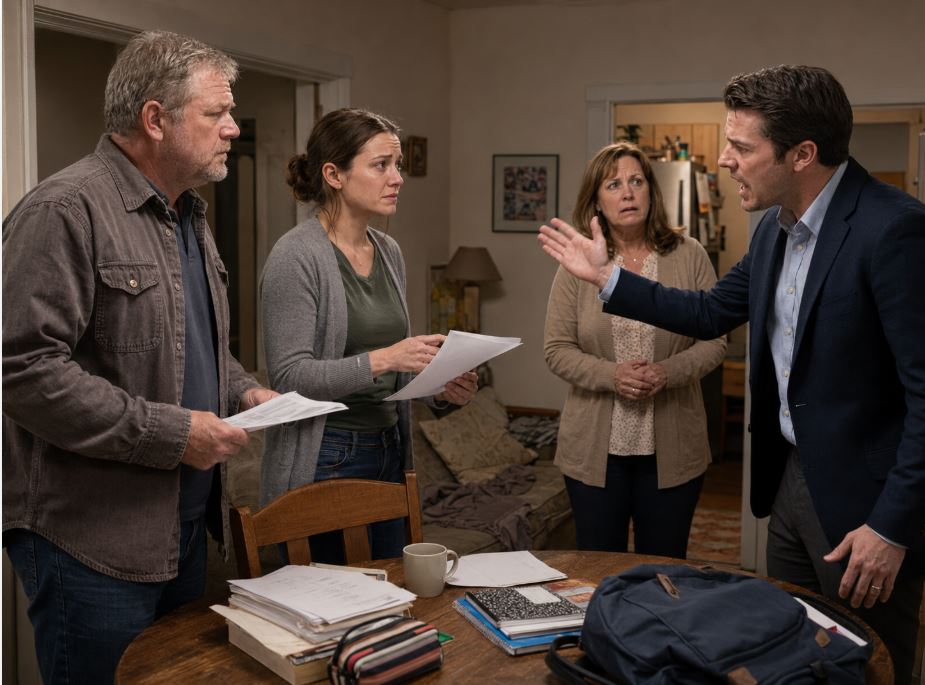
The cost.
Insurance would cover most of it, but not everything. There were deductibles, pre-op expenses, medication, transportation, and a required payment before the surgery date could be secured.
The amount was $3,500.
It was not a fortune to some people.
To Boris, it was the kind of number that sat on a man’s chest at night and made sleep impossible.
He and Caroline had savings, but not enough. A broken water heater and two months of reduced hours at work had already eaten through what little cushion they had.
In the truck after the appointment, Caroline sat staring through the windshield.
Boris held the folder from the hospital in his lap.
“I can ask for extra shifts,” he said.
Caroline turned on him. “You can barely breathe walking to the mailbox.”
He nodded, ashamed.
“I’ll figure it out.”
“You should call Richard.”
Boris looked at her.
There was a time when that would have been the natural thing to do.
Call your son.
Tell him his father was sick.
Let family be family.
But years had changed things.
Richard visited on holidays if Caroline reminded him enough times. He sent expensive gift baskets at Christmas, the kind ordered by assistants, with cheeses no one in the house liked. He spoke to Boris like a man speaking to an old employee he had once respected but no longer needed.
Still, Richard was his son.
And $3,500 to Richard was a dinner bill.
Boris called him that evening.
Richard answered on the fourth ring.
“Hey, Dad. I’ve got about three minutes before a call.”
Boris looked at Caroline sitting across from him at the kitchen table.
“I got some news from the doctor.”
There was a pause.
“What kind of news?”
“Cancer.”
The word landed between them.
For a moment, Richard said nothing.
Then he cleared his throat.
“That’s… I’m sorry to hear that.”
Boris closed his eyes.
“They want to operate. Soon. Insurance covers most, but I need to come up with thirty-five hundred before they schedule it.”
Another pause.
This one was different.
This one had distance in it.
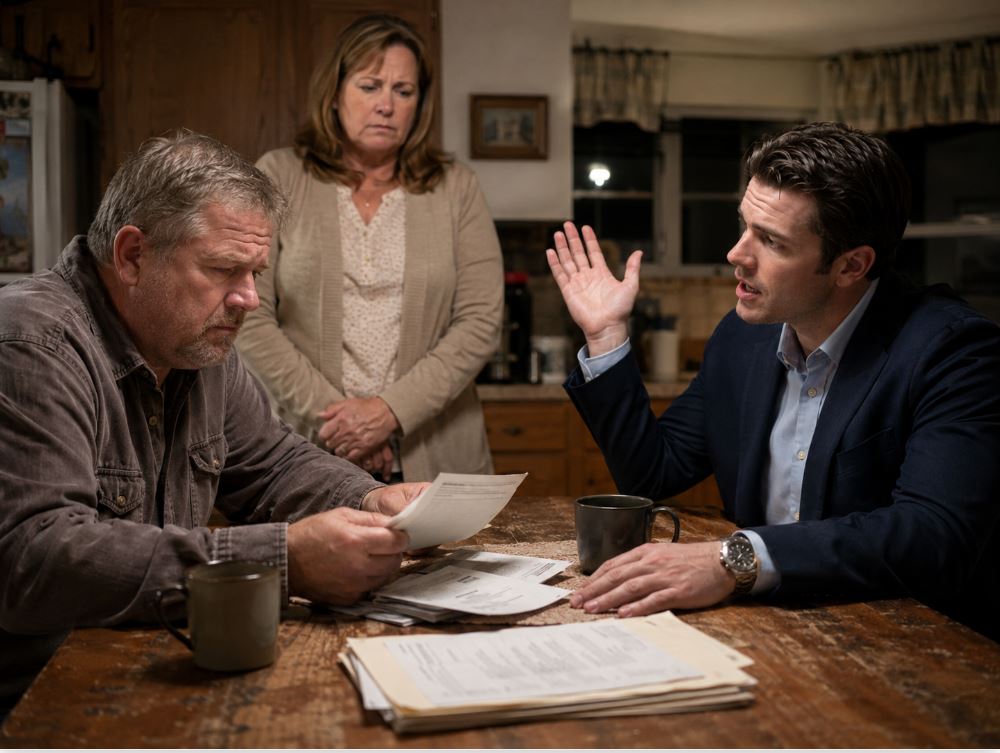
“You’re asking me for money?”
“I’m asking for help,” Boris said.
Richard exhaled, annoyed but trying to hide it.
“Dad, you know I have a lot tied up right now. Expansion costs. Payroll. Investments. It’s not as simple as looking at a bank balance.”
Boris looked down at his hands.
Hands that had taught Richard how to ride a bike.
Hands that had fixed Richard’s first car.
Hands that had signed a personal loan years ago when Richard’s first business nearly failed.
“I understand money gets complicated,” Boris said quietly. “But this is surgery.”
“I get that. But if I do this once, where does it stop?”
Boris opened his eyes.
Caroline stared at him, waiting.
Richard continued, “You and Mom need to plan better. I’ve told you that for years.”
Boris felt something in his chest tighten that had nothing to do with cancer.
“Richard.”
“I’m not trying to be cold. I’m just saying I can’t be everyone’s emergency fund.”
Everyone.
That was the word that did it.
Boris was not everyone.
He was his father.
“I see,” Boris said.
Richard’s voice softened in the way rich men soften when they know they are about to disappoint someone and want to sound reasonable doing it.
“Maybe ask Melissa. She’s closer to you guys anyway.”
Boris looked across the table at Caroline.
She had heard.
Her face did not change.
“Melissa doesn’t have that kind of money,” Boris said.
“She’ll figure something out,” Richard replied. “She always does.”
Boris almost laughed.
That was what people said about Melissa.
She’ll figure it out.
As if life had not forced her to.
As if being dependable meant she needed less.
“I have to jump on my call,” Richard said. “Keep me updated, okay?”
The line went dead.
Boris held the phone in his hand long after the call ended.
Caroline stood and carried two coffee cups to the sink even though neither of them had taken a sip.
“You heard him,” Boris said.
She did not turn around.
“He’s under pressure.”
Boris looked at the back of his wife’s head.
“Caroline.”
“What?”
“I have cancer.”
Her shoulders stiffened.
“I know that.”
“He has twelve million dollars in the bank.”
“You don’t know what’s liquid.”
Boris stared at her.
It was not the money that broke him.
It was the defense.
The automatic protection of Richard.
Even now.
Even with death standing close enough to fog the windows.
“You want me to ask Melissa,” he said.
Caroline wiped the counter slowly.
“She cares about you. She’ll want to help.”
“She makes forty-seven thousand a year teaching fourth grade.”
“She’s resourceful.”
There it was again.
The family word for Melissa.
Resourceful.
Boris stood too fast and had to grip the table.
“Resourceful is what people call someone after they’ve abandoned them and watched them survive anyway.”
Caroline finally turned.
Her eyes were wet, but her voice was firm.
“Don’t make this about old resentments.”
“This is not old,” Boris said. “This is happening right now.”
That night, he did not call Melissa.
He sat in his recliner after Caroline went to bed, the hospital folder on his lap, and stared at the photograph on the side table.
It was Melissa at eight years old, missing two front teeth, holding a handmade Father’s Day card.
The card had said:
Daddy, I would give you my whole piggy bank if you needed it.
He remembered laughing when she gave it to him.
Now the memory hurt.
The next afternoon, Melissa came over without being asked.
She had heard from her mother, of course.
She entered the house still wearing her school badge, her hair pulled back badly, one side falling loose from a clip. She carried a canvas tote stuffed with papers to grade.
“Dad,” she said.
That was all.
Then she hugged him.
Not carefully.
Not politely.
She held him like she was afraid he might disappear if she let go.
Boris tried to make a joke.
“Well, don’t squeeze the tumor.”
Melissa pulled back and gave him a look.
“Not funny.”
“Little funny.”
“No.”
He smiled despite himself.
They sat at the kitchen table, the same table where birthday cakes had been cut and report cards had been signed.
Melissa opened the hospital folder and read every page.
“How much do you need?”
Boris shook his head.
“No.”
“How much?”
“Melissa.”
“Dad.”
He looked away.
“Thirty-five hundred.”
She sat very still.
Boris could see the number moving through her mind. Rent. Car insurance. School supplies. Credit card. Groceries. The unpaid dental bill he knew she had been putting off.
“I can help,” she said.
“No, you can’t.”
“Yes, I can.”
“You don’t have it.”
“Not sitting in my checking account, no.”
“That means you don’t have it.”
Melissa closed the folder.
“You used to work double shifts when Richard needed braces.”
Boris flinched.
“You remember that?”
“I remember everything.”
He looked at her then.
Really looked.
There were dark circles under her eyes. Ink on her fingers. A small run in her sweater sleeve. She looked tired in the way good people look tired when life keeps asking more from them because they are the ones who keep answering.
“I already called Richard,” Boris said.
Melissa’s face changed, but only for a moment.
“What did he say?”
“He said no.”
She nodded once.
Not surprised.
That hurt him more.
“He told me to ask you.”
Melissa looked down at the table.
A small laugh escaped her, but there was no humor in it.
“Of course he did.”
Boris reached for her hand.
“I am not asking you.”
She squeezed his fingers.
“You don’t have to.”
Over the next three days, Melissa did things Boris did not find out about until later.
She sold her car to a used car lot for far less than it was worth because she needed the cash quickly.
She took the bus to school before sunrise.
She emptied the small savings account she had been building for a summer teaching conference.
She took a payday loan with an interest rate so ugly that when Boris finally saw the paperwork, he had to sit down.
She also called the hospital billing office, negotiated what she could, asked questions no one had thought to ask, and got the surgery date secured.
When Boris found out she had sold the Toyota, he was furious.
Not at her.
At himself.
At Richard.
At Caroline.
At a world where a teacher had to sell transportation to help save her father while a millionaire son explained liquidity.
“You shouldn’t have done this,” he told her.
They were in the hospital parking lot before his pre-op appointment.
Melissa was wearing a blue dress and sneakers because she had walked six blocks from the bus stop.
She looked at him with those steady eyes she had inherited from his mother.
“Yes, I should have.”
“I’ll pay you back.”
“I know.”
“I mean it.”
“I know.”
He tried to speak, but his throat closed.
Melissa put her hand over his.
“Dad, listen to me. You’re not a burden.”
Boris turned toward the window.
He did not want her to see him cry.
The morning of surgery, Caroline arrived late.
Richard did not come.
He sent a text.
Thinking of you. Keep me posted.
Melissa read it over Boris’s shoulder, then quietly turned his phone face down.
In the pre-op room, she sat beside his bed and held his hand.
Caroline sat on the other side, scrolling through messages from Richard.
Boris watched his daughter.
“You should be at work.”
“I took the day.”
“You can’t afford that.”
“I couldn’t afford not to.”
He tried to laugh, but it came out broken.
When the nurse came to roll him back, Boris gripped Melissa’s hand.
“If something happens—”
“Don’t,” she said.
“If something happens, I need you to know—”
“Dad.”
“I know who showed up.”
Her eyes filled.
“So do I.”
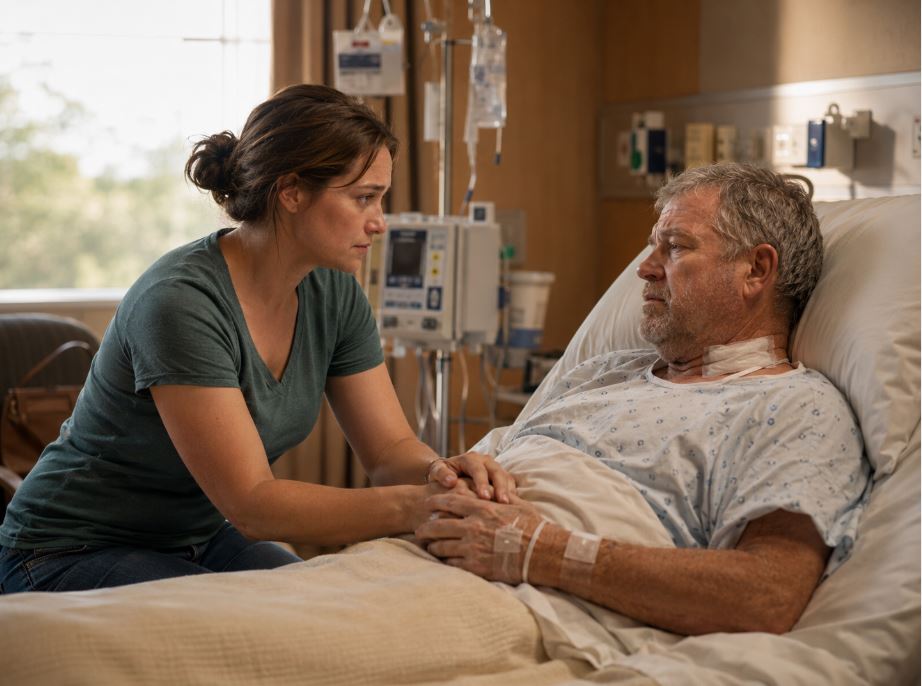
The surgery lasted four hours.
Then five.
Melissa paced the waiting room until her feet hurt.
Caroline cried quietly.
Richard called once, but only to ask whether there was “any update yet” because he was about to go into a meeting.
When Dr. Mehta finally came out and said the surgery had gone as well as they could hope, Melissa sat down hard in a chair and covered her face.
Boris woke later to fluorescent lights, a dry throat, and his daughter asleep in a chair beside him with her coat over her shoulders.
Caroline was gone.
Richard had not come.
But Melissa was there.
Always there.
Recovery was slow.
Boris hated needing help.
He hated the walker.
He hated the pills.
He hated the way Caroline hovered some days and disappeared emotionally on others, as if his illness had disturbed a life she preferred neat.
Melissa came after school with soup, medication charts, clean laundry, and stories about her students.
One little boy had written “get whale soon” on a card for him.
Boris kept it on the fridge.
Weeks passed.
His strength began to return.
Then, on a warm Thursday afternoon, a certified letter arrived.
Boris signed for it at the front door, confused by the thick envelope and the law firm’s return address.
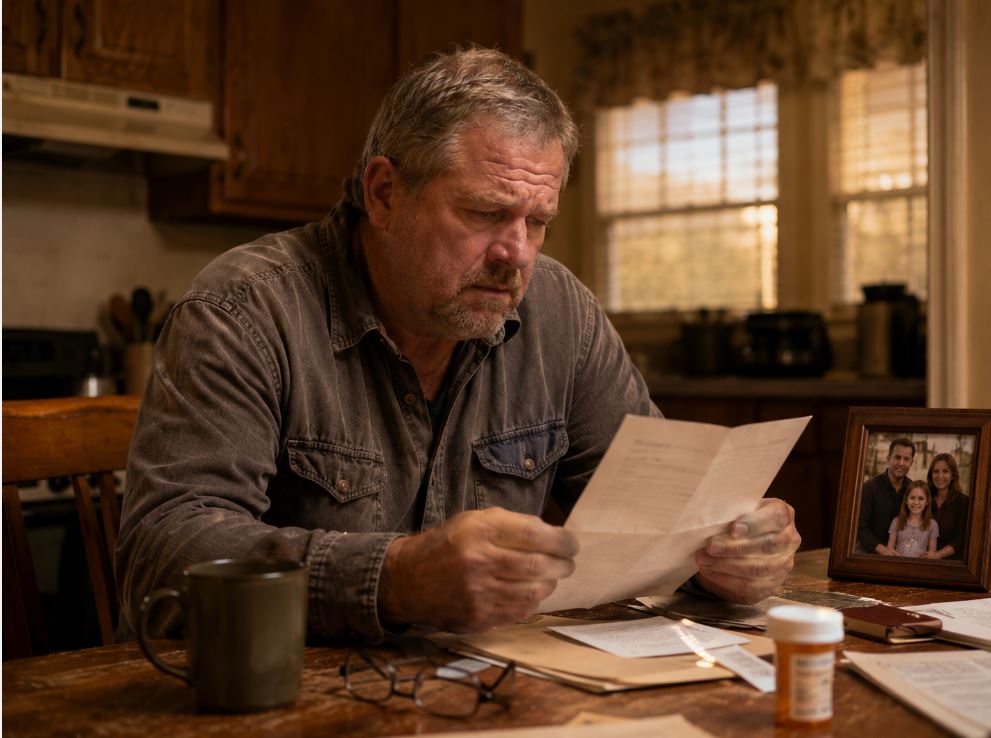
Inside was a letter that made him sit down slowly at the kitchen table.
The land.
Thirty years earlier, Boris had inherited a stretch of rural property from his uncle near the edge of a development zone. For years, it had been tangled in restrictions, environmental reviews, and old boundary disputes. The family had joked that the land was worthless because no one could touch it, sell it, build on it, or even agree where half the lines were.
Boris had nearly forgotten about it.
The letter explained that the federal restrictions had been lifted. A commercial developer had made an offer through the court-supervised partition process.
After taxes and fees, Boris’s share would be just over $15 million.
He read the number again.
Then again.
Caroline came into the kitchen.
“What is it?”
Boris folded the letter.
“Something about the old land.”
Her face sharpened.
“What about it?”
“They’re selling it.”
“For how much?”
He did not answer.
That was the first time in forty years of marriage that Boris chose silence as protection.
Not because he wanted to hurt Caroline.
Because he had finally understood something.
Some people only heard you when money was speaking.
That evening, after Caroline went to bed, Boris called his attorney, Alan Reeves.
Alan had been handling the old land dispute for years. He was an old-fashioned lawyer with white hair, careful words, and a memory like a locked file cabinet.
“I got the letter,” Boris said.
“I thought you might call.”
“Is it real?”
“It’s real.”
Boris closed his eyes.
“Does Caroline know?”
“Not from me.”
Boris looked toward the dark hallway.
Five years earlier, during one of the worst stretches of his marriage, Boris had signed an estate partition agreement related to the inherited land. Caroline had refused to participate in the legal costs at the time and had signed away any spousal claim to the future proceeds in exchange for not being tied to the debt, taxes, or liability.
Richard had also signed a document years earlier refusing any future claim after calling the land “a dead asset” and telling Boris to “stop throwing money at dirt.”
Only Melissa had once sent Boris a check for $300 to help cover a survey fee.
She had written on the memo line:
For your dirt dream.
He had laughed when he saw it.
He had kept a copy.
“Alan,” Boris said, “I want to set up a trust.”
“For your medical care?”
“For Melissa.”
A pause.
“All of it?”
Boris looked at the hospital bills on the table. He looked at the bus schedule Melissa had left beside his medication chart. He looked at the empty space in the driveway where her car should have been parked.
“Yes,” he said. “All of it.”
Alan was quiet for a moment.
“Boris, that will create conflict.”
“No,” Boris said. “The conflict already exists. This will only reveal it.”
The legal work took several weeks.
Boris told no one except Alan.
The money went first into protected accounts, then into an irrevocable trust in Melissa’s name. The trust would pay off her debts, replace her car, fund her retirement, help her buy a home, and support the tutoring program she had always dreamed of starting for children who were falling behind in school.
Boris kept enough for his own medical care and a modest emergency fund.
He did not want a mansion.
He wanted peace.
Melissa found out on a Saturday morning.
Boris asked her to come by after her grocery run.
She arrived carrying oranges, low-sodium soup, and a stack of worksheets she planned to grade at his kitchen table.
Alan was there in a suit.
Melissa stopped in the doorway.
“Dad?”
“Sit down, honey.”
She sat.
Boris explained the land.
The sale.
The documents.
The trust.
At first, Melissa looked confused.
Then frightened.
Then angry.
“No.”
Boris blinked.
“No?”
“No. Dad, I didn’t help you because I wanted money.”
“I know.”
“I mean it. I don’t want Richard saying—”
“Richard can say whatever rich men say when they realize money did not make them honorable.”
Melissa stared at him.
Alan coughed into his hand, pretending not to smile.
Boris reached across the table and placed the copy of her old $300 check in front of her.
Melissa looked down.
Her face crumpled.
“You kept that?”
“I kept everything that reminded me who my family was.”
Tears slid down her face.
“I only did what anyone should do.”
Boris’s voice softened.
“No. You did what everyone should do. That’s not the same thing.”
Three days later, Richard found out.
Caroline told him.
Boris had expected it.
Richard arrived at Melissa’s apartment that evening in a black SUV that looked too large for the narrow parking lot. Caroline came with him, wearing the face she used when she wanted to appear calm while carrying a storm inside her.
Melissa opened the door still in her school clothes.
Boris was sitting at her small kitchen table, drinking tea from a chipped mug.
Richard stepped inside without waiting to be invited.
“So it’s true,” he said.
Boris looked up.
“Hello to you too.”
Richard pointed at Melissa.
“You gave her fifteen million dollars?”
Melissa crossed her arms.
“Don’t point at me in my apartment.”
Richard ignored her.
“Dad, do you understand what you’ve done?”
“Yes.”
“You cut your own son out.”
Boris set down the mug.
“I did not cut you out. You walked away when the bill was thirty-five hundred dollars.”
Richard’s face reddened.
“That is not the same thing.”
“No,” Boris said. “It is not. One was about keeping me alive. The other is about making you richer.”
Caroline stepped forward.
“Boris, this is cruel.”
He turned to his wife.
That hurt more than Richard’s anger.
“Cruel was listening to our son refuse to help me breathe and then telling me he was under pressure.”
Caroline’s mouth tightened.
“You know Richard has responsibilities.”
“So does Melissa.”
“She doesn’t have a family to support.”
Melissa laughed once.
Sharp.
“I support twenty-eight children every day before I even come home.”
Richard scoffed.
“You’re a teacher, Melissa. Don’t make this heroic.”
Boris stood then.
Slowly.
Carefully.
But the room changed when he rose.
“Enough.”
His voice was not loud.
It did not need to be.
“I have heard this family explain Melissa away for years. She’s resourceful. She’s fine. She’ll manage. She doesn’t need as much. Every time we said those words, what we meant was: she will survive neglect without making us uncomfortable.”
Melissa looked away, crying silently.
Richard threw his hands up.
“This is emotional manipulation.”
Boris reached into the folder Alan had prepared and pulled out two pages.
“This is your text message.”
Richard frowned.
Boris read it aloud.
“Dad, I can’t be everyone’s emergency fund.”
The room went silent.
Then Boris placed Melissa’s bank statement beside it.
“Here is what Melissa had after paying for my surgery deposit.”
Caroline stared at the numbers.
$18.42.
Boris looked at his wife.
“She had eighteen dollars to her name, Caroline. Eighteen. And she still sat beside me before surgery while you were defending him.”
Caroline’s face broke.
Richard looked at the statement, then away.
Boris pulled out the final document.
“And here is the agreement you both signed years ago refusing any future interest in the land because you called it worthless.”
Richard snatched the paper and scanned it.
“This won’t hold.”
“It already has.”
“I’ll sue.”
“You can.”
“I’ll freeze everything.”
“You won’t.”
Richard glared at him.
“You think a small-town lawyer can stop me?”
Boris gave a tired smile.
“No. But the terms of an irrevocable trust can.”
For the first time, Richard looked uncertain.
Caroline sat down slowly on Melissa’s worn sofa.
“I didn’t know it was fifteen million,” she whispered.
Boris looked at her with sad eyes.
“I know.”
That was the whole truth.
She had not cared when it was a problem.
She cared when it became money.
Richard paced once across the room, then turned toward Melissa.
“You’re really going to keep it?”
Melissa wiped her face.
“No, Richard. I’m going to use it.”
“For what?”
“To pay off the loan I took to save Dad. To buy a car so I don’t have to take two buses to work. To start the tutoring program I’ve talked about for ten years. To help children whose families can’t pay for help.”
Richard shook his head.
“You sound noble now that you’re rich.”
Melissa looked at him.
“No. I sounded inconvenient when I was poor.”
That landed harder than a shout.
Richard had no answer.
Caroline began to cry.
“Boris, what about us?”
He looked at his wife.
There was still love there.
But it was buried under years of seeing too clearly.
“I am not leaving you homeless,” he said. “The house is protected. Your needs will be met. But you will not touch Melissa’s trust.”
“You’re punishing me.”
“No,” Boris said. “I am finally telling the truth with paperwork.”
Richard left first.
He slammed the door hard enough to rattle a picture frame.
Caroline stayed a moment longer.
She looked at Melissa.
“I’m sorry,” she whispered.
Melissa did not rush to forgive her.
She only nodded.
Sometimes that is all a person can give.
In the months that followed, Richard did threaten legal action. His attorney sent letters full of impressive language and empty leverage. Alan answered every one.
The trust held.
Richard’s anger became silence.
Caroline moved through the house like a woman realizing she had spent too many years standing on the wrong side of her own family.
Boris continued treatment.
Some days were good.
Some were not.
Cancer does not care about money, and recovery does not become easy just because a bank account changes.
But there was less fear now.
Melissa paid off the payday loan first.
Then she bought a used car, practical and safe, with working air conditioning and tires that did not make her nervous on the highway.
Boris insisted on going with her to the dealership.
When the salesman handed Melissa the keys, Boris cried.
She pretended not to notice.
A year later, the first Melissa Whitaker Learning Center opened in a rented storefront beside a laundromat.
It was not fancy.
The carpet was old. The sign was simple. The folding chairs did not match.
But every afternoon, children came in with backpacks, unfinished homework, and tired parents who looked embarrassed to need help.
Melissa made sure no one was turned away because they could not pay.
Boris sat in the corner on opening day wearing a clean button-down shirt and a baseball cap to hide the thinning hair from treatment.
A little girl with pink glasses walked up to him and asked, “Are you the boss?”
Boris smiled.
“No, ma’am. My daughter is.”
The girl looked toward Melissa, who was kneeling beside a boy struggling with fractions.
“She’s nice,” the girl said.
Boris nodded.
“She always was.”
Richard did not come to the opening.
Caroline did.
She stood near the door holding a bouquet of flowers, unsure where to place herself.
Melissa saw her and paused.
For a moment, neither woman moved.
Then Melissa walked over and took the flowers.
“Thank you,” she said.
Caroline’s eyes filled.
“I’m proud of you.”
Melissa held her gaze.
“I needed to hear that when I had eighteen dollars.”
Caroline nodded, tears slipping down her cheeks.
“I know.”
It was not forgiveness.
Not yet.
But it was a beginning.
That evening, after everyone left, Boris and Melissa sat outside the learning center on two folding chairs, watching the Texas sunset turn the strip mall windows gold.
His breathing was better that day.
Not perfect.
Better.
Melissa leaned back and closed her eyes.
“Are you tired?” he asked.
“Exhausted.”
“Happy?”
She opened one eye.
“Also yes.”
Boris smiled.
“I want you to know something.”
“Dad, if you’re about to give another emotional speech, I’m charging the trust by the minute.”
He laughed, then coughed, then laughed again when she fussed over him.
“I’m serious,” he said.
“I know.”
He looked at the little storefront.
“For a long time, I thought being a good father meant working hard and keeping food on the table. I did that part. But I missed other things. I let your mother make excuses. I let Richard take more room than he deserved. And I let you become the child who needed the least because you complained the least.”
Melissa looked down at her hands.
“I didn’t know how to ask for more.”
“You shouldn’t have had to.”
The sun dropped lower.
Traffic moved along the road.
Somewhere nearby, a child laughed.
Boris said, “That money did not make you valuable.”
Melissa looked at him.
“It only gave me a way to show this family what your value already was.”
She cried then.
Quietly.
And Boris let her.
The story spread through Rosenberg slowly, the way stories do in smaller places.
Some people said Boris had been too harsh.
Some said Richard got what he deserved.
Some said money always destroys families.
Boris disagreed.
Money does not destroy families.
It reveals them.
It shows who sees a sick father as a responsibility and who sees him as an inconvenience.
It shows who counts dollars and who counts heartbeats.
It shows who comes to the hospital when there is nothing to gain.
And who comes to the apartment only after there is fifteen million dollars to fight over.
Boris never became the same man he had been before cancer.
Illness changed his body.
Betrayal changed his family.
But Melissa’s love changed the ending.
Not into something perfect.
Real life is rarely perfect.
But into something honest.
Richard still had his mansion, his company, and his bank accounts.
Caroline still had to live with the memory of the day she defended the wrong child.
Melissa had a car, a home, a future, and a building full of children who knew someone believed in them.
And Boris had what he had been searching for long before the diagnosis.
Proof.
Not that he was rich.
Not that he had won.
Proof that when he was at his weakest, someone loved him without calculating the return.
One night, months after the learning center opened, Boris found an old Father’s Day card in a box of family papers.
It was the one Melissa had made when she was eight.
Daddy, I would give you my whole piggy bank if you needed it.
He held it for a long time.
Then he placed it in a frame and hung it on the wall of the learning center, right beside the front desk.
Underneath it, Melissa added a small printed note:
Real family is not measured by what they promise when life is easy.
It is measured by what they give when love costs them something.