My children told me they were taking me to Sunny Meadows “for my own safety.”
That was the phrase they used.
Not because I was bedridden.
Not because I could not feed myself.
Not because I had lost my mind.
I was seventy-three years old. My knees hurt when it rained, and I sometimes forgot where I left my reading glasses, but I still paid my own bills, cooked my own breakfast, remembered every grandchild’s birthday, and knew exactly which of my children called only when they needed something.
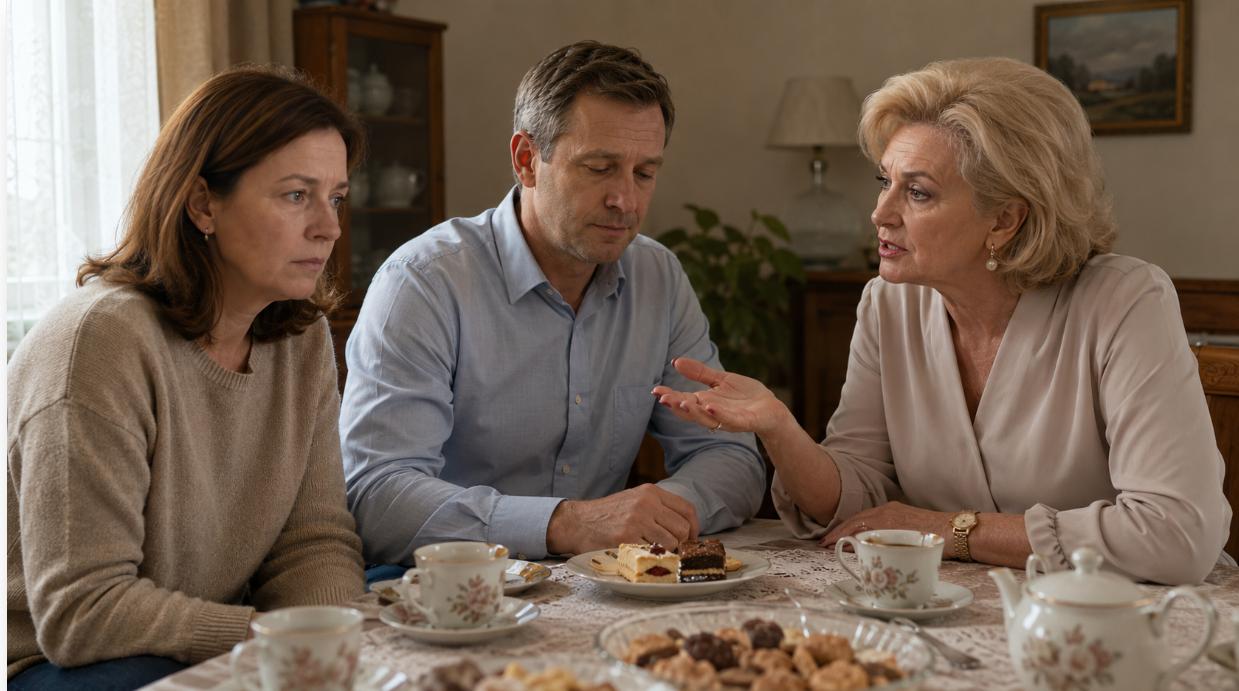
Still, they sat across from me at my kitchen table with folded hands and careful voices, as if they were discussing a sick dog they had finally decided to put down.
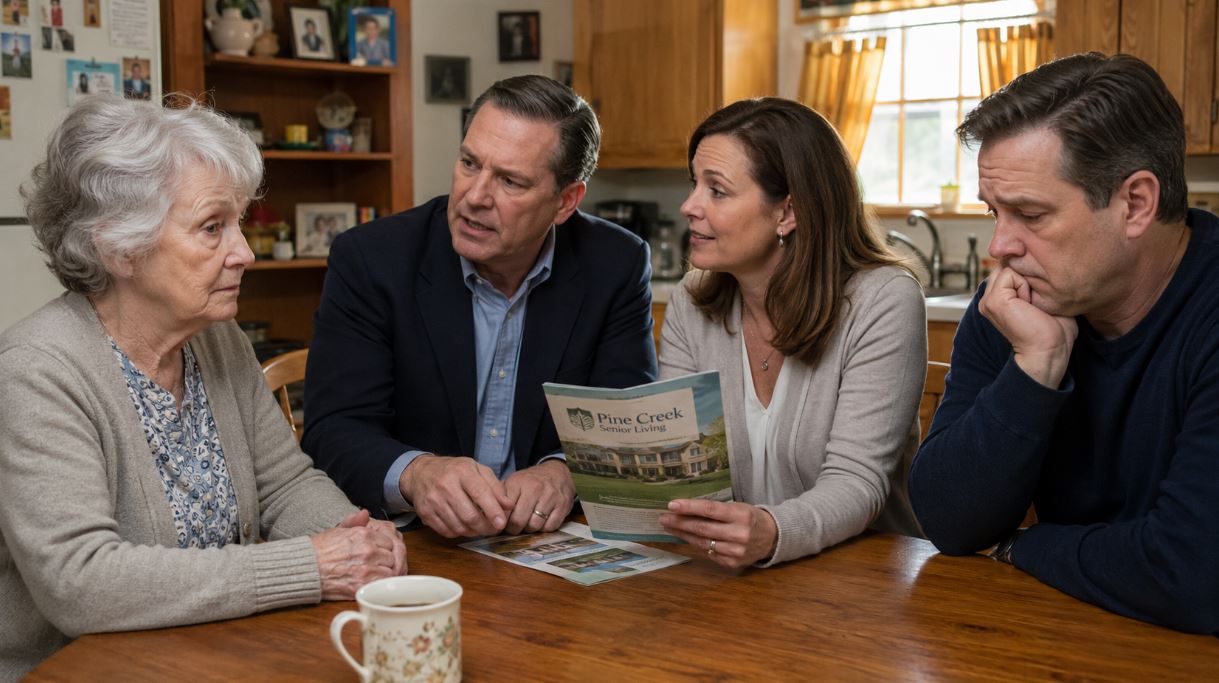
“Mom,” my oldest son, Daniel, said, “this house is too much for you now.”
My daughter, Marissa, nodded quickly.
“There are stairs everywhere. What if you fall?”
My youngest, Kevin, looked at the floor.
He always did that when he knew something was wrong but did not have the courage to say it.
I looked around my kitchen.
The yellow curtains I had sewn myself.
The oak table my late husband had sanded and varnished on our twentieth anniversary.
The little dent in the wall where Daniel once threw a baseball indoors and blamed the dog.
This was not just a house.
This was where I had raised them.
Where I had packed lunches, cooled fevers, paid bills at midnight, cried quietly after their father died, and kept going because mothers are not allowed to collapse when children still need dinner.
“I don’t want to leave my home,” I said.
Marissa reached across the table and squeezed my hand.
That squeeze was supposed to feel loving.
It felt like a lid closing.
“It’s not forever,” she said. “Just until we know you’re safe.”
Daniel slid a brochure across the table.
Sunny Meadows Assisted Living.
Smiling gray-haired people on the cover.
Fresh flowers.
Bright windows.
A nurse holding someone’s hand.
I stared at the brochure.
“I know what these places are,” I said.
Daniel sighed.
“Mom, please don’t be dramatic.”
There it was.
The word children use when a parent refuses to become convenient.
Dramatic.
I looked at Kevin.
He still would not meet my eyes.
“When would I go?” I asked.
Marissa’s smile came too fast.
“We packed some things already.”
My chest went cold.
“You packed my things?”
“Just the basics,” Daniel said. “Clothes, medication, toiletries.”
“Without asking me?”
“We didn’t want to overwhelm you.”
Overwhelm.
Another soft word with teeth.
I stood slowly.
My chair scraped against the tile.
“I am not confused,” I said.
No one answered.
That was the first time I understood.
They had not come to discuss it.
They had come to collect me.
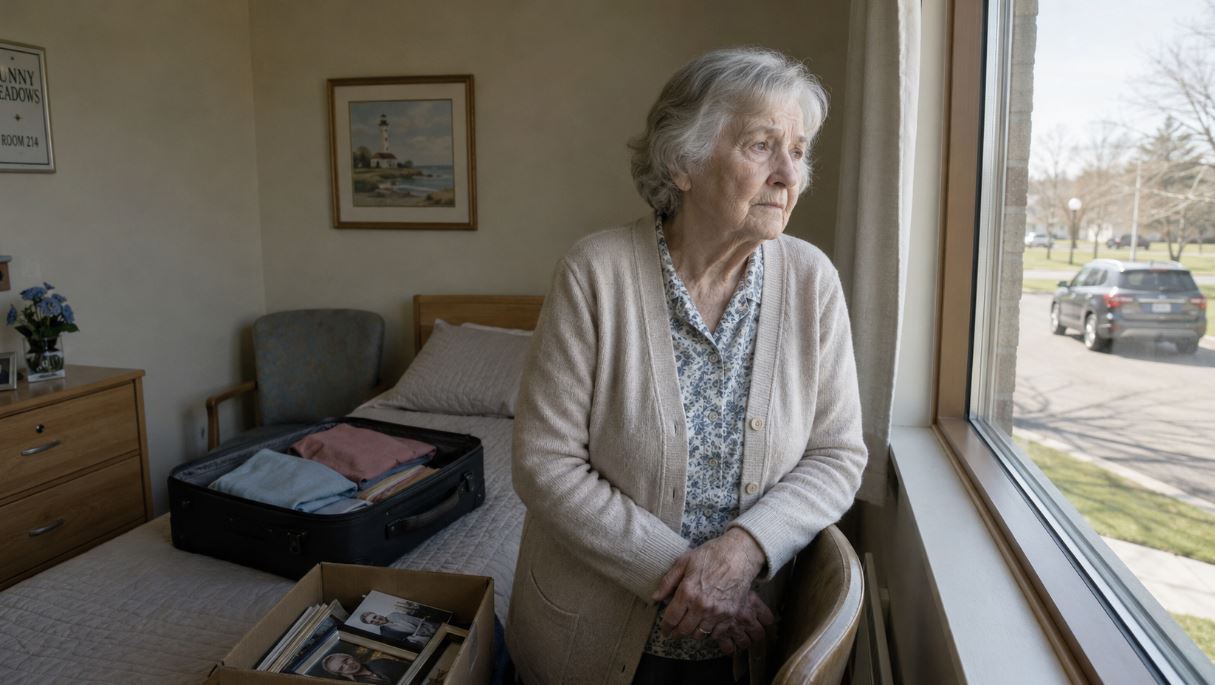
Two hours later, I sat in the back seat of Daniel’s SUV with one suitcase, a box of family photos, and my purse on my lap.
Marissa chatted the whole way as if we were going to lunch.
“The facility has a garden, Mom. And bingo on Thursdays. You used to like cards.”
“I still like my home,” I said.
She pretended not to hear.
Sunny Meadows sat on the edge of town behind a row of tired maple trees. The building was clean, but old. The carpet smelled faintly of disinfectant and canned soup. A television played too loudly in the common room, where three residents stared at the screen without really watching.
A young nurse named Holly greeted me kindly.
Kindness from a stranger is dangerous when your own children have just wounded you.
It almost makes you cry.
Daniel handled the paperwork.
Marissa arranged my sweaters in the small closet.
Kevin stood by the window, rubbing his thumb against his wedding ring.
I sat on the bed.
The mattress was narrow.
The room had one chair.
One dresser.
One framed print of a lighthouse that had never seen an ocean.
Marissa turned around with forced brightness.
“See? It’s cozy.”
I looked at her.
“Prison cells are cozy if you put flowers in them.”
Her face tightened.
Daniel stepped in.
“That’s unfair.”
“No,” I said. “Unfair is bringing your mother here like furniture you no longer have space for.”
Kevin whispered, “Mom…”
I turned to him.
“Say something, Kevin.”
His mouth opened.
Then closed.
Daniel placed a hand on his shoulder.
“We’ll visit all the time,” Daniel said.
Marissa nodded.
“Every week.”
Kevin finally looked at me.
“I’ll come Sunday.”
I wanted to believe him.
A mother can hear the lie and still reach for hope.
So I nodded.
They hugged me goodbye.
Daniel’s hug was quick.
Marissa’s smelled like expensive perfume and guilt.
Kevin held on the longest.
Then they left.
I stood at the window and watched the SUV pull away.
That was the first night I understood how quiet abandonment is.
It does not always arrive with shouting.
Sometimes it comes with a brochure, a packed suitcase, and children saying, “We only want what’s best for you.”
The first week, they called.
Marissa sent photos of her kids at soccer practice.
Daniel texted: Settling in?
Kevin came that Sunday, just like he promised. He brought muffins and sat with me in the garden for twenty-three minutes before his phone rang.
“Work,” he said apologetically.
I smiled like I understood.
I did understand.
That was the problem.
By the third week, the calls slowed.
By the sixth, Daniel stopped answering when I called before noon because he was “in meetings.”
Marissa said the children were busy.
Kevin texted that he would come “next weekend.”
Next weekend is where neglected parents are buried while still alive.
At Sunny Meadows, I learned everyone’s story.
Mrs. Alvarez in room 104 had three sons who lived within thirty miles. They sent flowers every Christmas but never visited.
Mr. Patterson used to own a hardware store. His daughter sold it after moving him in and told him it was “too much stress” for him to think about.
June, across the hall, dressed nicely every Saturday because her grandson once said he might come by after baseball practice.
He never did.
Every hallway had a version of the same ache.
Parents waiting for children who had become too busy to remember who had once waited for them.
I hated Sunny Meadows at first.
Then I realized the building was not the cruel thing.
Neglect was.
The staff did what they could. Most were underpaid, overworked, and tired in the bones. Holly sometimes stayed after her shift just to braid June’s hair or read mail to Mr. Patterson.
The place was not evil.
It was forgotten.
Just like us.
One afternoon, nearly two months after I moved in, Daniel and Marissa visited together.
That alone told me something was wrong.
They arrived dressed too nicely for a casual visit. Daniel wore his navy blazer. Marissa had a folder tucked under her arm.
Kevin was not with them.
“Where’s your brother?” I asked.
Daniel avoided my eyes.
“Busy.”
Marissa sat on the edge of my bed.
“Mom, we need to talk about the house.”
My hands went still in my lap.
“My house?”
Daniel corrected me.
“The family house.”
I looked at him.
“It is my house. Your father and I paid for it.”
Marissa opened the folder.
“We know. But it’s sitting empty. There are taxes, insurance, maintenance. It doesn’t make sense.”
“For whom?”
Daniel sighed.
“For anyone.”
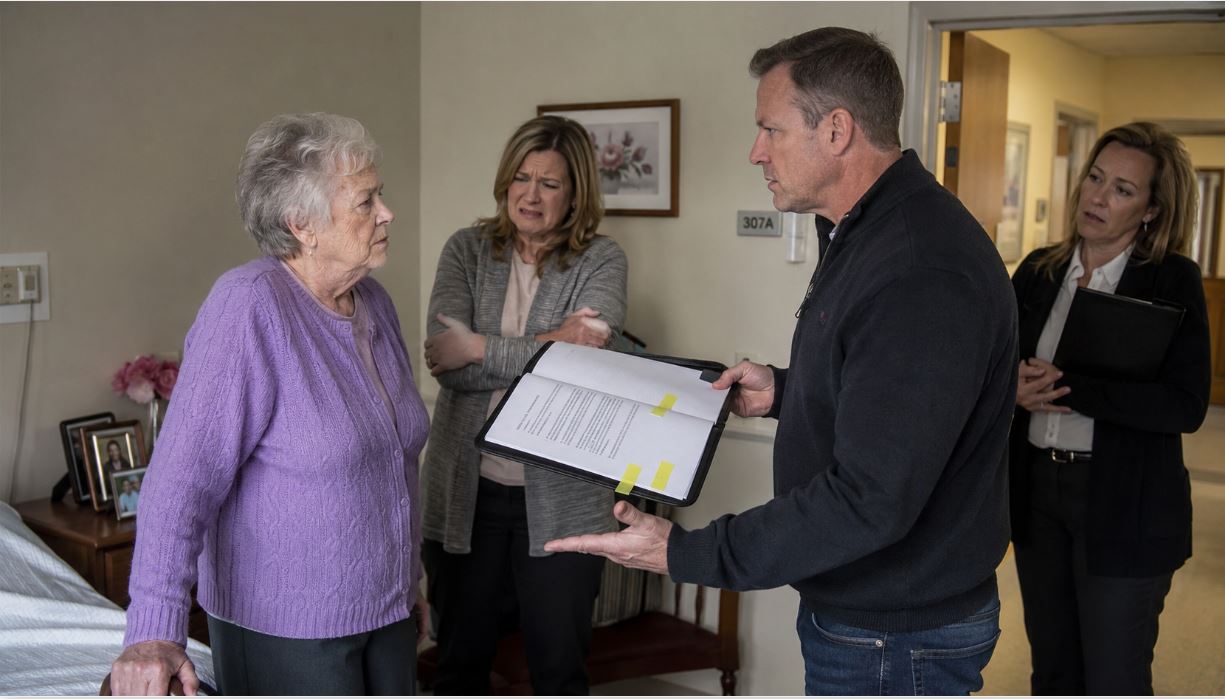
I saw the papers then.
Listing agreement.
Real estate evaluation.
Signature tabs marked in yellow.
My daughter had brought stickers to show me where to give away my home.
“You already spoke to a realtor,” I said.
Marissa softened her voice.
“Just to understand options.”
Daniel leaned forward.
“Mom, the market is strong. We could get a very good price.”
“We?”
His mouth tightened.
“You know what I mean.”
“Yes,” I said. “I do.”
Marissa touched my knee.
“The money would help cover your care.”
I almost laughed.
“My care? I have savings.”
Daniel looked at Marissa.
There it was.
A glance.
Small.
Fast.
But full of meaning.
“You have savings,” Daniel said carefully. “But care gets expensive.”
I looked from one child to the other.
“How long have you been planning this?”
“Mom—”
“How long?”
Marissa’s eyes filled.
“I hate when you make us sound cruel.”
“And I hate when you make cruelty sound practical.”
Daniel stood.
“We are not doing this today.”
He gathered the papers.
But one sheet slipped from the folder and fell near my chair.
He did not notice.
After they left, I picked it up.
It was not the listing agreement.
It was a handwritten note in Marissa’s neat, slanted script.
If Mom signs this month, we can divide proceeds before year-end. Daniel says Kevin doesn’t need equal say if he keeps avoiding responsibility.
I read it three times.
Not because I did not understand.
Because I did.
They were not selling my house to pay for my care.
They were dividing my life before I was done living it.
That night, I did something I had not done since arriving at Sunny Meadows.
I cried.
Not loudly.
Not where anyone could hear.
I sat in the dark on the edge of that narrow bed and cried for the children I had raised.
Then I stopped.
Grief can drown you if you let it.
But anger, used carefully, can become a ladder.
The next morning, I called my attorney.
Not the family attorney Daniel liked.
Mine.
Her name was Ruth Kaplan, and she had handled my sister’s estate when my older sister Beatrice died six months earlier.
Beatrice had never married.
Never had children.
She had spent her life investing quietly, wearing cheap shoes, clipping coupons, and telling everyone she was “comfortable.”
Comfortable, it turned out, was seven million dollars.
My children did not know that.
I had not told them.
At first, because I was grieving.
Later, because something in me wanted to wait.
Now I knew why.
Ruth answered on the third ring.
“Eleanor? Are you all right?”
“No,” I said. “But I’m thinking clearly.”
“Good. Those are different things.”
I told her everything.
The move.
The papers.
The visits that weren’t visits.
The note.
The house.
When I finished, Ruth was silent for a moment.
Then she said, “Do you want to stop the sale?”
“Yes.”
“That’s simple enough. They have no authority unless you gave it to them.”
“I haven’t.”
“Good.”
I looked around my small room.
Through the open door, I could see Holly helping Mr. Patterson down the hall. His daughter had promised to come that day. He had put on his best cardigan.
It was already four in the afternoon.
No daughter.
I lowered my voice.
“Ruth, I want to ask something strange.”
“I’ve been an attorney for forty years. Strange is relative.”
“How much would it cost to buy Sunny Meadows?”
She paused.
“That is strange.”
“I’m serious.”
“I can hear that.”
“I want to know who owns it. What it’s worth. Whether it’s profitable. Whether it’s failing. Everything.”
Ruth did not laugh.
That is why I trusted her.
“I’ll look into it,” she said.
For three weeks, nothing changed on the outside.
I went to meals.
Played cards with June.
Listened to Mrs. Alvarez complain about watery soup.
Smiled when Marissa called and said she was “swamped.”
Answered Daniel’s texts with short, polite words.
Kevin came once and brought a plant.
He looked around my room and said, “This place is depressing.”
I said, “Yes.”
He winced.
“I’m sorry.”
I looked at him.
“For putting me here?”
He stared at the plant.
“For not stopping it.”
That was the closest anyone had come to honesty.
I did not absolve him.
Mothers are too quick to hand out forgiveness before anyone has earned it.
Instead, I said, “Then start stopping things now.”
He nodded.
I did not know if he would.
But I hoped.
Three days later, Ruth called.
Sunny Meadows was in trouble.
The owners were a small investment group out of Ohio. They had bought three facilities, cut costs, raised fees, and let the buildings decline while waiting for the right buyer.
Sunny Meadows was losing staff.
The roof needed work.
The kitchen contract was cheap and poor.
The residents were profitable only because their dignity had been discounted.
“They may sell,” Ruth said.
“Then make an offer.”
“Eleanor, buying a facility is not like buying a car.”
“I know.”
“It will require inspections, regulatory review, management plans, licensing, staff evaluation—”
“Then hire people who know how.”
She went quiet.
Then she said, “Your sister would have enjoyed this side of you.”
I smiled for the first time in days.
“Beatrice always said I became too polite after marriage.”
The purchase did not happen overnight.
That would make a better movie, but not a true-feeling story.
It took lawyers, accountants, inspections, and more signatures than I had signed in my entire life.
But because the owners wanted out, and because cash has a way of making people efficient, the deal moved faster than anyone expected.
During that time, my children knew nothing.
Daniel kept texting about the house.
Marissa sent me paint samples for “staging.”
Kevin called more often, but still spoke like a man standing at the edge of a bridge, unsure whether to cross.
One Thursday morning, Daniel came with a notary.
That was when I knew he had stopped pretending.
He walked into my room carrying a folder and wearing the same expression he used when firing employees.
“Mom, this has gone on long enough.”
I looked at the woman beside him.
“Who is she?”
“A notary,” he said.
“For what?”
“The house paperwork.”
“I said I wasn’t signing.”
Marissa appeared behind him.
Of course she did.
“This is not healthy,” she said. “You’re clinging to a house you don’t live in.”
I was sitting in my chair by the window, wearing a lavender sweater Beatrice had once told me made me look “less like someone’s sensible aunt.”
I folded my hands in my lap.
“Where is Kevin?”
Daniel’s jaw tightened.
“Kevin doesn’t need to be part of everything.”
“He is my son.”
“He avoids hard decisions.”
“No,” I said. “He avoids cruel ones.”
Marissa flinched.
Daniel placed the folder on my bed.
“Sign the papers, Mom.”
There was no softness now.
No concern.
No safety.
Just command.
I looked at my son, and for a moment I saw him at seven years old, standing in the backyard with scraped knees, furious because I would not let him blame his brother for something he had done.
Even then, Daniel hated consequences.
“No,” I said.
His face darkened.
“Do you understand what happens if you refuse to cooperate?”
Marissa whispered, “Daniel.”
He ignored her.
“We may have to consider whether you’re capable of managing your affairs.”
The room went very quiet.
Even the notary looked uncomfortable.
I stood.
Slowly.
My knees protested, but I stood.
“Say that again.”
Daniel’s face changed.
He had not expected me to stand.
“Mom, don’t make this dramatic.”
“No. Say it again. In front of her.”
He glanced at the notary.
Marissa’s eyes were wide now.
I stepped closer.
“You brought me here. You stopped visiting. You tried to sell my home. And now, because I won’t sign, you want to suggest I’m incompetent?”
Daniel’s mouth tightened.
“We are trying to protect you.”
I laughed.
One short laugh.
It surprised him.
“You are trying to protect my money from me.”
Before he could answer, Ruth Kaplan appeared in the doorway.
Beside her stood Mr. Howard, the administrator of Sunny Meadows, looking pale and freshly humbled.
And beside him stood Kevin.
Daniel turned.
“What is this?”
Ruth walked in calmly.
“This is the end of this conversation.”
Daniel frowned.
“Who are you?”
“My attorney,” I said.
Marissa looked from Ruth to me.
“Your attorney?”
“Yes.”
Daniel grabbed the folder.
“Mom, this is a family matter.”
Ruth smiled.
“Financial coercion often is.”
The notary quietly closed her notebook.
Daniel noticed and snapped, “You can go.”
“I think I should,” she said.
Smart woman.
After she left, Ruth handed Daniel a document.
He scanned it.
His face went from irritated to confused.
Then white.
“What is this?”
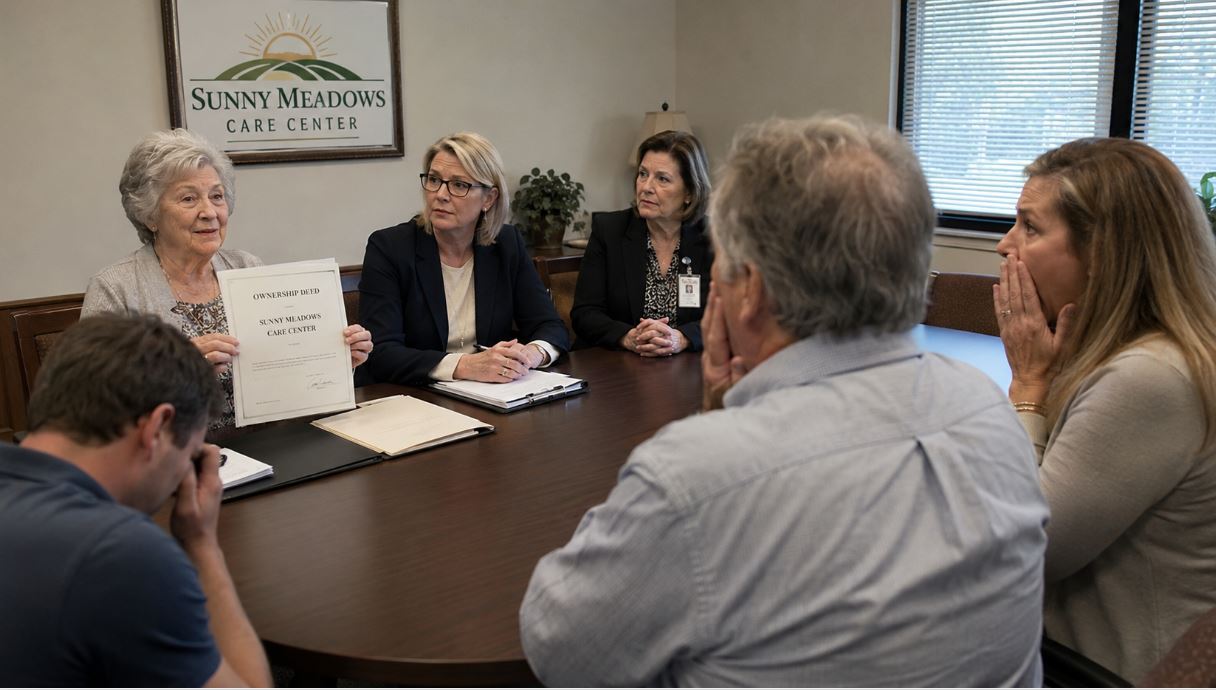
I answered.
“My proof of ownership.”
Marissa frowned.
“Ownership of what?”
I looked at both of them.
“Sunny Meadows.”
No one spoke.
Not Daniel.
Not Marissa.
Not even Kevin.
I let the silence do its work.
Then I said, “As of nine o’clock this morning, I own this facility.”
Marissa sat down on the edge of my bed like her legs had failed.
Daniel stared at the papers.
“That’s impossible.”
“No,” Ruth said. “It’s completed.”
He looked at me then.
Not like a son.
Like a man seeing a locked door where he expected an open safe.
“You bought a nursing home?”
“Yes.”
“With what money?”
I smiled.
That was the first moment I let him feel it.
“My money.”
Marissa whispered, “Mom…”
I looked at her.
“Your aunt Beatrice left me everything.”
Her face changed.
Beatrice had given the children birthday checks every year. Fifty dollars each. They sent thank-you texts half the time.
None of them had visited her in the last year of her life.
Not once.
Daniel found his voice.
“You hid seven million dollars from us?”
I tilted my head.
“How interesting that you know the amount.”
He looked trapped.
Marissa started crying.
“Mom, this isn’t fair.”
That sentence almost broke something loose in me.
Fair.
I thought of Mrs. Alvarez waiting for sons who sent flowers instead of themselves.
Mr. Patterson losing his store.
June dressing every Saturday for a grandson who never came.
I thought of my own suitcase in Daniel’s trunk.
My house papers marked with yellow tabs.
My children trying to turn my age into a weapon.
“No,” I said. “It isn’t fair. But not in the way you mean.”
Daniel stepped closer.
“Do you have any idea what you’re doing?”
“Yes.”
“You’re too old to run a facility.”
“I’m too old to be abandoned quietly. There’s a difference.”
Kevin made a sound that might have been a laugh or a sob.
I looked at him.
“Did you know about the notary?”
He shook his head.
“No.”
“Did you know they planned to question my competency?”
His eyes filled.
“No.”
Daniel snapped, “Don’t act innocent, Kevin.”
Kevin turned on him.
“I’m not acting innocent. I’m acting ashamed. You should try it.”
For once, Daniel had no reply.
Ruth handed me another paper.
I took it.
My hand did not shake.
“Sunny Meadows has a new family engagement policy,” I said.
Daniel blinked.
“What?”
I continued.
“Any family member seeking private administrative access, medical updates beyond standard consent, or estate-related meetings with a resident must maintain consistent personal contact with that resident unless the resident says otherwise.”
Marissa wiped her face.
“What does that mean?”
“It means no more disappearing for months and arriving with paperwork.”
Daniel’s voice was cold.
“You can’t force families to visit.”
“No,” I said. “But I can stop pretending neglect deserves the same access as care.”
Ruth added, “The policy is within resident-rights guidelines. It limits administrative privileges, not resident freedom. Residents may see whomever they choose.”
I looked at Daniel and Marissa.
“As for me, my visiting hours for the two of you are Sunday from two to four, by appointment, until I decide otherwise.”
Marissa began sobbing.
Daniel looked furious.
“You’re punishing us.”
I stepped closer to my son.
“No. I’m giving you what you gave me.”
He stared at me.
“Scheduled access.”
The words landed.
Kevin covered his mouth and looked away.
Daniel grabbed the papers from the bed.
“This won’t stand.”
Ruth calmly took them back.
“It already does.”
Mr. Howard cleared his throat.
“There is also the matter of your behavior toward a resident. If Mrs. Campbell requests it, you may be removed from the premises.”
Daniel looked at him with disbelief.
Yesterday, Mr. Howard would have rushed to please my son.
Today, he worked for me.
Power is not always loud.
Sometimes it is simply watching people realize they no longer hold the keys.
I did not have Daniel removed.
Not that day.
I wanted him to walk out by choice and feel the full weight of not being chased.
Marissa stood in the doorway, crying into a tissue.
“Mom, we were just scared.”
“No,” I said. “You were comfortable.”
She flinched.
“You liked knowing where I was. You liked not worrying about stairs, bills, meals, or whether I was lonely. You liked calling it safety because that sounded better than abandonment.”
Her shoulders shook.
“I’m sorry.”
I wanted to believe her.
But I had learned something in Sunny Meadows.
Sorry is not a repair.
It is only the first tool.
Daniel left without apologizing.
Marissa followed him.
Kevin stayed.
After the door closed, he sat in the chair beside my bed.
For a long time, he said nothing.
Then he whispered, “I should have stopped them.”
“Yes,” I said.
He nodded.
“I was afraid of Daniel.”
“So was I, for a while.”
He looked at me then.
“You?”
I smiled sadly.
“Children think mothers are made of walls. We are not. We are doors. We open too easily.”
Kevin began to cry.
Not loudly.
Not dramatically.
Just a grown man finally seeing the woman inside his mother.
“I’m sorry,” he said.
“I know.”
“Can I come tomorrow?”
I looked at him.
“Not because you feel guilty.”
He nodded.
“Because I want to.”
“Then come.”
The changes at Sunny Meadows began slowly.
I did not walk into the dining room and announce myself like a queen.
That would have been ridiculous.
Instead, I hired a proper director of care.
Raised wages.
Repaired the roof.
Changed the food vendor.
Added two more aides to the evening shift.
Put fresh paint on the walls, but not that awful hospital beige.
Residents got choices again.
Real choices.
When to eat breakfast.
What to plant in the garden.
Which activities were worth keeping and which were insulting.
“Not every old person wants bingo,” June said at the first residents’ meeting.
So we added a book club.
A music night.
A repair workshop where Mr. Patterson taught two teenagers how to fix lamps.
Mrs. Alvarez started a Sunday cooking group and nearly got us shut down by arguing with the dietitian about salt.
Sunny Meadows began to feel less like a place people were sent.
More like a place people still lived.
The family policy caused trouble, of course.
Families complained.
Some said we were shaming them.
Maybe we were.
But we did it carefully.
Legally.
Humanely.
No resident was punished for being neglected.
No family was banned for being busy.
But if someone had not visited in six months and then arrived demanding medical records, financial signatures, or private meetings about selling property, the answer was no.
Not without the resident’s chosen advocate present.
Not without proper consent.
Not behind closed doors.
The first time Mrs. Alvarez’s oldest son was told he could not discuss her bank account without her attorney present, she cried at dinner.
I asked if she was upset.
She said, “No. I think I just remembered I’m still alive.”
That became the sentence I carried with me.
Still alive.
That was what my children had forgotten.
Old does not mean gone.
Quiet does not mean empty.
Dependent does not mean owned.
Three months after I bought Sunny Meadows, Daniel requested a Sunday visit.
I almost refused.
Then I remembered my own rule.
Accountability, not revenge.
He arrived at 2:07 p.m.
Late.
But without papers.
That was progress.
He looked thinner.
Less polished.
Marissa came with him, holding a small bouquet of tulips.
My favorite.
I had never told her they were my favorite.
Her father had.
Maybe she remembered more than I thought.
Kevin was already there, helping Mr. Patterson adjust a loose wheel on his walker.
Daniel noticed.
“So now you work here?” he said.
Kevin looked up.
“Volunteer.”
Daniel gave a small scoff.
But weaker than before.
We sat in the garden.
For a while, no one knew how to speak.
Then Marissa said, “I went by the house.”
My body tensed.
She quickly added, “Just to check the outside. The gutters needed clearing. I hired someone. I paid for it.”
I stared at her.
She looked embarrassed.
“I should have done that before.”
“Yes,” I said.
Her eyes filled, but she nodded.
Daniel leaned forward.
“Mom, I was wrong.”
I looked at him carefully.
He looked like those words had cost him.
Good.
“About what?” I asked.
He swallowed.
“About the house. About the papers. About… thinking I knew better than you.”
I waited.
He looked at the table.
“And about using your age against you.”
There it was.
Not a perfect apology.
But a real sentence.
Marissa cried quietly.
Kevin stared at his hands.
I looked at my children.
All three of them.
They were not villains.
That would have been easier.
They were ordinary people who had let convenience harden into cruelty.
They loved me, I think.
But love that does not show up becomes theory.
And I was done living on theory.
“I am still angry,” I said.
Daniel nodded.
“You should be.”
“I am still hurt.”
“I know.”
“No,” I said. “You don’t. But maybe you are beginning to.”
He looked at me then.
Really looked.
For the first time in months, I felt seen by my oldest son.
Not as a problem.
Not as an account.
Not as a house.
As his mother.
We did not fix everything that day.
Families do not heal like broken cups.
There is no glue strong enough to make the cracks disappear.
But sometimes, if people are willing, the cracks become places where truth can finally breathe.
A year later, I still own Sunny Meadows.
I still live there too, though not because anyone put me there.
Because I choose to.
I kept my house.
The yellow curtains are still in the kitchen.
Kevin checks on it every Friday.
Marissa brings her children twice a month, and they help Mrs. Alvarez in the garden.
Daniel visits every Sunday from two to four.
At first, because those were the only hours I allowed.
Now, because he keeps them free.
Sometimes he stays until five.
Sometimes I let him.
The rule changed many families.
Not all.
Some children stayed absent.
Some only came long enough to complain.
Some residents decided they did not want visits from people who made them feel small.
That was their right.
But many families came back differently.
With less paperwork.
More patience.
More listening.
They learned that visiting an elderly parent is not about checking a box.
It is about remembering that the person in the chair once stood in doorways waiting for you to come home.
One afternoon, June’s grandson finally came.
He was seventeen, tall, awkward, and ashamed.
He brought grocery-store flowers and stood in her doorway like a boy facing a judge.
June looked at him for a long time.
Then she said, “You’re late.”
He started crying.
She held out her hand.
“Yes,” she said. “But you’re here now.”
That is the balance I have tried to learn.
Boundaries without bitterness.
Accountability without closing every door forever.
I do not believe every neglectful child is evil.
But I do believe neglect should stop being comfortable.
As for my children, we are still learning.
Daniel once asked me if I bought Sunny Meadows to punish him.
We were sitting in the garden, watching Marissa’s youngest teach Mr. Patterson how to use a tablet.
I thought about lying.
Then I decided I was too old for that.
“At first,” I said, “a little.”
He nodded.
“And now?”
I looked across the lawn.
At June laughing.
At Kevin carrying a box of donated books.
At Marissa wiping dirt from her daughter’s cheek.
At the building that once felt like the end of my life and had somehow become the place where I got it back.
“Now,” I said, “I think I bought it because everyone here deserved a witness.”
Daniel was quiet.
Then he said, “Including you.”
I looked at him.
“Yes,” I said. “Including me.”
He reached for my hand.
This time, the squeeze did not feel like a lid closing.
It felt like a son asking permission.
I gave it.
Not everything.
Not the house.
Not control.
Not instant forgiveness.
Just my hand.
That was enough for that day.
People think growing old means needing less.
Less space.
Less say.
Less privacy.
Less future.
They are wrong.
The older you get, the more fiercely you understand what remains.
Your name.
Your home.
Your choices.
Your dignity.
The right to say no.
The right to be visited not out of guilt, but out of love.
My children brought me to Sunny Meadows because they thought it would make their lives easier.
They thought I would shrink quietly into a room with one chair and a lighthouse print on the wall.
They thought my story had moved into its final chapter.
They were wrong.
They had not brought me to the end.
They had brought me to the place where I finally remembered my own power.
And the next time a son or daughter walks through these doors with papers in one hand and fake concern in the other, they will learn what my children learned.
Old does not mean helpless.
Mother does not mean property.
And no one gets to abandon a parent all week, then arrive on Sunday pretending love is just a signature away.