My Son Said Find Your Own Place After 50 Years — So I Sold the House and Moved to Monaco
Chapter 1: Someone My Age
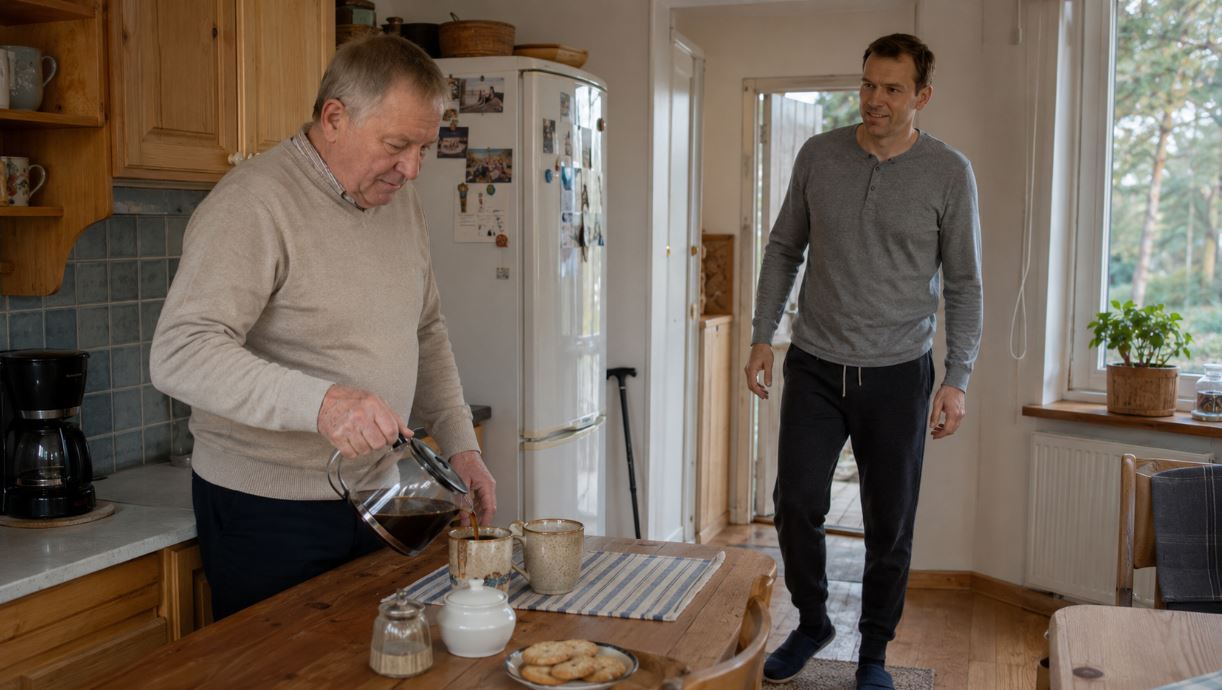
My son told me to find my own place on a Wednesday morning, while the coffee was still hot and the house still smelled faintly of the cinnamon rolls I had baked for him the night before.
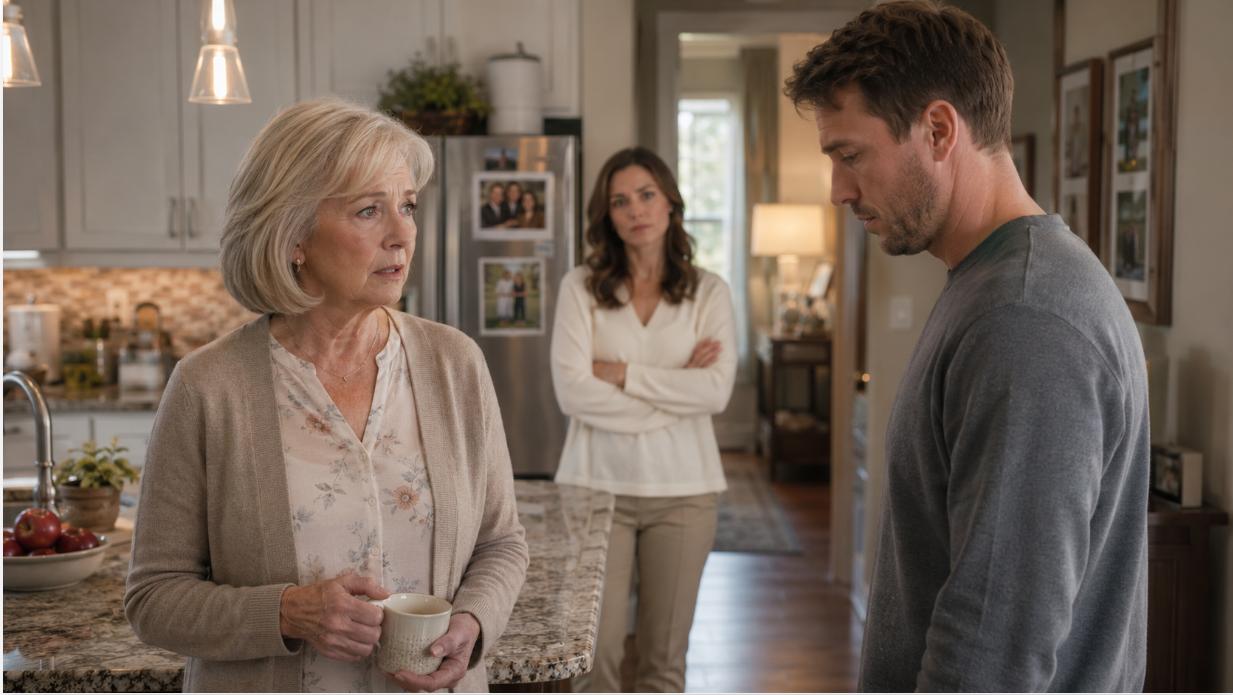
He did not say it cruelly at first. That was what made it worse. Marcus stood in my kitchen in his expensive gray sweatshirt, one hand wrapped around the mug I had poured for him, and looked at me with the careful expression people use when they have already made a decision but want you to believe you are part of it. Behind him, my daughter-in-law Isabelle stood near the doorway, arms folded, her blonde hair pulled back neatly, her face arranged into sympathy.
“Mom,” Marcus said, “maybe it’s time you found your own place.”
For a moment, I thought I had misunderstood him. I was sixty-eight years old, not helpless. I still taught piano lessons twice a week, volunteered at the animal shelter, grew tomatoes every summer, and walked three miles most mornings unless the weather was impossible. The house we were standing in was the same four-bedroom colonial where I had raised him, the same house where my husband David and I had spent nearly thirty years painting rooms, repairing floors, planting roses, and building the kind of ordinary life that only looks small to people who have never had to work for one.
“My own place?” I asked.
Marcus set his mug down. “Somewhere easier. Smaller. More appropriate.”
There it was. That word people use when they want to make removal sound like kindness.
Isabelle stepped forward as if she had been waiting for her part. “There are some lovely senior communities nearby, Geneva. Not nursing homes or anything depressing. Just places with activities, meals, people your own age.”
People my own age.
She said it gently, but it landed like a slap. Isabelle was thirty-three and had been living in my house rent-free for eighteen months while she and Marcus “saved for their future.” Her designer creams filled the vanity that had belonged to my grandmother. Her yoga mats leaned in the corner where my sewing table used to sit. Her mail came to my address, her groceries filled my refrigerator, and now she was standing in my kitchen explaining that I needed to be placed among people my own age.
“This is my home,” I said quietly.
Marcus looked away.
Isabelle did not.
“Well,” she said, “technically, isn’t it in Marcus’s name now? After your husband passed?”
My throat tightened.
David had died five years earlier from a heart attack so sudden that for months I still caught myself setting out two coffee cups in the morning. After the funeral, there had been meetings with lawyers, insurance papers, trust documents, and signatures I barely remembered because grief had made the world feel underwater. Marcus had come with me to some appointments. He had held my hand. He had told me not to worry about the details.
“Dad wanted everything simple,” he had said then. “I’ll help take care of you.”
At the time, I believed him.
Now he was looking at the counter instead of my face.
“It’s not like we’re throwing you out,” he said. “We just think it’s time. Isabelle and I want to start a family, and we need room to build our own life.”
“This house has four bedrooms.”
“Mom.”
That single word carried years of impatience. The teenage sigh. The adult correction. The reminder that I was supposed to understand his needs before he had to explain them.
“We can’t live with my mother forever,” he said.
“Then move out,” I replied.
He stared at me as if I had said something absurd.
“This is my inheritance.”
I looked at my son, my only child, and felt something cold and clear settle inside me. Not rage. Not yet. Rage is hot and messy. This was quieter. This was the moment you realize the child you raised has begun counting what he will receive while you are still alive.
“I see,” I said.
Relief crossed his face too quickly. “I knew you’d understand. We’ll help you look. Isabelle already found a place called Sunrise Manor. It’s only twenty minutes away.”
“You already looked?”
Isabelle smiled. “Just to make it easier for you.”
Of course.
They had researched where to put me before asking whether I wanted to go.
“How long do I have?” I asked.
Marcus hesitated. “End of the month?”
It was January fifteenth.
Two weeks to pack up thirty years.
Two weeks to leave the kitchen where I had taught him to make pancakes, the staircase where we had measured his height in pencil marks, the garden where David’s ashes were scattered beneath the white roses.
I nodded.
Marcus smiled then, the way he did as a boy when he thought a difficult thing had gone his way.
“You’re the best, Mom.”
I picked up my coffee and looked out the kitchen window at the winter garden, bare and sleeping under a thin sheet of frost.
“Yes,” I said. “I’ll start making arrangements.”
They thought that meant senior living.
It did not.
Chapter 2: The House David Built With Me
David and I bought the house in 1994 for eighty-five thousand dollars and more optimism than sense.
The porch sagged. The upstairs bathroom leaked into the pantry. The kitchen had orange countertops so ugly that even the real estate agent apologized when she showed them to us. But David stood in the backyard, hands on his hips, looking at the overgrown garden like it was already blooming.
“We can make something here, Genie,” he said.
Everyone called me Genie then. David started it, saying I had a habit of making impossible things appear: dinner from an empty pantry, Halloween costumes from old curtains, peace between two arguing neighbors. I liked the nickname because it sounded like a woman who could fix things. For most of my life, that was exactly who I tried to be.
We fixed the house slowly. Not with sudden money, but with weekends, tax refunds, borrowed tools, and stubbornness. David sanded the floors one room at a time. I stripped wallpaper, painted trim, planted perennials, and learned the difference between repairs that could wait and repairs that could not. When Marcus was little, he would follow his father around with a plastic toolbox, serious as a supervisor.
“This will be yours one day,” David told him once, tapping the porch railing.
I remember correcting him. “Ours first.”
David laughed and kissed my forehead. “Ours first.”
That mattered to me.
The house was never just property. It was scraped knuckles and late-night bills spread across the kitchen table. It was Marcus losing his first tooth in the upstairs hallway, breaking his arm falling out of the maple tree, bringing home report cards, prom dates, college brochures. It was David dancing with me barefoot in the kitchen after the dishwasher finally worked. It was grief too, of course. Every house that holds love eventually holds grief. But even after David died, I stayed because the walls still carried his voice.
Marcus and Isabelle moved in eighteen months before that Wednesday morning.
At first, I welcomed it. Marcus said they were saving for a house of their own. Isabelle said the rental market was impossible. I told them the guest room was theirs as long as they needed it.
The guest room became their bedroom. My sewing room became Isabelle’s dressing space. The basement shelves where I kept holiday decorations became storage for their gym equipment and unopened furniture boxes. They never asked outright to take over. They simply spread, slowly and confidently, the way water spreads under a door.
At first, I made excuses.
Young couples need space.
The economy is hard.
It is good not to be alone.
But soon I was cooking for three every night. Their laundry appeared in the hamper with mine. Their friends came over on weekends, and I found myself staying upstairs because the living room felt like it belonged to them. Isabelle started making comments about “updating the energy of the house.” Marcus laughed when she called my furniture “sentimental farmhouse.”
“It’s just her style,” he said when I looked hurt.
Then came the morning I walked into my old guest room and found Isabelle placing makeup across my grandmother’s vanity.
“That vanity is delicate,” I said.
“Oh, don’t worry,” she replied without looking up. “I’m careful with antiques.”
Antiques.
Like the vanity.
Like the house.
Like me.
By the time Marcus told me to leave, I realized they had not simply moved in.
They had been waiting me out.
Chapter 3: The Papers
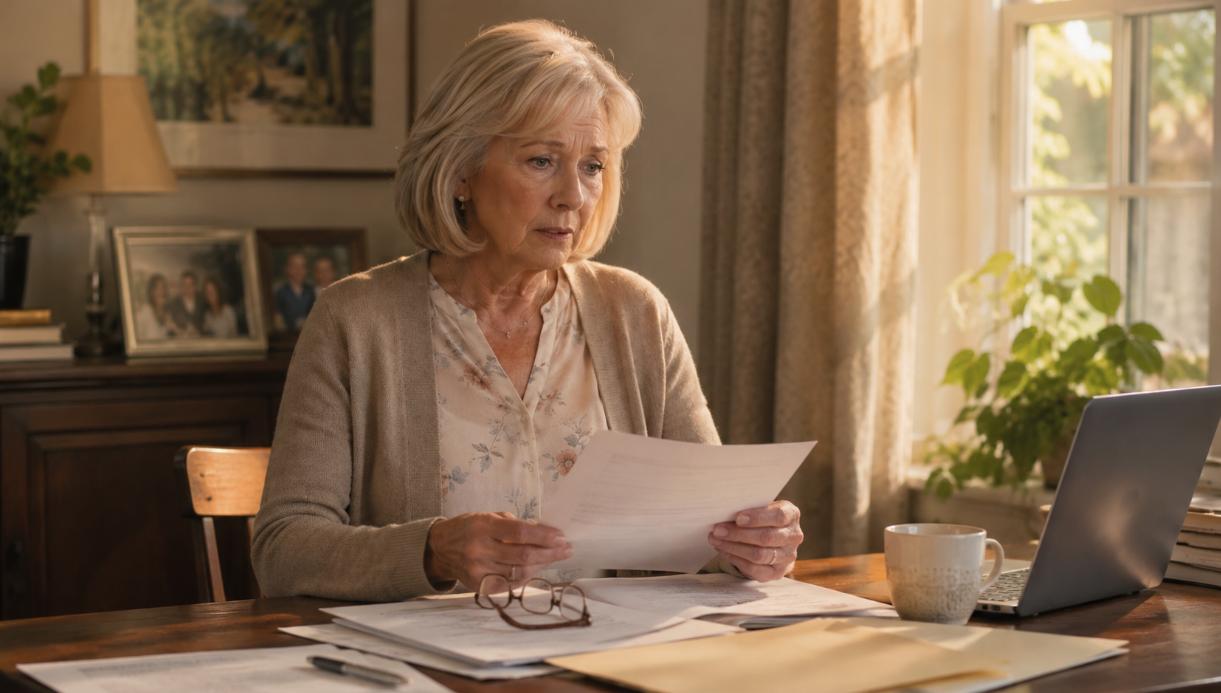
After Marcus and Isabelle left for the gym that morning, I sat alone at the kitchen table and let myself shake.
Only for a minute.
Then I wiped my face, opened my laptop, and pulled out the folder David’s attorney had given me after the funeral. It had been in the bottom drawer of the secretary desk for five years, along with insurance papers, tax records, and letters I had never had the heart to reread.
I spread everything across the table.
The trust documents were not simple, but they were clearer than I expected. David had placed the house into a revocable living trust years before he died. I was the surviving trustee. Marcus was the beneficiary after my death, and successor trustee only if I became incapacitated or died. There had been no transfer of ownership to him while I was alive.
No matter what Isabelle believed.
No matter what Marcus wanted to believe.
The house was not his.
Not yet.
I called Richard Chen, our financial adviser. He had worked with David for more than twenty years and still sent me polite quarterly summaries I usually skimmed and filed away.
“Genie,” he said warmly. “How are you?”
“I need to know exactly what I own.”
There was a pause.
“Is everything all right?”
“For the first time in a while,” I said, “I think it might be.”
I met Richard that afternoon in his downtown office, wearing the navy dress David always loved and the pearl necklace he gave me for our twentieth anniversary. Richard walked me through the numbers slowly: life insurance, the proceeds from David’s construction business, retirement accounts, investments, savings, the trust, the house.
When he finished, I stared at the final figure on the screen.
“Two point one million?” I said.
“Approximately. More if the house sells well.”
I sat back in the leather chair.
For five years, I had lived carefully, almost fearfully, as if widowhood required shrinking. I clipped coupons, repaired things instead of replacing them, and told myself I was being practical. Marcus looked at my simple life and decided I needed managing. Isabelle looked at my thrift and decided I had no choices.
David, it turned out, had left me more choices than I had allowed myself to see.
“Richard,” I said, “can I sell the house?”
He turned serious.
“As trustee, yes. It remains within your authority. Marcus has no ownership interest while you are alive unless you voluntarily give it to him.”
I closed my eyes for one second.
It felt like breathing after being underwater.
“I want to sell.”
Richard did not argue. He asked only one question.
“Because you need the money?”
“No,” I said. “Because I need my life back.”
That evening, I called Jennifer Morrison, a real estate agent who had sold three houses on our street in the past year. She came the next morning with a measuring tape, a tablet, and the careful politeness of someone entering a home full of memories.
“This house is beautiful,” she said after walking through each room. “You’ve taken exceptional care of it.”
“I loved it,” I said.
She looked up.
“Past tense?”
I looked toward the staircase, where Marcus’s childhood height marks were still faintly visible on the trim.
“Yes,” I said. “Past tense.”
Jennifer estimated the value between four hundred and thirty and four hundred and sixty thousand. More than five times what David and I had paid. She thought we could list quickly and attract cash buyers if I was serious about moving fast.
“I am serious.”
“How fast?”
“Before the end of the month.”
Her eyebrows rose, but she did not pry.
By Friday morning, the house was on the market.
Marcus and Isabelle thought I was touring senior living facilities.
In a way, I was touring my future.
Just not the one they had chosen for me.
Chapter 4: Offers
The showings began on Saturday.
Marcus went golfing. Isabelle went to Pilates and brunch. Neither of them noticed the fresh flowers on the table, the polished floors, or the way I had quietly boxed up personal photographs before strangers walked through our rooms.
The first couple was young with a baby. They loved the porch and the school district but looked frightened by the size of the garden. The second was an investor, polite but cold, measuring everything with his eyes. The third couple arrived near sunset, when the whole house turned honey-colored and the windows reflected the winter sky.
Their names were Carol and Dennis Henderson.
They were in their early fifties, maybe older, with kind faces and careful hands. Carol stopped in the kitchen and touched the butcher block island gently.
“Someone cooked here,” she said.
“I did.”
Dennis looked out at the garden. “And someone loved those roses.”
“My husband and I planted them together.”
Carol looked at me then, not as a buyer looking at a seller, but as one woman recognizing another.
“You must have been happy here.”
“I was.”
I had not expected to say it out loud.
That night, Jennifer called.
“They want to make an offer.”
“The Hendersons?”
“Yes. Cash. Above asking. Four hundred sixty-five thousand. They included a letter.”
I sat at the kitchen table with the phone pressed to my ear while Marcus and Isabelle watched television in the living room, laughing at something loud and stupid. Jennifer read the letter to me.
The Hendersons wrote that they felt the house had been cared for, not just maintained. They said they hoped to keep the garden alive, restore the porch swing, and make the home welcoming for their grown children and future grandchildren. Carol had asked if I would leave notes about the roses.
I put my hand over my mouth.
“Genie?” Jennifer asked.
“I’m here.”
“Do you want to accept?”
I looked around the kitchen. The chipped mug near the sink. The pencil marks on the door frame. The herb pots catching the last of the evening light. The place I had once believed would hold me until the end.
Then I heard Isabelle say from the other room, “Once she’s out, I want to rip out that wallpaper immediately.”
I closed my eyes.
“Yes,” I said. “Accept.”
The closing could happen in two weeks.
Exactly the amount of time Marcus had given me to remove myself from his plans.
The next days moved with strange calm. I sorted what to keep, what to donate, what to sell. I kept David’s watch, our photo albums, my grandmother’s china cabinet, two boxes of books, my piano music, and the oil painting David commissioned for our twenty-fifth anniversary. I let the rest go.
Letting go was easier than I expected.
Furniture is not memory.
Wallpaper is not marriage.
A house can hold love, but it cannot replace being loved.
Helen, my neighbor and closest friend, came over with wine after she saw Jennifer’s sign go up briefly for inspection photos.
“Tell me you didn’t lose your mind,” she said.
“I found it.”
I told her everything: Marcus’s words, Isabelle’s plans, the trust, the offer, the closing, the apartment I had found near the Mediterranean.
“Monaco?” she said, blinking.
“Technically a rental first. Near the harbor. Month to month.”
She stared at me for three seconds.
Then she raised her glass.
“To Geneva Walsh,” she said, “who apparently had a whole second act hiding under those cardigans.”
I laughed so hard I cried.
For the first time since David died, I cried from something other than loneliness.
Chapter 5: The Morning They Found Out
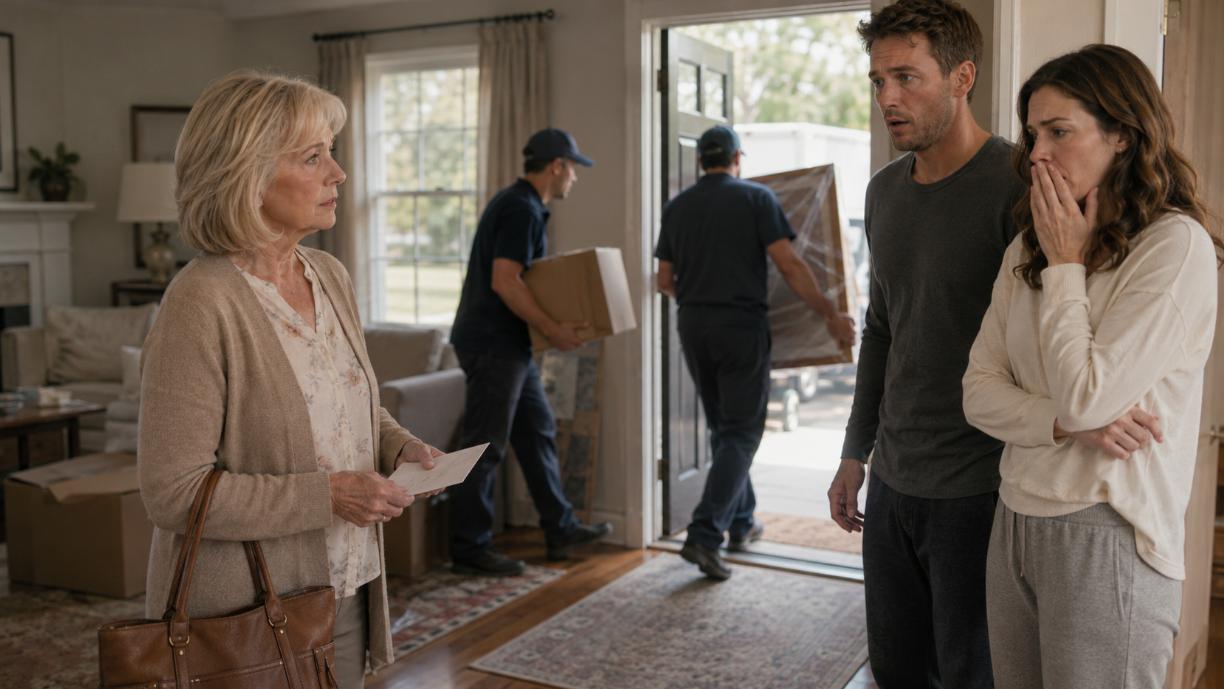
The movers came at seven on January thirty-first.
Marcus and Isabelle had returned late from a weekend spa trip in Vermont, one last little escape before they expected their “new life” to begin. They were still asleep when the truck pulled into the driveway. I had arranged everything carefully: the pieces I wanted were marked with yellow tape, the boxes were numbered, and the rest had already been sold, donated, or left for the Hendersons by agreement.
The movers worked quietly.
By eight-thirty, my grandmother’s china cabinet was gone. By nine, David’s painting was wrapped and loaded. By nine-thirty, the house had that strange echo empty rooms get when they are no longer pretending to belong to the people inside them.
I made coffee in the kitchen one last time.
Marcus came downstairs in pajama pants, rubbing his face.
“Mom?” He looked around. “Where’s the table?”
“On its way to storage in Nice.”
He blinked. “Nice?”
“France.”
Isabelle appeared behind him in a robe, her face still soft from sleep but sharpening quickly. “What’s going on?”
I placed two envelopes on the counter.
“One for each of you.”
Marcus did not take his at first.
“Mom.”
“You told me to find my own place,” I said. “I did.”
Isabelle tore open her envelope first. Her eyes moved fast across the page. Marcus opened his more slowly, as if delay might change the words inside.
“You sold the house?” he whispered.
“Yes.”
“You can’t sell the house. It’s mine.”
“No, Marcus. It was never yours while I was alive. You were the beneficiary after my death. I was the trustee. I confirmed everything with Richard and the attorney.”
His face went pale.
“But Dad said—”
“Your father said this would be yours one day. Not this day.”
Isabelle’s voice rose. “Where are we supposed to go?”
There it was. Not Where will you go, Geneva? Not Are you safe? Not How could we have made you feel this unwanted?
Where are we supposed to go?
I picked up my purse.
“You are both employed adults. I imagine you will do what you expected me to do. Find your own place.”
Isabelle stared at me like I had struck her.
Marcus sank into the chair by the counter. “Mom, please. We can talk about this.”
“We did talk. You told me I had two weeks.”
“I didn’t mean it like that.”
“You meant it exactly like that. You had already picked Sunrise Manor. Isabelle had already planned to redecorate. You decided my life was in your way and called it concern.”
His mouth opened, but no words came.
For one moment, I saw him not as the man in front of me, but as the little boy with scraped knees who used to run into my arms after school. That was the hardest part. People think walking away from cruelty feels clean. It does not. It feels like carrying love in one hand and self-respect in the other, knowing you cannot drop either one.
“I love you,” I said.
His eyes filled.
“Then don’t go.”
“I love you too much to keep teaching you that I can be discarded without consequence.”
A car horn sounded outside. My taxi to the airport.
Isabelle wiped at her face, angry tears streaking her makeup. “You’re really leaving us like this?”
I looked at her carefully.
“No. I am leaving because of this.”
Marcus followed me to the front door.
“Where are you going?”
“Monaco first. Maybe Nice. Maybe somewhere else after that. I haven’t decided.”
“You don’t know anyone there.”
“I’ll meet people.”
“You don’t speak French.”
“I’ll learn.”
“What if you hate it?”
“Then I’ll choose again.”
He looked lost in a way I had not seen since David died.
“I’m sorry,” he whispered.
“I believe you are.”
“Is that enough?”
I touched his cheek because he was still my son.
“No.”
Then I stepped onto the porch David and I had repaired with our own hands, walked down the steps, and got into the waiting car.
As we pulled away, Marcus stood in the doorway of the house he thought he owned, and for the first time in years, I did not feel responsible for solving the problem on his face.
Chapter 6: My Own Place
I arrived in Monaco the next morning after flying into Nice and taking a taxi along the coast.
The road curved beside the sea, and every turn opened into blue water, pale buildings, red roofs, and sunlight that seemed to belong to another life. I sat in the back seat with my hands folded over my purse, feeling both terrified and absurdly alive. The driver told me about villages we passed. I understood half of it and smiled at all of it.
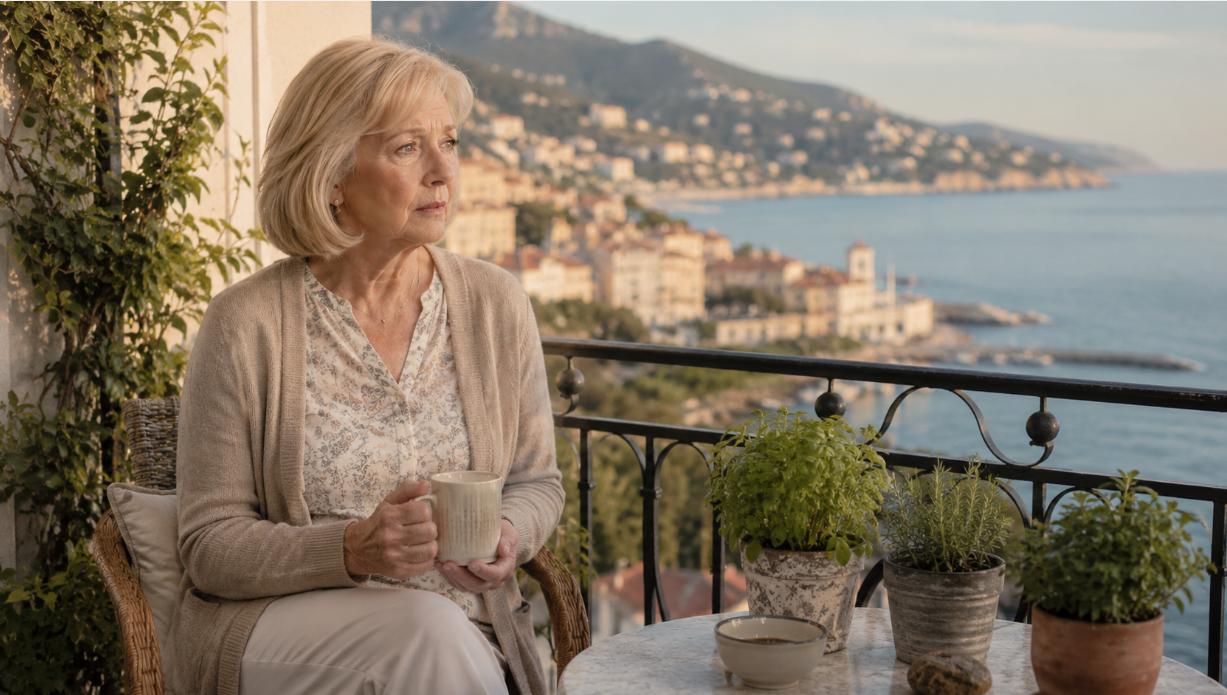
My apartment was on the fourth floor of an older building near the harbor. It was not a palace. It did not need to be. It had tall windows, herringbone floors, a small kitchen, and a terrace just wide enough for a table, two chairs, and a row of potted herbs. When the agent opened the French doors, I stepped outside and saw the Mediterranean glittering below like something God had polished just for the morning.
For a long time, I said nothing.
The agent, Celeste, smiled.
“Madame Walsh?”
“It’s perfect,” I said.
That first week, I learned small things. How to order coffee. Which shop sold the best bread. How to use the elevator without fumbling the key. Where the nearest pharmacy was. I got lost twice and cried once, not because I was sad, but because starting over at sixty-eight requires humility and good shoes.
Marcus called every day for the first week.
I let the calls go to voicemail.
His messages changed. First panic. Then anger. Then apology. Then silence.
Three months later, I answered.
“Mom,” he said, and his voice sounded older.
“Hello, Marcus.”
He told me Isabelle had left. Not divorced yet, but gone to her parents because “the stress was too much.” He was renting a one-bedroom apartment and trying to pay down debt he had not admitted existed when he lived under my roof. He did not ask for money. That surprised me.
“I want to understand,” he said. “Not argue. Understand.”
So I told him.
I told him what it felt like to be discussed as if I were furniture. What it felt like to hear “someone your age” from people living off my kindness. What it felt like to realize my son saw his inheritance more clearly than he saw his mother.
He cried.
I did not soften the truth for him.
But I did not punish him with it either.
“I love you,” I said. “But if we rebuild anything, it will be as two adults who respect each other. I will not be your fallback plan.”
“I know,” he said. “I’m learning that.”
Six months after I left, Marcus came to visit. He stayed in a modest hotel because he had saved for the trip himself. We walked by the harbor, ate dinner at a small restaurant, and talked more honestly than we had in years.
He was thinner. Quieter. Humbled by life in ways I would not have chosen for him but maybe he needed. He told me he had started therapy. He told me he had accepted a promotion in another state. He told me he was learning the difference between loving someone and assuming they would always absorb your mistakes.
On his last morning, he stood on my terrace with coffee in both hands and looked out at the sea.
“I thought I was pushing you into a smaller life,” he said.
I smiled.
“You pushed me out of one.”
He looked at me then.
“Are you coming back?”
I watched the sunlight move across the water.
“Not to the life I had.”
He nodded.
“That’s fair.”
After he left, I bought the apartment.
Not because Monaco was a fantasy. Not because I needed to prove anything. But because the first morning I woke there, I did not feel like someone waiting to be needed. I felt like someone living.
That was new.
That was enough.
Chapter 7: What I Took With Me
People ask if I miss the house.
Of course I do.
I miss the kitchen in the early morning. I miss David’s roses. I miss the sound of rain on the porch roof and the way the stairs creaked on the fifth step. I miss the version of Marcus who still believed I could fix anything.
But missing something does not mean you belong there.
The Hendersons send me pictures of the garden now. Carol asks about pruning the roses and whether the rosemary survives winter if cut back too hard. Their grandchildren drew chalk flowers on the driveway last spring. When I saw the photo, I cried a little. Not because they had taken my place, but because the house was still being loved.
That is what houses deserve.
That is what people deserve too.
I did not move to punish my son. I moved because staying would have punished me. There is a difference.
At sixty-eight, I learned that being a mother does not mean handing over the rest of your life before you are finished living it. It does not mean shrinking so your children can feel large. It does not mean accepting disrespect because someone says the word “family” after hurting you.
Marcus and I are rebuilding slowly. Some weeks we talk. Some weeks we do not. He knows I will always love him, but he also knows love no longer comes with free housing, automatic forgiveness, or permission to treat me like a problem to manage.
I still teach piano, though now my students are two French children from the building and one retired Englishman who always apologizes before playing the wrong notes. I still grow herbs in pots on my terrace. I still volunteer, this time with a small rescue group that brings abandoned dogs from shelters outside the city.
Life did not become perfect.
It became mine.
Some evenings, I sit outside with a glass of wine and watch the harbor lights turn on one by one. The sea gets dark. The city glows. Somewhere below, people are arriving, leaving, beginning again.
David and I used to joke about Monaco when bills were tight and winter was long.
“When we’re rich,” he would say, “we’ll drink champagne by the Mediterranean.”
I used to laugh and tell him we were rich already because the roof didn’t leak and Marcus had finally passed algebra.
Maybe we were both right.
The first night I opened a bottle of champagne on my terrace, I poured two glasses. One for me. One for David. I raised mine toward the dark water and whispered, “I found my own place.”
The wind moved through the herbs.
For a moment, I could almost hear him laughing.
My son thought he was sending me away.
He did not know he was setting me free.