CHAPTER ONE: THE KEY
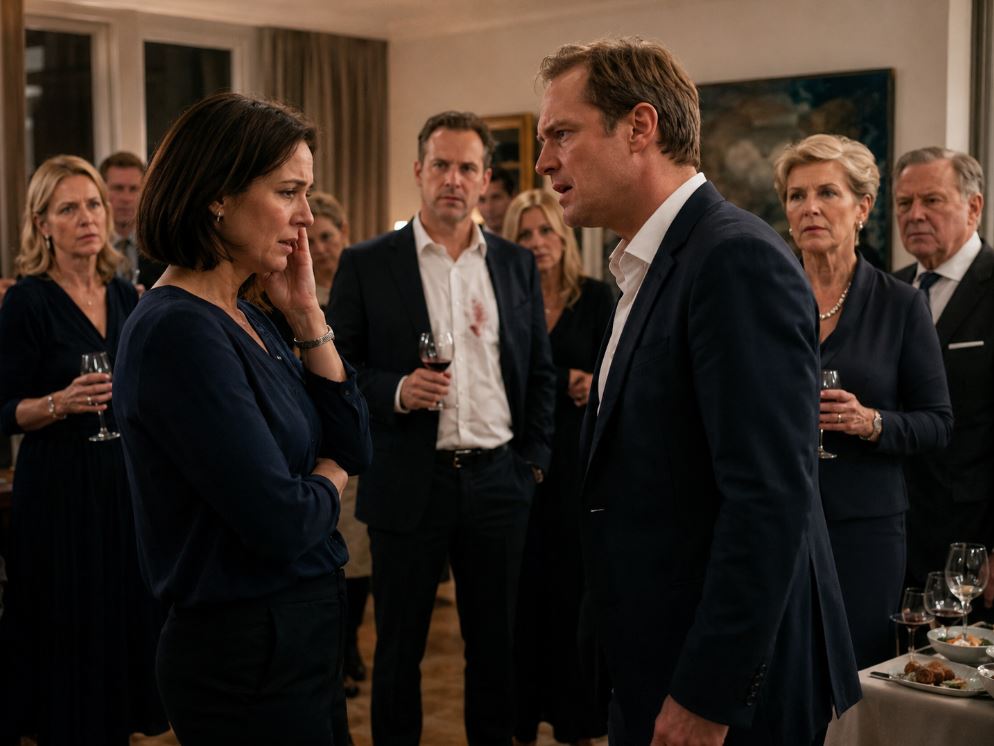
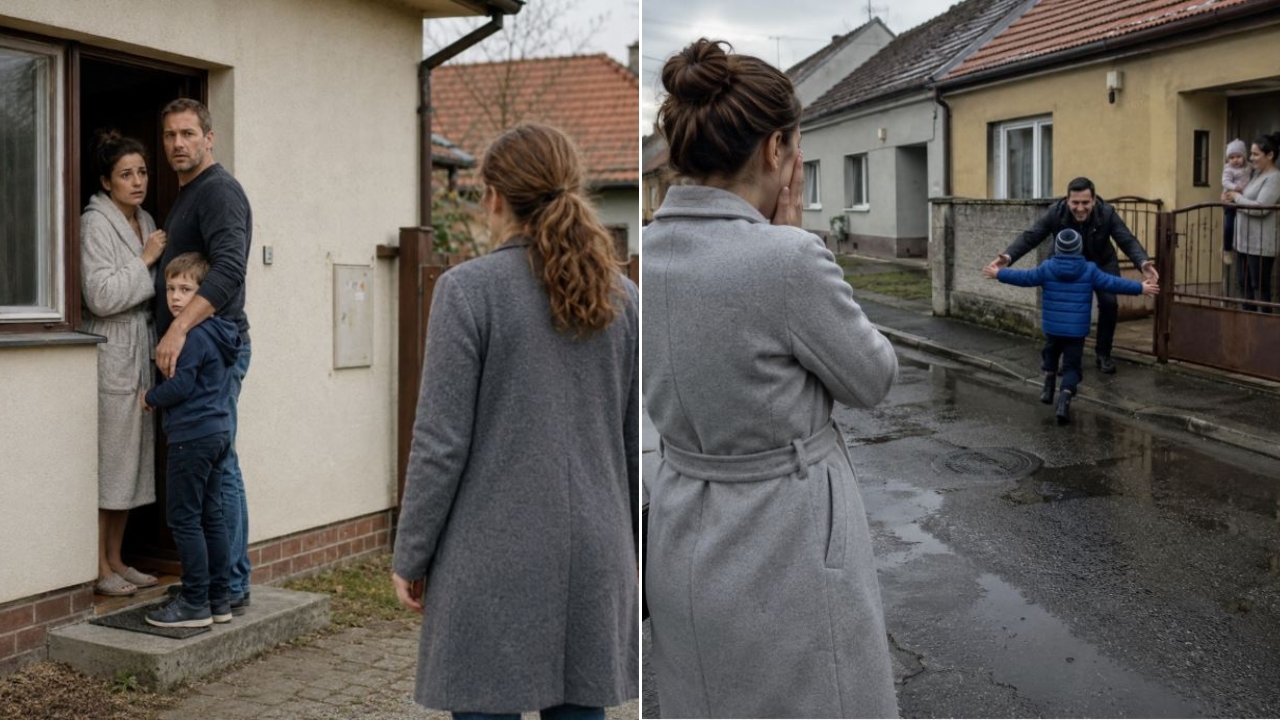
Six weeks after my father died, I was still sleeping in the guest room of the house where I grew up. I had not planned to stay that long, but grief has a way of making even simple decisions feel impossible. My stepmother, Lorraine, had made it clear that she wanted the house to herself again. She did not say it directly at first, but the message was there in the shorter conversations, the closed doors, and the way she began referring to the house as “her home.” I was thirty-one years old, recently unemployed, and still trying to understand how quickly a person could disappear from a family after dying.
My father, Owen, had always been the person I called when something went wrong. He was the one who knew how to fix a leaking faucet, restart an old truck, and make an ordinary problem seem manageable. When he died, I discovered how many small things in my life had quietly depended on him. The car needed an oil change. A bill was overdue. The back door would not close properly. None of those things were serious, but every one of them reminded me that I could no longer call him.
Then came the reading of his will.
The estate attorney, Mr. Pelham, sat at the dining room table with a folder in front of him. Lorraine sat across from me. I remember the room feeling colder than it actually was. The house, the savings, the truck, and nearly everything else went to Lorraine as the surviving spouse. I had expected that. My father and Lorraine had been married for years, and I had never assumed I would inherit his home.
Then Mr. Pelham read the final item.
A half-acre property on Garnet Creek Road, including “whatever structure stands upon it.”
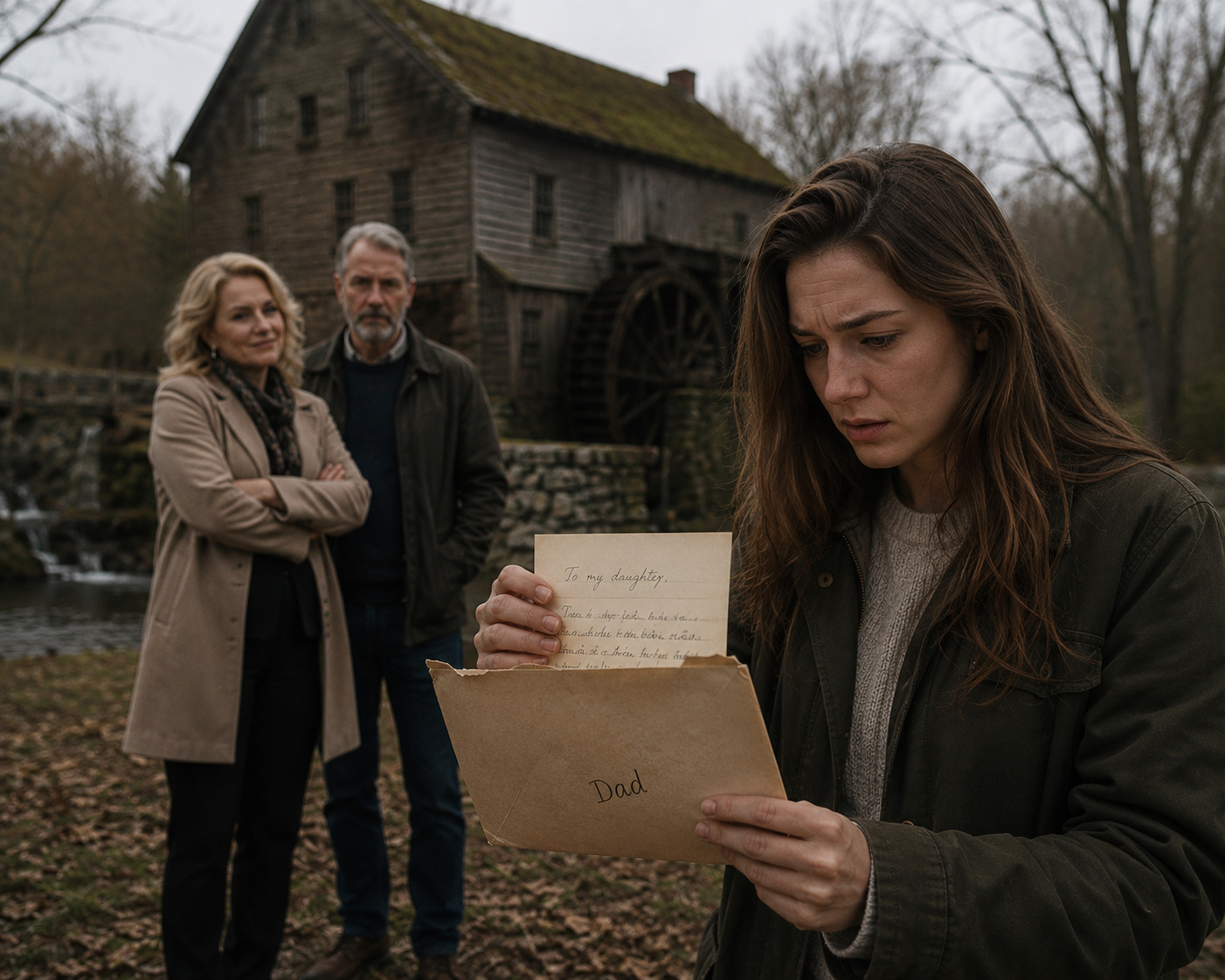
The property was an old stone mill.
Lorraine looked at me for the first time that afternoon.
Then she reached into her purse and pulled out an iron key.
She placed it on the table between us.
“You can have the mill,” she said.
The way she said it made it clear she believed she was giving me something nobody wanted.
“It isn’t worth anything,” she added. “It’s just an old building and a broken water wheel.”
I looked at the key.
Then I looked at her.
And I took it.
CHAPTER TWO: THE PLACE EVERYONE HAD FORGOTTEN
The mill was about twenty minutes from the house, down a narrow road that followed Garnet Creek through the countryside. I had been there as a child, but I had not visited in years. My father had always been interested in old buildings, and when I was young, he occasionally took me there on weekends.
I remembered the creek.
I remembered the trees.
I remembered the large wooden wheel outside the building.
What I did not remember was my father spending so much time there.
According to Lorraine, he had “played around with that old place” for years.
That was the phrase she used.
She said he had always collected things.
She said he had a habit of spending money on objects that other people would have thrown away.
She said the mill was full of old junk.
At the time, I did not argue.
I had no reason to think she was wrong.
My father had always been fascinated by old tools and machinery. He could spend an entire afternoon looking at a piece of equipment that I would have walked past without noticing. He would tell me how old it was, who might have made it, and what people once used it for.
I rarely understood what he saw.
I simply liked listening to him talk.
After the will reading, I drove to the mill for the first time in years.
The iron key turned in the lock.
The door opened with a long, heavy creak.
Inside, the building smelled like dust, old wood, and the creek outside.
For several minutes, I simply stood there.
I had expected an abandoned building.
Instead, I found a workbench.
And on that workbench were nine blue notebooks.
The handwriting on the first one was my father’s.
I knew it immediately.
I sat down.
Then I opened the first page.
CHAPTER THREE: MY FATHER HAD LEFT ME INSTRUCTIONS
The first notebook began with a date from three years earlier.
At first, I thought it was simply a record of repairs.
My father had written down measurements, names, dates, and descriptions of objects. He had noted where each item came from and what condition it had been in when he found it.
Then I noticed something that made me stop.
Several pages were addressed to me.
Not directly in the way a letter would be.
But my name appeared in the instructions.
If Rena ever has to handle this, start here.
I read that sentence several times.
My father had written down the name of an attorney.
He had written instructions about the deed.
He had listed people I had never heard of.
He had even written down what questions to ask if someone tried to sell the collection without understanding what it was.
I sat in that dusty mill for almost two hours.
The strangest part was that I had never known he was doing any of this.
I had known my father liked old things.
I had not known he had spent three years carefully restoring them.
Inside the mill were antique spinning wheels, hand looms, tools, and pieces of textile equipment that looked to me like objects from another century.
My father had cataloged each one.
He had researched the makers.
He had searched for records.
He had contacted museums and collectors.
He had even kept copies of provenance documents.
Then I found the steel box.
Inside was a letter from Sotheby’s asking about the collection.
I read it twice.
Then I found the contact list.
There were experts in Ohio, North Carolina, and several other states.
My father had clearly been preparing for something.
I called the attorney listed in the notebook.
Her name was Sylvia Crane.
When I told her that Owen Callaway was dead, she was quiet for a moment.
Then she asked me one question.
“Did he leave you the mill?”
“Yes.”
She exhaled.
“Then he finally did what he wanted to do.”
I did not understand.
She explained that my father had transferred the property to me eleven months before his death.
The deed had already been recorded.
It was not part of the estate.
It had been placed in my name separately.
My father had done it quietly.
He had not told Lorraine.
He had not told me.
And he had apparently been waiting for me to discover it myself.
CHAPTER FOUR: THE THINGS MY FATHER SAW
Within a few days, Sylvia helped me contact Garrett Meacham, an expert in historic textile equipment.
I expected him to come to the mill, look around, and tell me that my father had collected some interesting antiques.
Instead, he spent nearly an entire day examining the pieces.
He took photographs.
He checked markings.
He compared measurements.
He opened drawers and inspected the construction of the machinery.
I watched him work without really understanding what he was seeing.
At one point, he stopped in front of an old spinning wheel.
“This is from around 1820,” he said.
I nodded.
I had no idea whether that was impressive.
Then he gave me an estimate.
I thought I had misunderstood him.
The spinning wheel alone was worth more than I had expected the entire mill property to be worth.
There were other pieces.
A rare floor loom.
Several hand looms.
Specialized equipment that I had previously assumed was simply old farm machinery.
One large frame loom carried a maker’s mark.
C. H. C. 1847.
When the records were examined, the initials led to a name.
Caleb Holt Callaway.
My great-great-grandfather.
I sat down on a wooden crate.
The loom was not simply an antique.
It was a piece of my own family history.
My father had purchased it at an auction in 2018.
He had recognized the name.
He had traced the connection.
Then he had brought it back to Garnet Creek Road.
He had spent years restoring it.
I thought about all the times I had visited my father and asked what he had been working on.
He had always said something simple.
“Just fixing a few things.”
I had believed him.
I realized then that my father had not been hiding a fortune from me.
He had been building something quietly.
And he wanted me to find it when I was ready.
CHAPTER FIVE: THE VALUE OF SOMETHING OVERLOOKED
The news changed the way people looked at the mill.
It also changed the way Lorraine looked at it.
Until then, she had believed the property was worthless.
That was why she had given it to me.
But once she learned that the collection could be worth hundreds of thousands of dollars, the conversations changed.
At first, she asked questions.
Then she asked for documents.
Then she said that some of the pieces might have been purchased during the marriage.
Her attorney filed a claim arguing that certain items could be considered marital assets.
The main focus was a warping mill and a small heddle loom.
I remember sitting in Sylvia’s office while she explained the situation.
I was still grieving my father.
I was still learning what he had left behind.
And now I was receiving legal letters from my stepmother about things he had spent years restoring.
It was difficult not to feel angry.
Lorraine had called the mill worthless.
She had handed me the key as if she were removing a burden.
But once she learned that the old equipment had value, she wanted a share.
Sylvia remained calm.
She gathered the purchase records.
The bank statements.
The dates.
My father’s notes.
The history of the collection.
She built a timeline showing exactly what Owen had purchased, when he had purchased it, and how much time he had spent restoring it.
The documents told a very different story from the one Lorraine’s attorney was trying to present.
This was not a collection suddenly discovered after my father’s death.
It was the result of years of work.
My father had researched each piece.
He had restored many of them himself.
He had kept detailed records.
And he had transferred the mill to me long before he died.
The legal claim began to weaken.
Eventually, the claim involving the loom was dropped.
The family connection made the situation even more difficult to argue.
No one could seriously claim that a loom built by my own ancestor belonged to someone who had never shown interest in it until learning what it was worth.
There was still a settlement discussion regarding the remaining claims.
It was not easy.
But in the end, we reached an agreement.
The amount was not what Lorraine had initially demanded.
And for me, the money was not the main point.
I wanted to protect what my father had built.
That was what mattered.
CHAPTER SIX: THE LAST CONVERSATION
The mediation took place in a small office in the county seat.
There was nothing dramatic about the room.
A long table.
Several chairs.
A pitcher of water.
Stacks of paperwork.
That was where Lorraine and I sat across from each other for what would probably be the last time.
For most of the meeting, we spoke through our attorneys.
Then, near the end, Lorraine looked at me.
She seemed tired.
Maybe I did too.
She had spent years believing that the mill was worthless.
I had spent weeks learning that my father had built a future there without telling anyone.
Finally, Lorraine said something I did not expect.
“He left it to the right person.”
I did not know what to say.
It was not an apology.
It did not erase everything that had happened.
But it was the closest thing to an acknowledgment I had received from her.
I wrote the settlement check.
The claims were released.
And the mill remained mine.
When I left the building that afternoon, I sat in my truck for several minutes before starting the engine.
I thought about the iron key.
The one Lorraine had handed me without hesitation.
The key to the property she considered worthless.
She had thought she was giving me the least valuable thing in my father’s estate.
Instead, she had given me the place where he had left the most important part of his life.
CHAPTER SEVEN: LEARNING WHAT MY FATHER KNEW
After the legal issues were settled, I could finally focus on the mill.
I still did not know what I was going to do with everything.
Selling the entire collection would have been the easiest option.
The money could have changed my life immediately.
But every time I looked at the objects, I thought about my father.
He had not spent three years restoring them so they could disappear into someone’s private storage room.
He had wanted them to be understood.
That was why I contacted museums and serious collectors.
A museum in Georgia, led by Dr. Patricia Ryan, became interested in the 1820 spinning wheel.
They wanted it for their permanent collection.
They wanted to research it.
They wanted to display it.
They wanted visitors to understand how textile production had once shaped entire communities.
My father would have loved that.
I agreed to the sale.
The museum also agreed that the collection’s history would include my father’s name.
The wheel would not simply become another anonymous object behind glass.
It would carry the story of the person who found it, restored it, and recognized its importance.
The small heddle loom was purchased by a serious collector from Virginia.
His name was Sattler.
He visited the mill and spent nearly an hour examining the loom.
He did not rush.
He did not talk about flipping it.
He asked questions about the restoration.
He wanted to know what parts were original.
He wanted to know what my father had repaired.
I knew then that the loom was going to someone who understood it.
The money from the sales allowed me to maintain the mill, buy materials, and build a small financial foundation for myself.
For the first time in years, I did not feel like I was constantly trying to catch up.
But the money was not the part that mattered most.
CHAPTER EIGHT: THE LOOM
One of the people who came to help me was Adair Holt.
She was a specialist in historic textile equipment and spent three and a half weeks restoring the Callaway loom.
She repaired a crack in the breast beam.
She restrung the heddle frames.
She replaced a missing part in the warp beam mechanism.
I watched her work every day.
Sometimes I helped.
Mostly, I asked questions.
When the restoration was complete, she stood back and looked at the loom.
Then she said, “It’s ready to run.”
I had never woven before.
My father had never taught me.
He had probably assumed I would learn if I wanted to.
So I did.
I ordered my first warp of undyed wool.
The first piece I made was uneven.
The edges were wrong.
The tension was inconsistent.
I made mistakes constantly.
But I kept going.
Every morning, I spent time at the loom.
There was something about the rhythm of it that I found comforting.
The movement was repetitive.
The work demanded attention.
There was no way to rush through it.
Sometimes I thought about my father sitting in that same building, working on something that nobody else understood.
I wondered if he had imagined me sitting there one day.
Maybe he had.
Maybe he had not.
But I knew what he had written in the notebooks.
He had wanted me to discover it.
Not because he wanted to surprise me with money.
Because he wanted me to understand the work.
The history.
The responsibility.
The possibility.
“I am not a master weaver,” I would tell people.
And I was not.
But I was learning.
That was enough.
CHAPTER NINE: WHAT HE HAD REALLY LEFT ME
People in the area began hearing about the mill.
Some came because they had seen the story online.
Others had read about the collection in local news.
There were conversations about old barns, mills, and family properties that people had ignored for generations.
Estate planners began receiving questions about historic equipment.
Real estate agents started hearing from people who wanted to know what might be hidden in old structures on their land.
But the more people talked about the value of the collection, the more I realized that the money was not what I wanted people to remember.
My father had not left me a fortune.
He had left me a foundation.
A place.
A skill I had never expected to learn.
A connection to a family history I had never known.
And a way to build something that did not depend on anyone else deciding whether I belonged there.
After the settlement, I moved into a small apartment above a friend’s garage.
I spent most of my days at the mill.
The water wheel still did not work.
It was going to require a specialist from Kentucky and probably a significant amount of restoration.
That would be next year’s project.
For now, I was content to listen to the creek.
I liked the sound of water moving over the flat stones.
I liked the smell of the old wood.
I liked knowing that the building had a future.
For years, my father had worked there alone.
Now, I was there.
CHAPTER TEN: THE KEY WAS NEVER THE POINT
Sometimes I still think about the day Lorraine gave me the iron key.
She had placed it on the table without much thought.
To her, the mill was an unwanted piece of property.
A building that needed repairs.
A broken water wheel.
A half-acre of land that had no obvious value.
She had no idea what my father had been doing there.
She had no idea what he had preserved.
She had no idea that the property had already been transferred to me months before his death.
And she certainly did not know that the key she considered worthless would lead me to the one place my father had prepared for my future.
I do not blame her for not seeing it.
Not everyone recognizes value in the same things.
My father did.
That was one of the things I admired most about him.
He could look at an old spinning wheel and see a story.
He could look at a broken loom and see what it had once meant to a family.
He could look at an abandoned mill and see a place worth saving.
I had spent most of my life thinking he was simply interested in old things.
Now I understand that he was paying attention.
He was preserving pieces of the past before they disappeared.
And in the end, he did something similar for me.
He gave me a place where I could begin again.
CHAPTER ELEVEN: A WAY THROUGH
My father did not leave me the house.
He did not leave me the savings.
He did not leave me the truck.
He left those things to the person he had built a life with.
Instead, he left me an old mill that everyone thought was worthless.
He left me a collection of objects that I did not initially understand.
He left me notebooks filled with instructions.
He left me a key.
At first, I thought the key had opened a door.
Now I think it opened something else.
It gave me a way forward.
I had been living in my childhood home after his death, feeling like a guest in a place that had once been mine too.
I had been waiting for someone else to tell me what came next.
My stepmother had given me a property she did not want.
My father had quietly prepared it for me.
And somewhere between those two things, I found a life I had never planned.
The mill is still not perfect.
The roof needs work in places.
The water wheel is still waiting for its turn.
The creek still runs past the building every day, whether I am there or not.
But the loom works.
I know how to use it now.
The cloth I make is still far from perfect.
Sometimes the edges are uneven.
Sometimes I have to start over.
But I have learned not to throw something away simply because it is not finished.
My father understood that.
He spent years restoring things other people had overlooked.
Maybe, in a way, that is what he was doing for me too.
He was giving me a place where I could become something new.
When I look out the mill window in the afternoon, I can see the creek moving over the stones and the sycamores casting long shadows across the water.
Sometimes I imagine my father standing there.
Not saying anything.
Just watching.
And I think about the sentence I have repeated more times than I can count:
He wasn’t leaving me a fortune.
He was leaving me a way through.
And he trusted me to find it.