Why Most Seniors Have a Short Lifespan After 80 and 5 Secrets to Living Beyond 100 Wisdom for Old..
After 80, small changes can become big ones surprisingly quickly.
A few weeks of inactivity can make walking feel harder.
A poor appetite can lead to weakness.
Losing a spouse or close friend can make someone stop going out.
One fall can suddenly change how safely a person moves around the house.
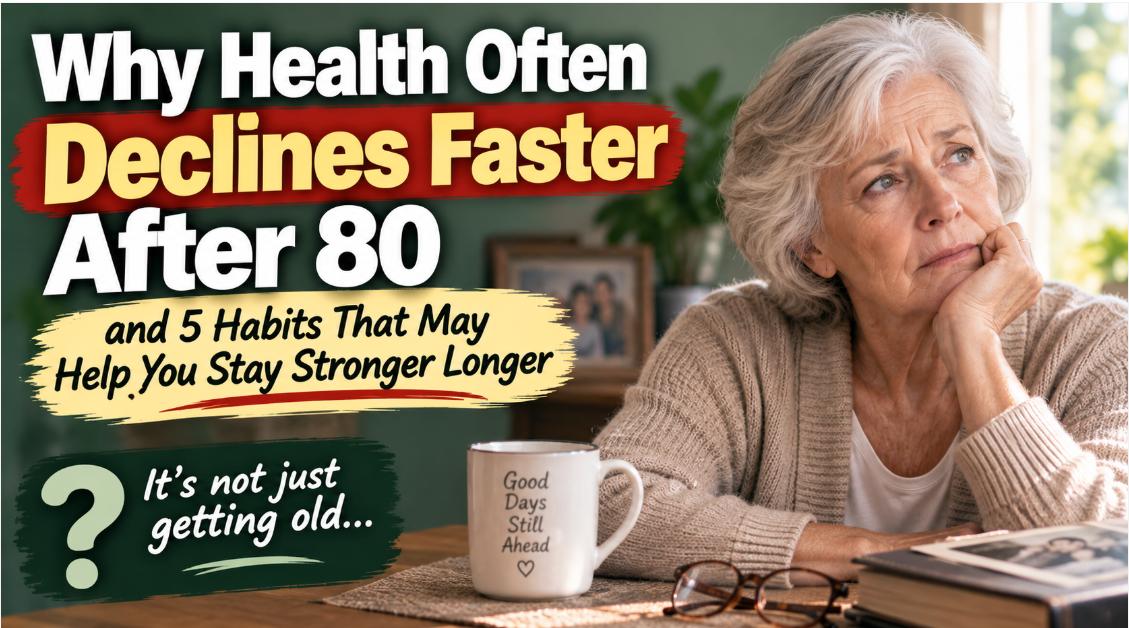
And a minor illness that would have been easy to recover from at 60 may take much longer to bounce back from at 85.
That is one reason many people feel that aging seems to “speed up” after 80.
But this does not mean decline is inevitable.
It also does not mean there is a secret formula that guarantees anyone will live to 100.
Genes matter.
Medical history matters.
Access to care matters.
Life circumstances matter.
And sometimes illness appears despite years of healthy living.
Still, research on healthy aging consistently points to several areas that can influence how well older adults maintain strength, mobility, independence, and quality of life.
The goal is not simply to add more years.
It is to preserve as much function and enjoyment as possible in the years that remain.
Here are some of the biggest challenges that tend to matter after 80 — and five habits that may help support healthier aging.
## Why Can Health Change So Quickly After 80?
Aging affects nearly every system in the body.
Muscles become easier to lose.
Bones may become more fragile.
Balance may worsen.
Recovery from illness can take longer.
The heart, lungs, kidneys, and immune system may have less reserve than they once did.
That means the body can become less forgiving of long periods of inactivity, poor nutrition, dehydration, infection, or untreated health problems.
But physical changes are only part of the picture.
Loneliness, grief, reduced independence, and loss of purpose can also influence everyday habits.
A person who feels lonely may stop cooking regular meals.
Someone who is afraid of falling may stop walking.
A person who loses a spouse may stop attending social activities.
One problem can quietly create another.
That is why healthy aging after 80 is rarely about one single “secret.”
It is usually about protecting several areas at the same time.
## 1. Muscle Loss Can Affect Independence Faster Than Many People Realize
One of the most important changes in later life is the gradual loss of muscle strength.
Older adults may notice it in very ordinary moments.
Getting out of a low chair takes more effort.
Carrying groceries feels heavier.
Climbing stairs requires a railing.
Walking across a parking lot feels more tiring.
These changes matter because muscle strength is closely connected with independence.
Strong legs help people stand up.
They help with balance.
They help protect against falls.
They make it easier to continue cooking, shopping, bathing, dressing, and moving around without assistance.
The problem is that reduced activity can create a cycle.
Walking becomes uncomfortable, so a person walks less.
Because they walk less, the legs become weaker.
Because the legs become weaker, walking becomes even harder.
This is why safe, regular movement can be so important in later life.
The goal does not have to be intense exercise.
For some people, it may be walking.
For others, it may be chair exercises, supervised strength work, water exercise, stretching, or balance practice.
What is safe depends on the individual.
Someone with heart disease, severe arthritis, osteoporosis, frequent falls, dizziness, or other medical conditions may need guidance from a healthcare professional before changing their activity level.
But one principle is worth remembering:
**The body usually benefits from continuing to move within its safe abilities.**
## 2. Chronic Conditions Can Become Harder to Ignore
By the time someone reaches 80, it is common to be living with more than one long-term health condition.
High blood pressure.
Heart disease.
Diabetes.
Arthritis.
Lung disease.
Kidney disease.
Vision or hearing problems.
Memory changes.
Each condition can affect the others.
For example, joint pain may reduce activity.
Less activity may contribute to weakness.
Weakness may increase fall risk.
A fall may then cause even more inactivity.
This is why regular medical follow-up can become especially important in later life.
It is not only about treating one disease at a time.
It is also about looking at the whole person.
Are medications still appropriate?
Is blood pressure controlled?
Has vision changed?
Is hearing loss making social interaction more difficult?
Has appetite declined?
Are there new balance problems?
Is a person becoming unusually tired?
Have memory or mood changed?
Small changes can sometimes be easier to address when they are noticed early.
Older adults and families should also avoid assuming that every new symptom is “just aging.”
Sudden weakness, major weight loss, new confusion, repeated falls, unusual shortness of breath, chest pain, or other significant changes deserve medical attention.
Aging changes the body.
But not every health problem should automatically be blamed on age.
## 3. Eating Less Can Quietly Become a Serious Problem
Many people think nutrition becomes less important as they get older.
In reality, it may become more important.
Older adults often eat less for practical reasons.
Food does not taste the same.
Cooking feels tiring.
Living alone makes meal preparation less appealing.
Dental problems make some foods difficult to eat.
Medications may reduce appetite.
Illness can interfere with hunger.
And thirst may become less noticeable with age.
The danger is not simply losing weight.
The bigger concern is losing strength.
If an older adult eats too little protein or too few nutrient-rich foods, muscle loss may accelerate.
Low food intake can also make recovery from illness more difficult.
Hydration matters too.
Some older adults intentionally drink less because frequent trips to the bathroom are inconvenient.

Others simply do not feel thirsty very often.
But dehydration can contribute to weakness, dizziness, and confusion.
A healthy diet after 80 does not need to be complicated.
The exact plan should depend on medical conditions and individual needs, but many older adults benefit from meals that include:
– enough protein;
– vegetables and fruits;
– whole grains or other high-fiber foods;
– healthy fats;
– adequate fluids;
– foods that are easy to prepare and enjoyable to eat.
People with kidney disease, heart failure, diabetes, swallowing problems, or other medical conditions may need more individualized nutrition advice.
The goal is not perfection.
It is giving the body enough fuel to maintain strength.
## 4. Loneliness Can Change Much More Than Mood
One of the hardest parts of getting older is that a person’s social world may gradually shrink.
A spouse dies.
Friends become ill.
Some stop driving.
Others move closer to their children.
Workplace friendships disappear after retirement.
Activities that once filled the week become harder to attend.
The result can be long stretches of time alone.
Loneliness is not simply feeling bored.
Social isolation has been associated with poorer health outcomes in older adults.
But the mechanism is often practical as well as emotional.
People who are socially connected may have more reasons to leave the house.
They may walk more.
They may eat more regular meals.
Someone may notice when they are not feeling well.
There is conversation.
There is laughter.
There are plans.
There is something on the calendar.
And that matters.
Social connection does not have to mean being surrounded by dozens of people.
For some older adults, one or two dependable relationships can make a meaningful difference.
A weekly lunch.
A phone call.
A walking partner.
A church group.
A senior center.
A volunteer activity.
A neighbor who stops by.
The important thing is having regular contact that feels meaningful.
## 5. Loss of Purpose Can Quietly Affect Daily Life
Retirement is often described as freedom.
And for many people, it is.
But retirement can also remove things people depended on for decades:
structure,
responsibility,
social contact,
identity,
and a reason to get up at a certain time.
Later, other losses may follow.
A spouse dies.
Driving becomes difficult.
Children become busy with their own families.
Activities that once felt easy become harder.
A person may begin asking:
**“What am I still here for?”**
That question matters.
Purpose does not need to be grand.
It can be caring for a garden.
Calling grandchildren.
Helping a neighbor.
Volunteering.
Looking after a pet.
Attending a community group.
Learning something new.
Cooking Sunday dinner.
Keeping family photographs organized.
Having a reason to get dressed in the morning can matter more than it seems.
Emotional health deserves attention just as physical health does.
Persistent sadness, loss of interest, hopelessness, anxiety, or major changes in sleep and appetite should not simply be dismissed as normal aging.
Older adults can experience depression and anxiety, and help is available.
Now let us look at five habits that may support healthier aging.
## Habit 1: Keep Moving in Ways Your Body Can Safely Handle
You do not need to become an athlete at 80.
You do not need to run.
You do not need to lift heavy weights.
But regular movement can support mobility, balance, strength, circulation, and everyday function.
Walking is one of the simplest options for people who can do it safely.
Even short walks can add movement to the day.
Some older adults may benefit from strength exercises using light resistance.
Others may prefer water exercise because it reduces stress on painful joints.
Balance exercises can also be useful, especially for people concerned about falls.
The most important point is consistency.
A little movement done regularly is often more realistic than a difficult routine that lasts one week.
If you have been inactive for a long time or have significant health problems, ask a healthcare professional what level of activity is appropriate for you.
The goal is not to prove how fit you are.
The goal is to preserve what your body can still do.
## Habit 2: Protect Muscle With Enough Nutrition
After 80, eating for strength becomes especially important.
Many older adults focus heavily on avoiding sugar, fat, or salt.
Those things can matter depending on medical conditions.
But eating too little can also become a problem.
Protein is especially important because the body needs it to maintain muscle.
Good sources may include:
eggs,
fish,
poultry,
beans,
lentils,
yogurt,
milk,
tofu,
and other protein-rich foods.
Vegetables, fruits, whole grains, nuts, and healthy fats can provide additional nutrients.
A Mediterranean-style eating pattern is one well-studied approach associated with cardiovascular health and healthy aging.
But no single diet is right for everyone.
People with certain medical conditions may need adjustments.
The most useful diet is one that is nutritious, medically appropriate, affordable, and realistic enough to follow.
And do not forget fluids.
Regular hydration can be easy to overlook.
## Habit 3: Treat Social Connection Like Part of Your Health Routine
Many people schedule medical appointments.
They schedule medications.
They schedule meals.
But they leave social connection to chance.
That may be a mistake.
Try putting human contact on the calendar.
Monday: call a friend.
Wednesday: attend a community activity.
Friday: lunch with someone.
Sunday: visit family or speak by phone.
This may sound simple.
But regular social interaction gives the week structure.
It also gives people a reason to stay engaged with the outside world.
If mobility is limited, technology can help.
Phone calls.
Video chats.
Online groups.
Virtual religious services.
Community transportation programs.
Even small forms of contact can be meaningful.
The goal is not popularity.
It is connection.
## Habit 4: Keep Giving Your Brain Something New to Do
The brain changes with age, just like the rest of the body.
But later life does not mean learning has to stop.
Reading.
Games.
Puzzles.
Music.
Conversation.
Learning a language.
Trying a new recipe.
Using a new piece of technology.
Taking a class.
Writing down family memories.
These activities can help keep the mind engaged.
It is important not to overstate what brain games can do.
No crossword puzzle, book, or hobby can guarantee protection from dementia.
But staying mentally and socially active is generally considered a reasonable part of healthy aging.
There is another benefit too.
Learning creates anticipation.
It gives the mind something to work toward.
Curiosity itself can make life feel larger.
## Habit 5: Protect Your Sense of Purpose and Perspective
A positive attitude is not a cure for disease.
Optimism does not prevent every illness.
And someone who is grieving should not be told to simply “think positive.”
That is not realistic.
But the way people respond to the challenges of aging can still affect daily life.
Ask:
What can I still do?
What do I still enjoy?
Who still matters to me?
What gives me a reason to get up tomorrow?
Gratitude can be useful when it is genuine.
So can mindfulness.
Prayer.
Meditation.
Time outdoors.
Music.
Writing.
Spending time with people who make you feel calmer.
The goal is not to pretend that aging is easy.
It is to keep loss from becoming the only thing you see.
Aging often requires letting go of certain abilities.
But it can also create space for different kinds of meaning.
## What People Who Age Well Often Protect
There is no single profile of a healthy 90-year-old.
Some have survived cancer.
Some have heart disease.
Some use walkers.
Some live alone.
Some need help with daily tasks.
Healthy aging does not mean having no medical problems.
It often means maintaining as much function, connection, and purpose as circumstances allow.
People who remain engaged later in life often protect several things:
their mobility;
their nutrition;
their relationships;
their medical care;
their curiosity;
and their sense that life still contains something worth showing up for.
These areas reinforce one another.
Movement helps preserve strength.
Strength makes social activity easier.
Social activity supports mood.
Better mood may make it easier to eat, exercise, and keep medical appointments.
Healthy aging is often a system, not one secret.
## Living to 100 Is Not the Only Goal
It is easy to become fascinated with centenarians.
What do they eat?
How much do they exercise?
What is their secret?
But there is an important truth.
No lifestyle can guarantee a person will live to 100.
Genetics, disease, environment, medical care, chance, and many other factors influence lifespan.
A more useful goal may be:
**How can I protect the quality of the years I do have?**
Can I keep walking?
Can I stay connected?
Can I continue making my own decisions?
Can I enjoy meals?
Can I keep learning?
Can I maintain relationships that matter?
Can I ask for help when I need it?
Those questions may matter more than a number on a birthday cake.
## A Simple Starting Point
If you are over 80, you do not need to change everything tomorrow.
Choose one area.
Take a short walk if it is safe for you.
Add a source of protein to breakfast.
Call someone you have not spoken with recently.
Schedule a medical checkup you have been postponing.
Drink an extra glass of water.
Return to a hobby you once enjoyed.
Small actions are easier to repeat.
And repeated actions are more useful than dramatic plans that disappear after a few days.
If you have significant medical conditions, mobility problems, frequent falls, unexplained weight loss, or major changes in memory or mood, speak with a healthcare professional before making major changes to diet or exercise.
## The Real Wisdom of Growing Older
Reaching 80 is not the beginning of an automatic decline.
It is a stage of life in which the margin for ignoring small problems may become smaller.
Strength matters more.
Nutrition matters more.
Connection matters more.
Medical follow-up matters more.
Purpose matters more.
But none of these requires perfection.
The goal is not to defeat aging.
The goal is to work with the body you have now.
Keep moving in ways that are safe.
Eat enough to support strength.
Stay connected to people.
Give your mind something to do.
And keep something in your life that makes tomorrow worth anticipating.
You may never know exactly how many years remain.
None of us do.
But there is still great value in protecting the independence, relationships, curiosity, and meaning that can make those years worth living.
Because after 80, the most important question may not be:
**“How do I live to 100?”**
It may be:
**“How do I stay as strong, connected, and fully alive as possible for as long as I can?”**