Chapter 1: The Request
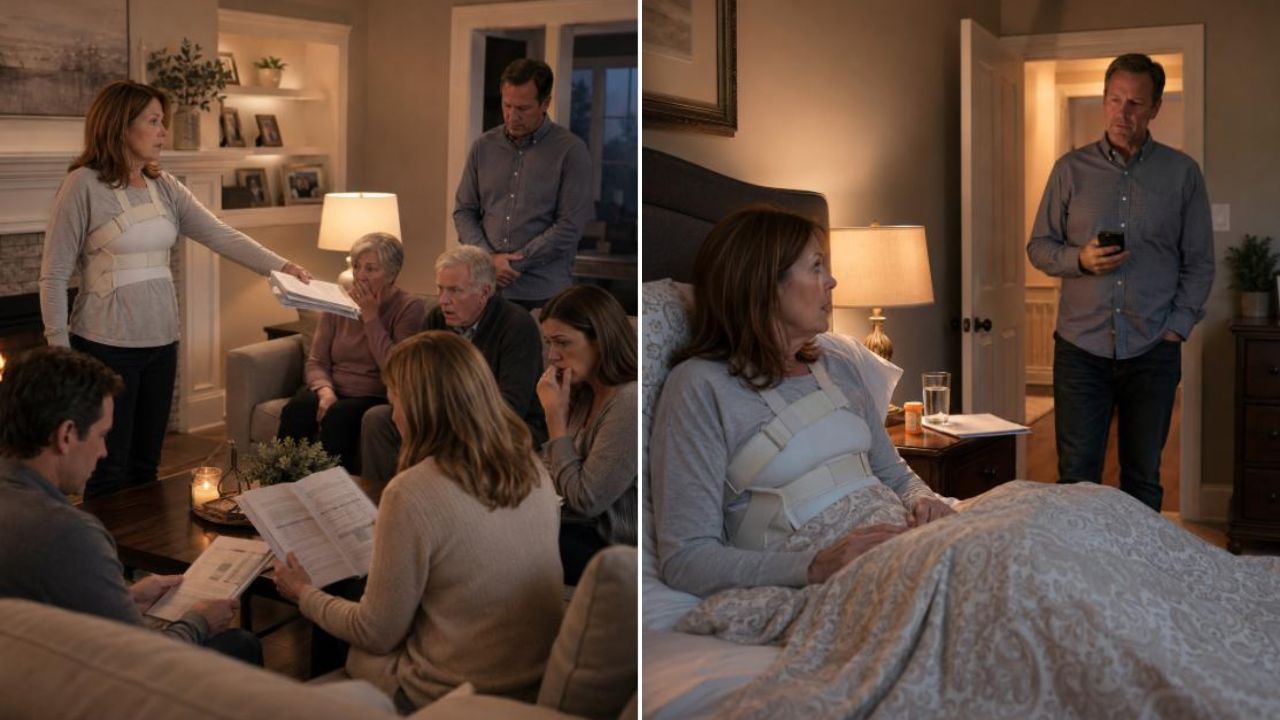
Five days after my spine surgery, my husband stood in the doorway of our bedroom and told me twelve members of his family were coming to stay for two weeks. He said it the way someone might announce a package delivery, his arms folded, his phone glowing in one hand, his eyes barely landing on the brace strapped around my lower back. I was propped against three pillows, still pale from anesthesia, still moving like my body had become something fragile and unfamiliar. A purple bruise from the IV line marked the back of my left hand. The orange prescription bottle on my nightstand rattled every time the ceiling fan pushed air across the room.
“This Saturday,” Kyle said, “everyone’s coming. Mom, Dad, Ethan’s family, Lauren’s family. All twelve of them. Have everything ready.”
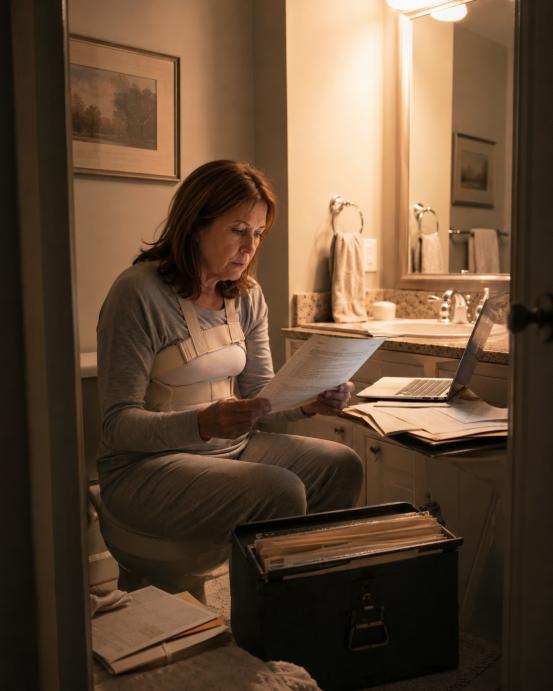
At first, I laughed. Not because it was funny, but because my mind tried to make it a joke before my heart could understand it as cruelty. Kyle did not smile. He looked down at his phone and typed something with his thumb, probably confirming arrival times with his mother, as if the conversation had already been settled somewhere I had not been invited. I shifted against the pillows, and a sharp pain ran through my lower back, clean enough to steal my breath for a second. Dr. Whitfield’s instructions were folded in the drawer beside me: no lifting, no bending, no standing longer than fifteen minutes, no stairs unless absolutely necessary, minimum four weeks of careful recovery.
“Kyle,” I said, keeping my voice even, because I had learned over twenty-two years that calm was usually the only tone he respected, “I just had surgery. Can we please postpone this? Even a week would help.”
He did not look up. “No one is waiting. Just do as I say.”
That sentence entered the room and stayed there. It settled between the bed and the dresser, between the photo of our daughter Chloe on the nightstand and the laundry basket I could not lift. In twenty-two years of marriage, Kyle had annoyed me, disappointed me, overlooked me, and defended his family when he should have defended me. But he had never spoken to me like that. Not like a husband. Not even like a tired man. Like a supervisor rejecting a request from an employee he had never planned to thank.
I nodded because I did not trust myself to speak. Kyle took my silence as agreement and left the room satisfied. That was one of his great talents: turning my exhaustion into consent. I heard him downstairs a few minutes later, opening cabinets, moving through the kitchen that used to be my mother’s kitchen, in the house that had once held my childhood. Then I heard his voice brighten when he called his mother. “Yeah, she knows,” he said. “We’ll be ready.”
That night, I lay awake long after Kyle fell asleep beside me. The ceiling fan turned slowly, cutting the blue light from the streetlamp into moving shadows across the room. My back ached in a deep, structural way that reminded me this was not a headache or a pulled muscle, but healing bone and muscle, stitches and swelling, a body begging not to be used. I thought about the past twenty-two summers, each one beginning the same way: Kyle’s family arriving with coolers, suitcases, beach chairs, special dietary needs, and the easy confidence of people who believed my home was a hotel they had been born entitled to use.
Every year, I made the beds, washed the towels, stocked the fridge, planned the meals, drove to the airport, cut grapes for toddlers, bought gluten-free crackers for Linda, low-sodium options for George, string cheese for Ethan’s teenagers, and enough paper towels to clean up after a youth camp. I smiled in photos where I was always standing at the edge, one foot turned toward the kitchen because something was boiling over or someone needed another blanket. Kyle called it family time. His mother called it tradition. I called it nothing, because I had never been brave enough to name something that everyone else benefited from.
Not once had anyone asked if I was tired. Not once had anyone asked if the timing worked for me. Not once had Kyle said, “Melissa, what do you need?” The visits happened because I made them happen. The meals appeared because I cooked them. The beds were clean because I washed the sheets. The chaos stayed cheerful because I absorbed the cost before anyone had to see it.
At one in the morning, I reached for the pain medication, then stopped. I wanted my mind clear. Instead, I reached past the bottle, opened the drawer, and pulled out the old fireproof box my father had bought decades ago. I had not opened it in years. Inside were insurance papers, my parents’ death certificates, Chloe’s birth certificate, and the manila folder containing the deed to the house. I carried the folder and my laptop into the hallway bathroom, locked the door, and sat on the closed toilet lid under the harsh vanity light, reading legal language with my brace cutting into my ribs.
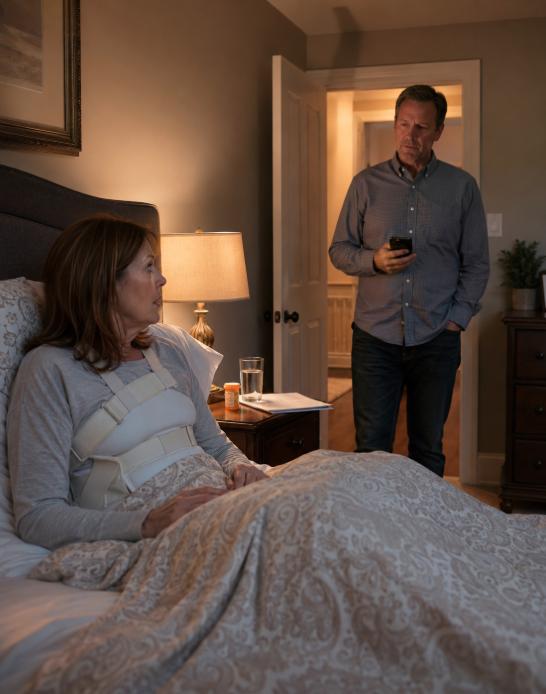
My parents bought the house in 1994. I grew up in the bedroom that later became Chloe’s nursery, then her room, then the guest room where Kyle’s mother slept every summer without once thanking me for the fresh sheets. When my father died, and my mother followed a few years later, the house came to me. Not to Kyle and me. To me. The deed was painfully clear. Sole owner: Melissa Roberts. My name, and only my name, beneath the notary seal.
I read the page twice, then a third time. In Kyle’s mind, the house had become “ours” the moment we moved back into it after my mother died. In his family’s mind, it had become “the family house” because they had used it often enough to feel entitled to it. Somehow, over years of quiet grammatical theft, my childhood home had been turned into a shared resource, and I had been turned into the woman who kept it running. Sitting there in that small bathroom with my back throbbing and my husband asleep down the hall, I felt something settle inside me. Not rage. Something steadier. Clarity.
Chapter 2: The House Was Mine
The next morning, after Kyle left for work, I called Diane Foster, the attorney who had handled my parents’ estate. I expected her not to remember me, but she did. “Melissa,” she said warmly, “you brought peach jam to my office after the closing.” That almost made me cry. There is something dangerous about being remembered kindly when your own house has forgotten you.
I told her everything. I told her about the surgery, the brace, the doctor’s restrictions, Kyle’s announcement, the twelve relatives, the two-week stay, and the sentence he had delivered without looking up from his phone. Diane did not interrupt. Good lawyers know how to let silence do part of the work. When I finished, she asked one question. “Whose name is on the deed?”
“Mine,” I said. “Only mine.”
“Then legally, you control who occupies the property and under what conditions,” she said. “Your husband does not have the right to invite twelve people into your home while you are recovering from major surgery, especially over your objection. You are not asking for permission, Melissa. You are informing him.”
I sat at the kitchen table, staring at the backyard where George always placed his folding chair in the exact patch of shade that crushed my hydrangeas. “I don’t want to hurt him,” I said. That was true, even then. I did not hate Kyle. I still loved parts of him, or maybe I loved the memory of the man I thought he would become. What I did know was that somewhere along the way, he had stopped seeing the difference between my kindness and his right.
“This isn’t about hurting him,” Diane said. “You had spine surgery five days ago. Your doctor gave you explicit medical restrictions. Setting boundaries is not cruelty. It is the minimum requirement for recovery.”
I wrote that sentence down on a sticky note and stuck it to the edge of my laptop. Setting boundaries is not cruelty. It looked strange in my handwriting, almost radical. Diane and I talked through practical steps for twenty minutes. “Paper trail,” she kept saying. “Everything in writing. Everything defensible. Do not act out of revenge. Act out of necessity.”
After we hung up, I sat for a long time, looking at the kitchen I had cleaned for decades. The cabinets were still the pale oak my mother chose when I was thirteen. The small chip in the tile near the sink was from the year Chloe dropped a mug while dancing in socks. The house was full of history, but almost none of it was visible to Kyle’s family. To them, it was space. Bedrooms. Showers. A grill. A place to land every summer and be served.
By Thursday, I had made three calls from my car in the pharmacy parking lot because I did not want Kyle overhearing and talking me out of it. The first was to a restoration company to schedule long-overdue repairs: the water stain in the upstairs hallway, the warped flooring near the laundry room, repainting in the guest rooms. All real problems. All things I had postponed because every July, the house was too full of other people’s needs. The second call was to an HVAC company about the rattling central air unit. The third was to a painting and flooring crew Diane recommended because their contract included a strict no-occupancy clause during interior work for safety and liability reasons.
That clause became the hinge on which the whole thing turned.
By Friday afternoon, I had signed the work agreements. By Friday evening, I had confirmed with my insurance provider that my recovery plan qualified me for a short-term rehabilitation apartment fifteen minutes away, all on one level, with grab bars in the bathroom and wellness checks twice a week. I packed slowly while Kyle was at Ethan’s house “working out logistics,” as if logistics had ever meant anything except my labor. I folded two weeks of clothes, packed my medications, the discharge paperwork, my laptop, and the framed photo of my parents from our mantel. Then I wrote a note and left it on the kitchen counter.
Gone to recovery housing per doctor’s orders. House is closed for scheduled renovation work beginning Saturday morning. Contractors have keys. Please do not interfere with the work schedule. Insurance and liability restrictions apply.
I did not decorate the note with emotion. I did not mention the words “just do as I say.” I did not accuse him of anything. Facts, Diane had said. Facts are harder to twist than feelings. Then I drove myself to the rehab apartment, wincing every time the car hit a pothole, and slept better than I had since the surgery.
Saturday morning, I was not there when the three SUVs pulled into my driveway. Kyle told me about it later, in pieces, once his anger had worn down enough to become embarrassment. Twelve people spilled out onto the lawn with suitcases, coolers, folding chairs, tote bags, and the confident noise of a family that had never once considered the possibility of being told no. On the front door, taped at eye level, were two laminated signs: Home closed for renovation. No occupancy until further notice. Contractor and insurance restrictions in effect.
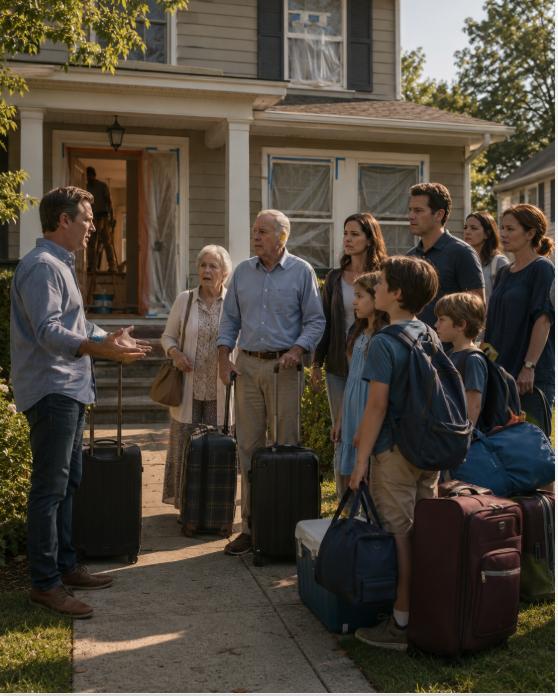
Through the front windows, they could see plastic sheeting over the furniture, workers sanding the hallway floor, paint cans lined against the wall, and the living room transformed into a work site. The smell of primer had already begun to seep through the screen. Kyle tried the door first, then called my name as if I might be hiding inside. The foreman opened the door just far enough to be polite and informed him that no one could enter during active contracted work. “Nothing personal, sir,” he said. “It’s liability protocol.”
Kyle called me four times before I turned my phone on. I watched the missed calls stack on the screen from my narrow bed in the rehab apartment. I expected guilt to rise in me. Instead, I felt a quiet I did not recognize, the quiet of not solving a crisis I did not create. On the fifth call, I answered.
“What did you do?” he demanded.
No hello. No “How are you feeling?” No “Are you safe?” Just accusation, sharp and immediate.
“I did exactly what my surgeon told me to do,” I said. “I arranged a safe place to recover, and I scheduled repairs my house has needed for years.”
“Your house?” he snapped.
I closed my eyes. There it was. The nerve.
“Yes,” I said. “My house. Legally and historically.”
Silence stretched between us. In the background, I heard Linda’s voice, high and furious, asking where the children were supposed to sleep. Someone else said the word “hotel” like it was a personal tragedy. Kyle lowered his voice. “My parents are standing on the porch, Melissa.”
“I told you I couldn’t host them.”
“You embarrassed me.”
“No,” I said quietly. “You embarrassed yourself when you expected a woman five days out of spine surgery to serve twelve guests for two weeks.”
He hung up.
Linda called next. I almost let it ring, but some old habit of politeness made me answer. Her voice came through tight and shaking with outrage. “Do you have any idea how humiliating this is? We drove six hours. The children are tired. George needs his medication. This is completely selfish of you.”
I did not defend myself with a speech. I texted her a photo of my discharge instructions, the restrictions printed in bold at the bottom. No lifting over ten pounds. No standing longer than fifteen minutes. Minimum four weeks recovery. Under the photo, I wrote: This is why. I hope you find comfortable arrangements.
Then I turned my phone face down and did not look at it again until morning.
Chapter 3: The Price of Being Invisible
For the first week, Kyle lived inside the machinery I had quietly operated for twenty-two summers. He had to find hotel rooms during a wedding weekend. He had to organize meals for twelve people with conflicting preferences and medical restrictions. He had to drive George to a pharmacy because his blood pressure medication had been forgotten. He had to take Ethan’s teenagers to the outlet mall because they were bored. He had to listen to Linda complain about hotel pillows, restaurant menus, room rates, traffic, and the fact that the Marriott did not feel “homey.”
By Wednesday, his texts changed. The first days had been all accusation and exclamation points. Then came shorter messages, worn down around the edges.
Long day.
Mom wants steak. Dad says no red meat. Can’t win.
Do you always do the grocery runs twice a day when they’re here?
I did not answer the first two. Not because I wanted to punish him, but because I no longer trusted the part of myself that rushed to comfort people who were finally meeting the consequences of their own choices. On Thursday night, he called. His voice sounded exhausted in a way I had never heard before.
“The kids are cranky. Mom hates the hotel. Ethan says his house isn’t big enough for everyone, which is funny, because somehow ours always was.” He stopped, as if the sentence had surprised him. Then he said, softer, “I didn’t realize how much you handled.”
I waited. For twenty-two years, I had completed Kyle’s unfinished sentences for him. Not this time.
“I mean it,” he said. “I didn’t know.”
That was when I opened the spreadsheet.
I had started it fifteen years earlier as a household budget. Groceries, utilities, repairs, school expenses, Chloe’s college fund. Somewhere along the way, almost without meaning to, I had begun logging the summer visits. The grocery bills that doubled every July. The water and electric spikes. The air mattresses replaced after Ethan’s teenagers punctured them. The firm mattress we bought for George’s back. The rental car we covered when Ethan’s transmission failed. The airfare we quietly paid for Linda and George three separate times when retirement money was, as George put it, “a little tight.”
I had not kept the spreadsheet out of bitterness. At least, not at first. I kept it because numbers made me feel less crazy. Numbers did not roll their eyes. Receipts did not say I was overreacting. Bills did not tell me family helps family while only one person was doing the helping.
When I added the summer-related costs across twenty-two years, the total appeared at the bottom of the column.
$185,412.
I sat back from the small table in my rehab apartment and stared at the number. It did not include my time. It did not include the hours of cooking, cleaning, shopping, driving, planning, soothing, folding, smiling, and swallowing words. It did not include the vacations I never had because every summer became a job no one called work. It did not include the part of me that disappeared each time someone called it tradition.
I thought I would cry. I didn’t. Something colder moved through me, not cruelty, but precision. The way a surgeon studies an X-ray before cutting. If my feelings had never been enough to make them see me, maybe evidence would.
For the rest of my recovery stay, I built a presentation. It felt absurd at first, sitting there with my laptop, formatting twenty-two years of invisible labor like a boardroom report. But the more I organized it, the calmer I became. The cover page read: Twenty-Two Years of Hospitality. Beneath that: Documented Household Costs for Extended Family Visits. Then the total: $185,412.
I included year-by-year grocery increases, utility spikes, receipts for mattresses and repairs, airfare records, restaurant charges, and photos from summers past. Linda in my kitchen, opening the fridge I had stocked. George asleep in the recliner I bought for his back. Ethan’s children on air mattresses I inflated. Kyle smiling in group photos while I stood half-visible near the doorway, apron on, hair coming loose, one hand still holding a dish towel.
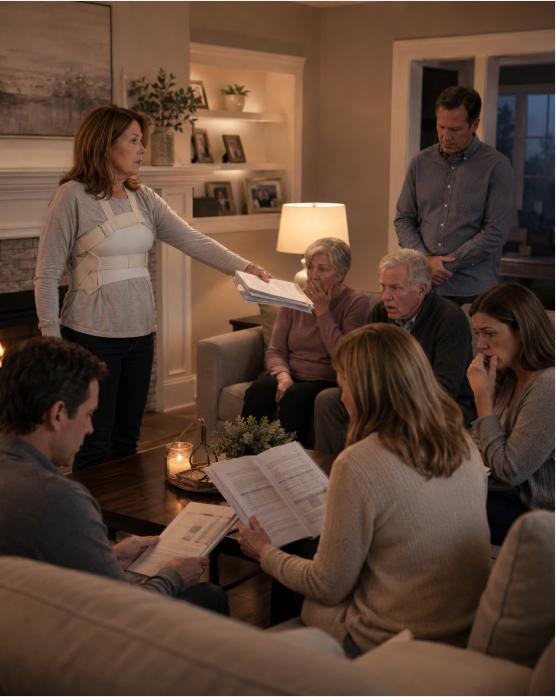
On the final day of the family visit, I called Kyle and asked him to gather everyone at the house that evening. The renovation crew had finished early. The hallway floor gleamed under fresh varnish, the old water stain was gone, and the air conditioning ran quietly for the first time in months. Kyle sounded cautious but relieved. I think he believed I was coming home to apologize.
When I arrived, all twelve of them were in the living room, perched on furniture that still smelled faintly of fresh paint. Linda stood when she saw me, her arms half-lifted as if preparing to receive my apology with grace. George sat stiffly in the recliner. Ethan leaned against the fireplace with the expression of a man ready to be reasonable as long as reason cost him nothing. Kyle sat on the arm of the sofa, watching me carefully.
I did not sit down. I placed a folder in each person’s hands.
No one spoke at first. They read the cover page in silence. Linda’s face changed first. George’s followed. Ethan flipped quickly through the pages until he landed on the rental car receipt from the year his transmission failed, and his ears turned red.
I stood beside the fireplace, in the same spot where I had stood in a hundred family photos, always close enough to serve but far enough to be cropped out. “Can anyone name one visit,” I asked, “where I was treated like a guest instead of staff?”
No one answered.
“Can anyone remember asking if I was healthy enough, rested enough, or willing before twelve people arrived for two weeks every summer?”
The room stayed still. Not peaceful still. Heavy still. The kind of stillness that happens when people realize the story they liked telling about themselves has just been contradicted by paper.
“I am not asking to be repaid,” I said. “That is not why I kept these records. I kept them because somewhere along the way, I stopped trusting my own sense of what was fair. I needed to see it written down before I believed myself.”
Linda looked down at a photograph of herself standing in my kitchen, pointing at something on the counter while I stood beside her with my hands full. For the first time since I had known her, she did not look ready to argue. She looked like a woman confronting a mirror she had not expected to find in someone else’s living room.
“I have loved having family,” I said. “I have never loved being invisible in my own home.”
George cleared his throat, but no words came. Ethan closed the folder and set it on the coffee table as gently as if it might explode. Kyle stared at his copy, and I watched something move across his face that was not defensiveness. Recognition, maybe. Shame, maybe. Both would do.
I did not wait for apologies. I had waited twenty-two years to be seen. I did not need to stand there begging them to describe the view. I picked up my purse, told Kyle I would return home the next day, and drove back to the rehab apartment for one final night.
Chapter 4: The New Rules
I moved home eleven days after I left. The house smelled of fresh paint instead of old obligation. Sunlight ran across the polished hallway floor, and for the first time in years, the rooms felt like they had been waiting for me rather than bracing for guests. Kyle carried my bag upstairs without asking if I needed help in the performative way he sometimes used after arguments. He just did it quietly, then came back down and made coffee.
We did not have one dramatic conversation that fixed everything. Real repair is not usually cinematic. It is quieter and more uncomfortable. A few days later, we sat at the kitchen table with two mugs going cold between us, and Kyle said the sentence I had waited half my marriage to hear.
“I didn’t know because I never had to know.”
I looked at him across the table. His face seemed older. Not because of wrinkles, but because denial had left it. He turned his mug slowly between both hands. “You always handled everything before it reached me. I thought that meant it wasn’t heavy.”
“It was heavy,” I said.
“I know that now.”
“That doesn’t erase anything.”
“No,” he said. “It doesn’t.”
That mattered. More than an apology, maybe. Apologies can be performance. Accountability has less music in it. We agreed that there would be no more open-door policy. No more automatic summer invasion. No more relatives treating the house as a birthright. Any visit, from his family or mine, would require both of us to agree in advance. Guests would contribute to groceries, clean up after themselves, make their own plans, and understand that my home was not a resort staffed by one recovering woman.
The first test came six weeks later, when Kyle invited only his parents for dinner. Properly. With two weeks’ notice. With a conversation beforehand about what we were serving, how long they would stay, and what I was willing to do. George arrived stiff and formal, carrying a bottle of wine he had clearly purchased at the last minute. Linda brought a casserole, something she had never done in twenty-two years of visits, and placed it on the counter with both hands like an offering.
Halfway through dinner, Ethan called Kyle. I heard his voice from across the room, loud enough to be recognized even through the phone. He wanted to know why he had not been invited, why things had to be “so formal now,” why everyone was acting like strangers. Kyle stepped into the hallway, but he did not lower his voice enough to hide.
“No, Ethan,” he said. “Not this time. We’re keeping it small. If you want to visit, you’ll plan it with us in advance, the same as anyone else.”
There was a pause. Ethan’s voice rumbled on the other end.
Kyle said, “Because it’s Melissa’s home. It was her home before it was ever mine, and I should have remembered that years ago.”
I stood in the kitchen doorway with a dish towel in my hands and felt something in my chest loosen that had been tight for longer than I knew. Not fixed. Not healed. But loosened.
Later that evening, as George and Linda were leaving, George paused near the front door and looked down the hallway. “Floor looks good,” he said gruffly.
It was not an apology. It was not even close. But it was George Roberts noticing something in my house that he had not been served, something that existed because I had chosen it. I decided to accept it for what it was: a beginning too small to admire, but too real to dismiss.
Autumn came. Chloe visited for a long weekend and laughed when she heard the story from me instead of her grandmother’s dramatic version. “Mom,” she said, wrapping me in the careful hug of someone who knew my back had only recently healed, “I’m proud of you.” Those words did what no apology from Kyle’s family could have done. They reminded me that my daughter had been watching more than I realized, and that maybe she would inherit more than a house from me. Maybe she would inherit the right to say no sooner than I did.
One Tuesday evening in October, my phone rang. Linda’s name appeared on the screen. For a moment, old habit made my thumb hesitate. Then I answered.
“Melissa,” she said, and her voice sounded smaller than I expected. “Would next Saturday be a good time to visit? Just for the afternoon. I’ll bring lunch, if that’s all right with you.”
I stood alone in the kitchen, looking at the late golden light through the window above the sink. It was not an apology. Linda Roberts might never manage the words themselves. But it was something I had waited twenty-two years to hear from a woman who once treated my home as her family’s property.
She was asking.
Not assuming.
Not arriving.
Asking.
“Saturday would be lovely,” I said. “I’ll see you then.”
After I hung up, I looked around the kitchen. The counters were clear. The house was quiet. My back no longer ached with every movement, but I still remembered the pain, and in a strange way, I was grateful for it. Pain had forced me to stop moving long enough to see what my life had become.
For years, I thought love meant making room for everyone. I thought being a good wife meant being easy to count on and hard to inconvenience. I thought a home was generous only if its doors were always open. But a home that never protects the person who tends it is not generous. It is hungry.
That summer, I did not get revenge. I got rest. I got receipts. I got my name back on a house where it had legally been all along. Most of all, I got the quiet pleasure of walking through my own front door without feeling like the help.
And when Saturday came, Linda knocked.