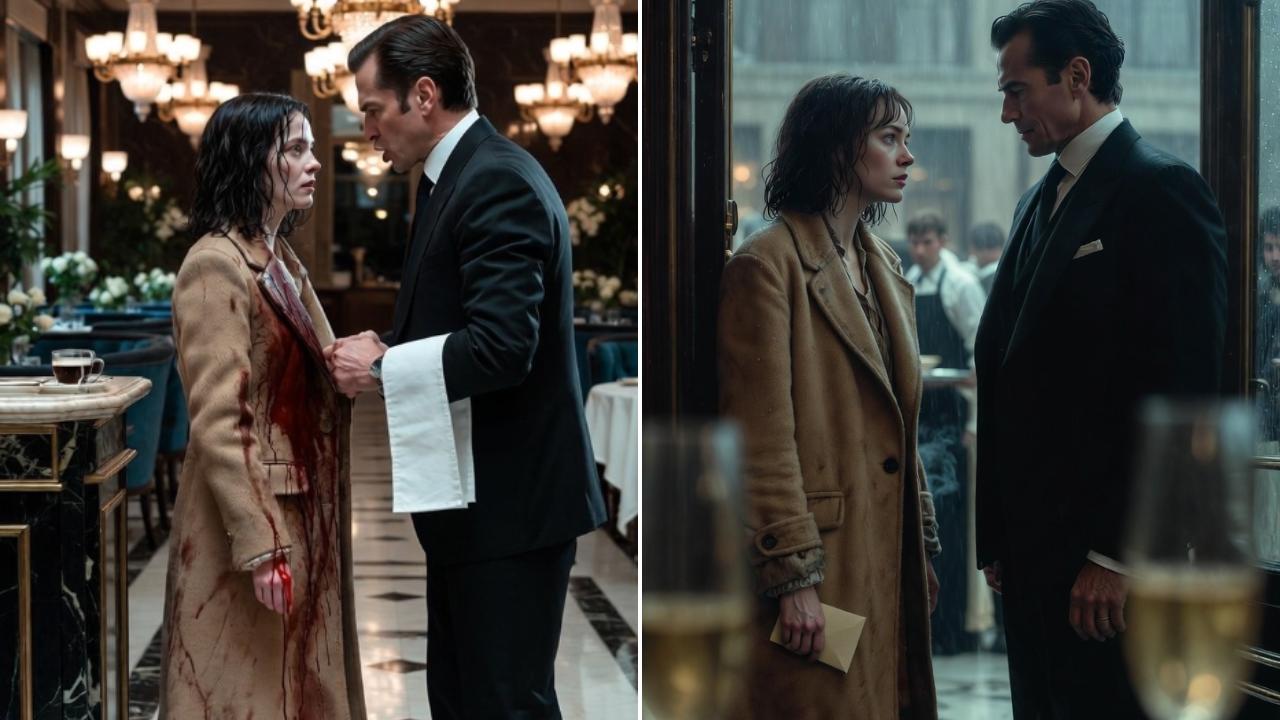
A young woman in a worn-out coat walks into one of Manhattan’s most exclusive cafés and is humiliated by its status-obsessed manager—only for him to discover, too late, that she may be the new owner of everything he is desperate to protect.
Chapter One
The Coat Did Not Belong There
The first thing Marcus Vale noticed was the coat.
Not the woman wearing it.
The coat.
It was camel-colored once, maybe ten winters ago, before rain had darkened the seams and city dust had settled permanently into the cuffs. One button had been replaced with another that did not match. The hem hung tiredly, as if it had given up trying to look respectable.
At Café Bellamy, details mattered.
A crooked fork could ruin a table.
A fingerprint on a champagne flute could ruin a mood.
A woman in a coat like that could ruin the illusion.
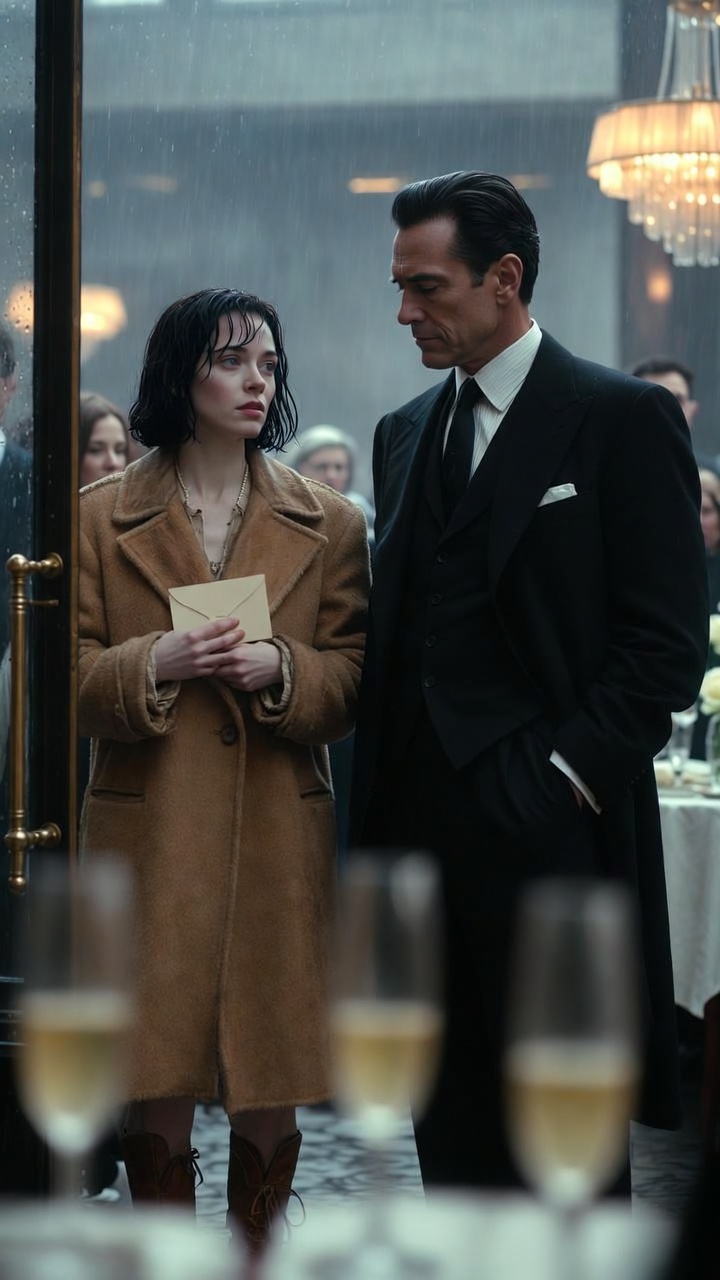
Marcus stood beside the marble host stand, one hand folded neatly over the other, the white cloth on his forearm pressed flat with military precision. Behind him, the dining room glowed under amber chandeliers imported from Milan. Rain tapped softly against the tall windows, blurring Park Avenue into streaks of silver and brake lights. The air smelled of espresso, orange peel, polished wood, and money.
The woman paused just inside the entrance.
A drop of rain slid from a loose strand of her dark hair and landed on the polished floor.
No one spoke at first.
But the room noticed.
A man in a navy suit lowered his newspaper by half an inch. Two women near the window, both wearing pearls too casual to be fake, stopped stirring their cappuccinos. A young waiter carrying a silver tray slowed just enough for the cups to tremble.
Marcus smiled.
It was a smile he had practiced for twelve years. Warm enough for guests. Cold enough for problems.
“Good morning,” he said, stepping toward her. “May I help you?”
The woman looked at him. Her face was pale from the weather, though not weak. Her eyes were a dark, steady gray, the kind that made people uncomfortable because they did not move away first.
“I have a reservation.”
Her voice was quiet. Not timid. Just economical.
Marcus let his gaze travel once, carefully, from her damp hair to the scuffed leather boots peeking beneath the coat.
“A reservation,” he repeated.
“Yes.”
“Under what name?”
“Clara.”
He waited.
Only Clara.
No last name offered. No embarrassed explanation. No nervous laugh to show she understood she had entered the wrong world by mistake.
Marcus looked down at the leather-bound reservation book, though he already knew what he would find. Bellamy did not take first names alone. Bellamy did not seat uncertainty.
“Clara,” he said, turning a page slowly. “I’m afraid I don’t see that here.”
“You haven’t checked.”
His fingers stopped.
The waiter with the silver tray froze three feet away.
Marcus lifted his eyes.
“I beg your pardon?”
“You turned one page,” Clara said. “Reservations for the east room are on the next.”
The room changed temperature.
Only slightly.
A breath held here. A spoon set down there. The espresso machine hissed from behind the bar like steam escaping a pipe about to burst.
Marcus closed the book.
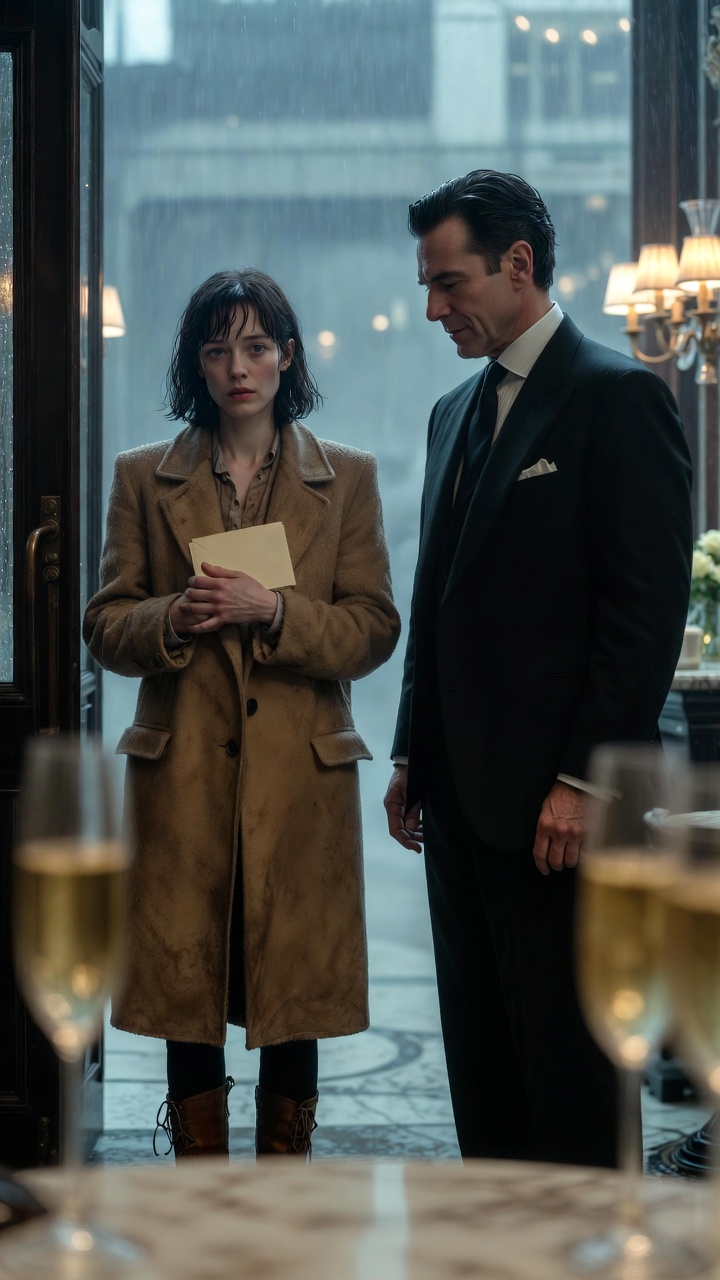
“Miss,” he said, still smiling, “Café Bellamy is fully committed this morning.”
“There are eight empty tables.”
“Reserved.”
“For people who are not here.”
“For guests who are expected.”
Clara glanced past him.
At the table by the window.
Small. Round. Set for one. A white rose in a narrow glass vase. A folded linen napkin shaped like an envelope.
“That one is mine.”
Marcus did not turn around.
He knew exactly which table she meant. Table Seven. The best single table in the room. The table where publishing executives waited for authors, wives waited for lawyers, and old men waited for decisions they did not want to make at home.
It had been reserved under a name Marcus had not recognized.
C. Bell.
He had assumed it was a mistake. Or a junior assistant. Or one of those quiet nobodies who booked expensive places simply to photograph the menu and pretend they belonged.
He hated those most.
“Table Seven is unavailable,” he said.
Clara slipped one hand into her coat pocket.
For the first time, Marcus noticed her hands. They were slender, clean, unpolished. No rings. No watch. A faint red mark crossed one knuckle, as if she had recently carried something heavy.
She pulled out a small cream envelope.
Marcus looked at it.
The Bellamy crest was embossed on the front.
His smile thinned.
“I received this confirmation yesterday,” Clara said.
He took the envelope but did not open it.
The paper was real. Thick. Custom stock. The kind only the private office used for VIP confirmations, charity luncheons, acquisition dinners. It did not belong in her hand any more than the rose on Table Seven belonged in a subway station.
A few diners had stopped pretending not to listen.
At the window table, one of the pearl women leaned toward her friend and whispered, “Is she selling something?”
The friend gave a soft laugh into her napkin.
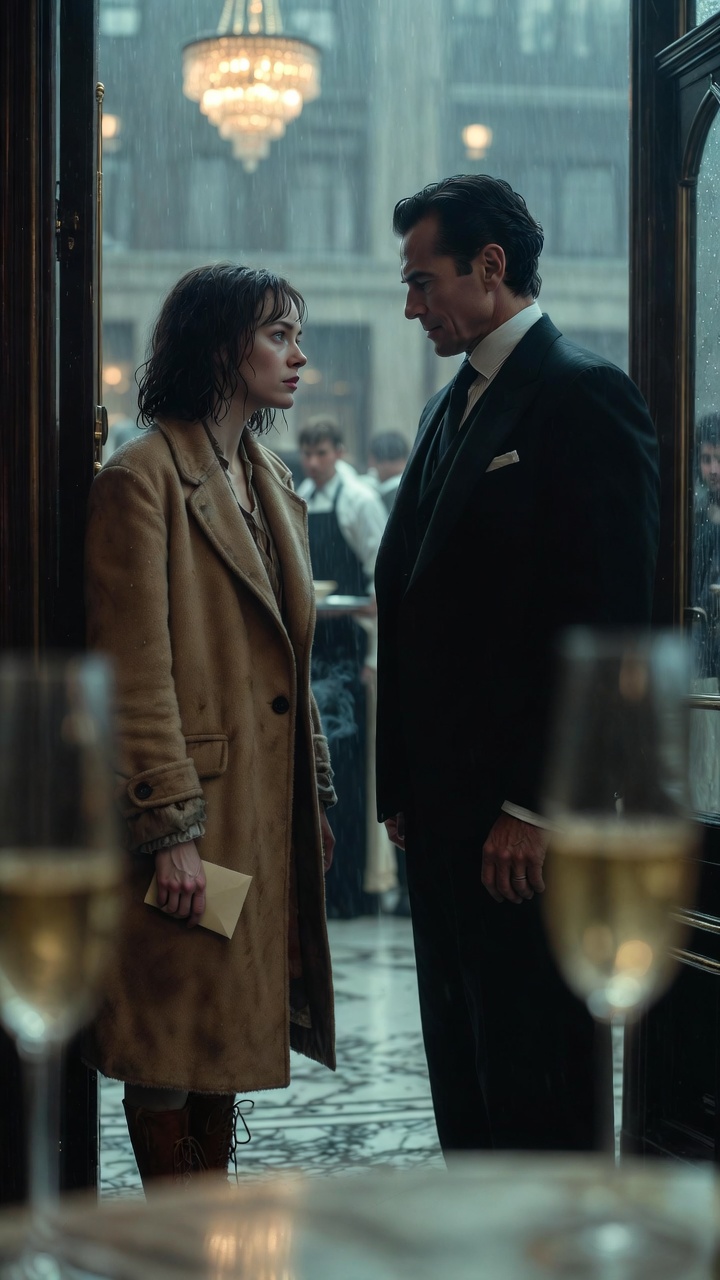
Clara heard it.
She did not look over.
Marcus did.
The laugh embarrassed him—not because it was cruel, but because it was public. Problems were supposed to be handled before guests had to witness them.
He lowered his voice.
“Miss Clara, perhaps there has been a misunderstanding.”
“There has.”
A muscle moved in his jaw.
“It would be best if we discussed this outside.”
“No.”
The word landed softly.
But it landed.
Marcus looked toward the bar. Ethan, the youngest server on the floor, stood beside the espresso machine with a cup in his hand. Twenty-four, nervous shoulders, good instincts, bad courage. He glanced at Clara, then at Marcus, then down at the cup as if foam art had suddenly become a matter of national importance.
Marcus turned back.
“Miss, this is a private establishment.”
“It’s a public café.”
“With standards.”
Clara’s eyes shifted, just for a second, to the white cloth on his arm.
Then back to his face.
“Standards for coffee,” she said, “or clothing?”
Somewhere, a chair leg scraped the floor.
Marcus felt heat climb the back of his neck.
He had worked too long to let a woman in a ruined coat turn him into entertainment before breakfast.
“Ethan,” he said without looking away from Clara.
The young waiter stepped forward. “Yes, Mr. Vale?”
“Please bring Miss Clara a coffee to go.”
Clara’s expression did not change.
“I didn’t order coffee to go.”
“It will be on the house.”
“I reserved a table.”
“You reserved a misunderstanding.”
The pearl woman near the window smiled openly now.
Clara saw that too.
Still, she did not defend herself loudly. She did not look around for sympathy. She simply stood there under the amber light, rainwater gathering at the tips of her hair, while the room waited for her to shrink.
That was what unsettled Marcus most.
People shrank.
When they were poor. When they were caught. When they were embarrassed. When a man in a tailored suit explained the world to them in a pleasant voice.
They lowered their eyes.
They apologized for existing.
Clara did neither.
Ethan returned with a paper cup, both hands around it as if delivering evidence.
“Here you go, ma’am,” he said.
His voice was almost kind.
Clara looked at him.
For a moment, something in her face softened.
“Thank you,” she said.
Ethan’s shoulders loosened.
Then Marcus reached for the cup.
“I’ll take that.”
Ethan hesitated.
Marcus turned his head slowly.
The hesitation died.
Ethan handed him the cup.
Marcus held it out to Clara, not close enough for her to take easily, forcing her to step forward.
She did not.
“I’m not leaving,” she said.
The smile disappeared from Marcus’s face.
Not all at once. It drained.
“You are making my guests uncomfortable.”
“No,” Clara said. “You are.”
The words were not loud.
They were worse.
They were clear.
Marcus stepped closer, lowering his voice until only she and the nearest tables could hear.
“Do you have any idea where you are?”
Clara looked around the café.
At the gold-veined marble. The velvet banquettes. The fresh white roses. The framed charcoal sketches of Parisian streets. The men in cufflinks. The women whose handbags could pay rent in Queens.
“Yes,” she said.
“Then act like it.”
That got a reaction.
Not from Clara.
From Ethan.
His head lifted. His mouth opened slightly, then closed.
Marcus saw it and hated him for it.
Clara finally reached for the coffee.
Marcus held it a fraction too tight.
Their fingers touched the cup at the same time.
For half a second, nothing happened.
Then Marcus let go.
Too late.
The lid popped loose.
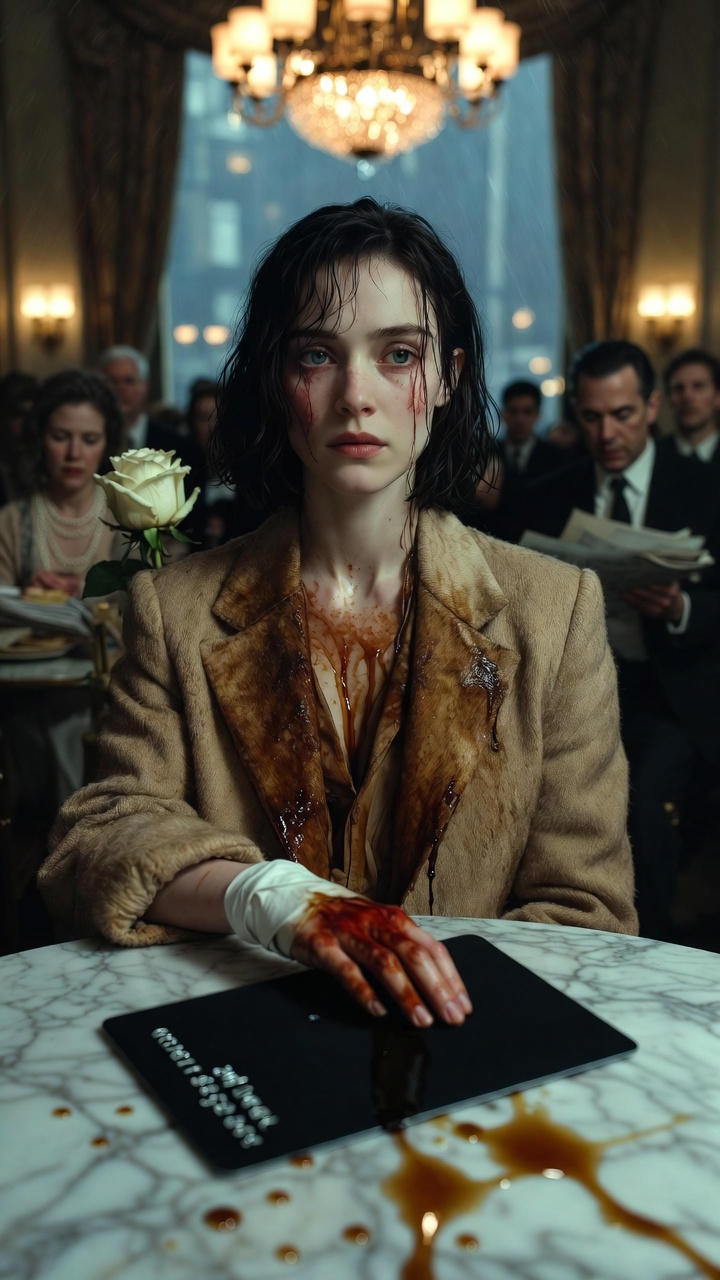
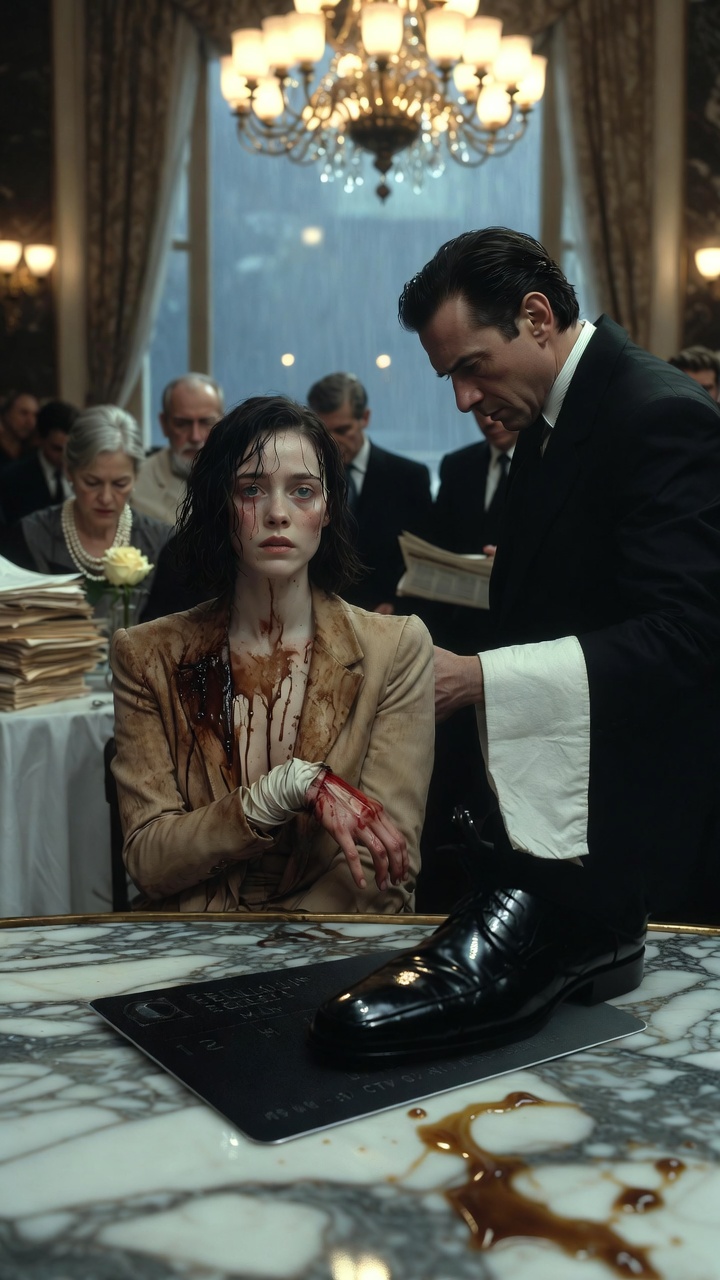
Hot coffee spilled down the front of Clara’s coat.
A dark stain bloomed across the old camel fabric.
Someone gasped.
The pearl woman whispered, “Oh my God,” but she did not stand.
Ethan moved first.
“Sir—”
“Careful,” Marcus snapped.
Clara looked down at the stain.
Steam rose from her coat.
A thin line of coffee had splashed her wrist. The skin there flushed red.
Marcus saw it.
He also saw every face in the room watching him.
There were moments in hospitality when an apology saved everything.
He knew this.
He had taught this.
He had fired people for failing to do it.
But the old fear rose in him before the apology could.
The fear of losing control.
The fear of being laughed at by people who had never scrubbed floors after midnight.
The fear of becoming again the boy in borrowed shoes outside a restaurant where the hostess had looked at him like he carried disease.
Marcus straightened.
“Miss,” he said, “you need to leave.”
Clara lifted her eyes.
The room held still.
Coffee dripped from the hem of her coat onto the marble floor.
One drop.
Then another.
“I’d like to speak to the owner.”
A laugh escaped him before he could stop it.
It was small. Ugly.
“The owner,” Marcus said.
“Yes.”
“The owner is not available to walk in every time someone wants to turn a personal embarrassment into a lawsuit.”
Clara slipped the cream envelope from his hand.
He had forgotten he still held it.
This time, she opened it herself.
Slowly.
The paper inside was folded once. She removed it, glanced at the printed confirmation, then set it on the host stand.
Marcus looked down despite himself.
Reservation: Table Seven
Name: C. Bell
Time: 9:00 a.m.
Guest Note: Private visit. No announcement.
His eyes caught on the small printed signature at the bottom.
Bellamy Holdings Transition Office.
For the first time that morning, Marcus felt something colder than irritation.
Transition Office?
He looked back at Clara.
“Where did you get this?”
“It was sent to me.”
“By whom?”
Before she could answer, he reached for the paper.
Clara moved it away.
Not dramatically.
Just enough.
Marcus’s hand closed on air.
The room saw.
His face hardened.
“That document could belong to anyone.”
“It has my name.”
“It has an initial and a fake last name.”
“Bell is not fake.”
His eyes narrowed.
“Do you think this is amusing?”
“No.”
“What do you want?”
“To sit down.”
“That is not going to happen.”
Clara folded the confirmation and placed it back inside the envelope.
Marcus saw his morning collapsing into something he could not categorize.
A poor woman with private office stationery.
A table reserved under a name tied to the ownership group.
A tone that did not plead.
He stepped closer and lowered his voice again.
“I don’t know what game you’re playing, but it ends now.”
Clara held the envelope against her stained coat.
“You should check your email.”
“I don’t take instructions from walk-ins.”
“I’m not a walk-in.”
“You are whatever I decide you are inside this room.”
Silence followed.
The sentence sat between them, heavy and revealing.
Even Marcus heard it after he said it.
Ethan looked away.
A man in the navy suit behind his newspaper lowered it fully now.
Clara’s hand tightened slightly around the envelope.
It was the first crack in her calm.
Not fear.
Pain.
Old pain, maybe.
Something that had recognized the shape of those words because it had heard them before in other rooms, from other men, wearing better watches.
Marcus saw it and almost regretted speaking.
Almost.
Then the front door opened behind Clara, letting in a sharp gust of cold rain.
Two guests stepped inside and stopped at the sight of the spilled coffee, the frozen staff, and the woman in the stained coat.
Marcus seized the moment.
“Ethan,” he said, louder now. “Please escort Miss Clara out.”
Ethan did not move.
Marcus turned.
“I said escort her out.”
Ethan swallowed.
“She has a reservation, Mr. Vale.”
It was barely above a whisper.
But in that room, it was a bell.
Marcus stared at him.
The young waiter’s face had gone pale, but his feet remained planted.
For one dangerous second, Clara looked at Ethan with something like gratitude.
Marcus hated that too.
He stepped around the host stand.
“Fine,” he said. “I’ll do it myself.”
He reached for Clara’s arm.
She moved back.
“Don’t touch me.”
But Marcus was already past listening.
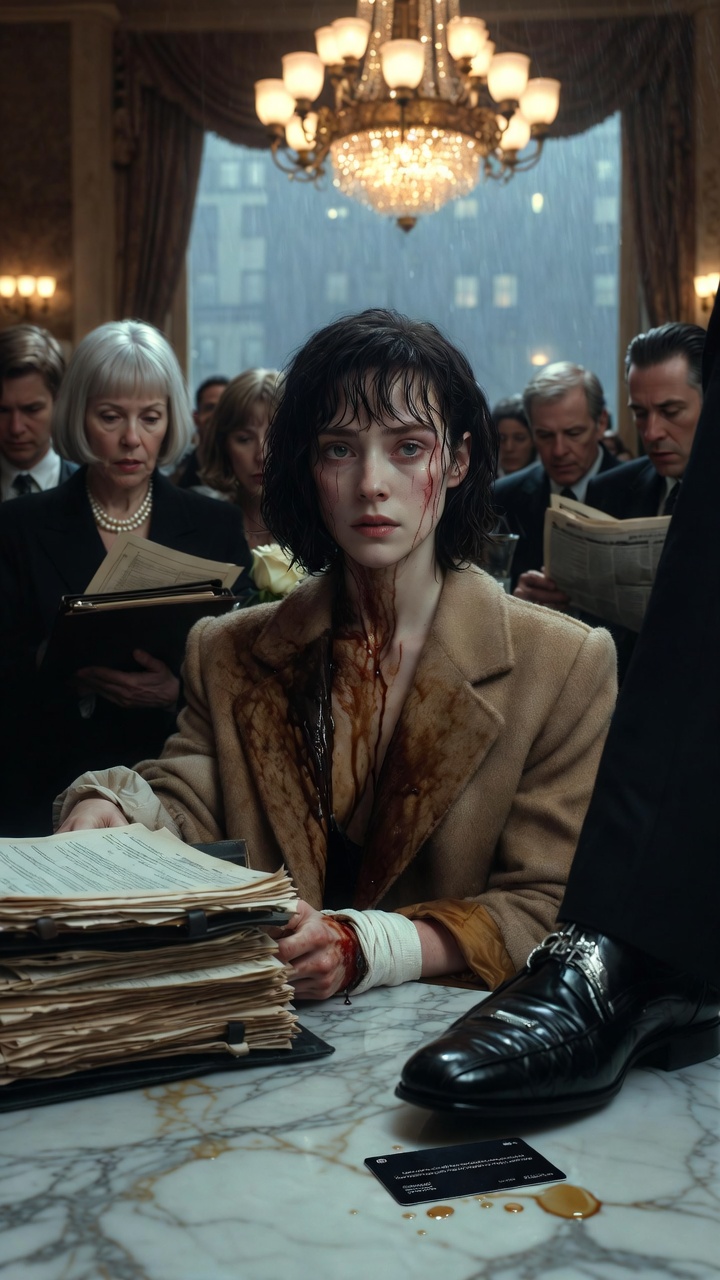
His fingers closed around her wrist.
The room inhaled.
Clara’s skin was warmer than he expected. Fragile, maybe, but not weak. Beneath his grip, he felt her pulse kick once hard against his fingers.
“Let go,” she said.
“Outside.”
“Let go.”
“Now.”
He pulled.
Not violently enough to look like violence.
That was the trick, wasn’t it?
Just enough force to make her stumble. Just enough control to make it seem necessary. Just enough pressure that anyone watching could later say it happened quickly, that maybe she resisted, that maybe Marcus had no choice.
Her boot slipped on the wet marble where coffee had fallen.
The cream envelope dropped.
Something small slid out across the floor.
Not money.
Not a phone.
A keycard.
Black.
Matte.
No logo on the front.
Only a line of silver text near the bottom.
BELLAMY HOLDINGS
EXECUTIVE ACCESS
It came to rest beside Marcus’s polished shoe.
No one moved.
Not Marcus.
Not Ethan.
Not the pearl women.
Not the man with the newspaper.
The espresso machine behind the bar clicked off, and the sudden absence of sound made the room feel enormous.
Marcus stared at the card.
Then at Clara.
Her wrist was still in his hand.
He let go as if burned.
Clara bent down slowly and picked up the card.
Her hand shook once before she closed her fingers around it.
Marcus saw the red mark his grip had left on her wrist.
For the first time, his voice did not obey him.
“What is that?”
Clara slipped the card back into the envelope.
Then she looked at the table by the window.
The white rose waited there, untouched.
“My key,” she said.
Marcus swallowed.
“To what?”
The front door opened again.
This time, no guests stepped in.
Three people entered wearing dark suits, rain shining on their shoulders. They did not shake off umbrellas. They did not look around for a table. They moved with the quiet precision of people who had already read the room before entering it.
The woman in front had silver hair cut blunt at her chin and a leather portfolio under one arm.
Her eyes moved from the coffee stain on Clara’s coat to the red mark on her wrist.
Then to Marcus.
The room seemed to pull away from him.
The woman approached Clara.
“Ms. Bellamy,” she said, her voice low and exact. “Are you injured?”
Marcus heard the name.
Bellamy.
Not Bell.
Bellamy.
The marble floor beneath him might as well have opened.
Clara did not answer right away.
She looked at Marcus.
Not triumphantly.
That would have been easier.
She looked at him as if he had just proven something she had hoped, foolishly, not to find.
Then she said:
“Not enough to leave.”
Chapter Two
Everyone Saw
Evelyn Hart did not raise her voice.
She had no need to.
Some people carried authority like jewelry. Loud, bright, meant to be seen. Evelyn carried hers like a blade tucked inside a sleeve.
The dining room of Café Bellamy remained suspended around her. Forks paused over plates. Phones hovered inches above tablecloths. A banker in the corner slowly placed his espresso cup down without making a sound.
Evelyn looked at Clara’s wrist again.
“Do you need medical attention?”
“No,” Clara said.
The answer came too fast.
Evelyn noticed.
So did Marcus.
Clara tucked her injured wrist beneath the sleeve of her stained coat as if hiding the evidence could make the room less guilty.
Marcus tried to speak.
“Ms. Hart, I believe there has been—”
Evelyn turned to him.
“Mr. Vale.”
His name in her mouth sounded like a file being opened.
He straightened automatically.
“Yes.”
“Step away from her.”
He had already stepped away.
Still, he took another step.
Ethan stood beside the bar, paper cup forgotten in his hand. His eyes moved between Marcus and Clara as though watching a bridge burn in slow motion.
Evelyn opened her portfolio and removed a slim tablet.
Behind her, the two men in suits separated without instruction. One moved toward the bar. The other toward the host stand.
Marcus noticed everything now.
The way the man at the host stand photographed the reservation book.
The way the man at the bar looked up toward the security camera above the pastry case.
The way Evelyn did not ask permission.
His tongue felt too large in his mouth.
“This is highly irregular,” he said.
“Yes,” Evelyn replied. “It is.”
A few guests exchanged glances.
The pearl woman by the window whispered, “Who is she?”
Her friend did not answer.
Clara did.
Without turning around.
“No one you recognized.”
The words struck harder than anger.
The pearl woman looked down at her cappuccino.
Evelyn’s eyes flicked briefly toward Clara—not warning, not approval. Something more complicated. Concern, perhaps, braided with professional restraint.
Marcus gathered what remained of his composure.
“Ms. Hart, I was not informed that Ms. Bellamy would be visiting the property today.”
“You were informed that a private guest had reserved Table Seven.”
“Under an incomplete name.”
“For her safety and privacy.”
“I had no way of verifying—”
“You had several,” Evelyn said. “You chose not to use them.”
The sentence landed cleanly.
Marcus glanced at the host stand.
The cream envelope lay there now, open, impossible to deny. The black keycard had vanished back into Clara’s pocket, but everyone had seen it.
Everyone.
That was the problem.
Not the mistake.
The witnesses.
He could survive a mistake. He had survived worse. Hospitality rewarded men who could smooth over disasters with gift cards, apologies, and the proper amount of eye contact.
But this was not smoothing.
This was rupture.
“May we continue this in the office?” Marcus asked.
Evelyn gave him a faint look.
“No.”
A murmur moved through the café.
Marcus felt it crawl over his skin.
“No?” he repeated.
“No,” Evelyn said. “The incident occurred publicly. The preservation of evidence begins publicly.”
“Evidence?” His laugh came out brittle. “That is a rather dramatic word for a seating misunderstanding.”
Clara finally looked at him fully.
The coffee stain had spread down her coat in an ugly diagonal line. Her hair had begun to dry unevenly around her face. She should have looked smaller now, exposed beneath the chandelier light.
She did not.
“You grabbed my wrist,” she said.
Marcus lowered his voice.
“I escorted you.”
“You pulled me.”
“You refused to leave.”
“I had a reservation.”
“You refused to identify yourself.”
“I shouldn’t have to be rich before I’m treated like a customer.”
The room went still again.
A man near the center table cleared his throat and suddenly became fascinated with his phone.
Evelyn looked toward the ceiling camera.
“Mr. Vale, please instruct your staff to preserve all footage from 8:45 a.m. onward.”
Marcus’s mouth tightened.
“Our security system is managed by corporate.”
“It is now managed by Bellamy Holdings.”
That was when the second wave hit him.
Not just her name.
Not just the executive card.
Bellamy Holdings.
Transition Office.
Private guest.
The rumors from last week returned in pieces.
A quiet acquisition.
A change in upper ownership.
No disruptions to daily operations.
Management evaluations pending.
He had ignored the last line.
Everyone ignored the last line until it stood in front of them wearing an old coat.
Marcus looked at Clara.
“Are you here to evaluate me?”
Clara did not answer immediately.
Rain traced the window behind her in silver threads. Outside, a yellow cab stopped at the curb, then pulled away. Inside, the chandeliers made everything appear warmer than it was.
“I was here to have coffee,” she said.
Evelyn’s expression did not change, but Marcus saw one of the suited men glance up.
Clara continued.
“And to listen.”
“To what?”
“To how this place speaks when it thinks no one important is listening.”
No one moved.
Then, quietly, Ethan set the paper cup on the bar.
It sounded louder than it should have.
Marcus turned toward him.
The young waiter froze.
Evelyn noticed.
So did Clara.
“Ethan,” Clara said.
His eyes widened.
“You know my name?”
“You wear a name tag.”
He looked down, embarrassed by his own question.
Clara’s gaze softened again.
“Did you see what happened?”
Ethan’s face changed.
Not much.
Just enough for Marcus to understand danger had shifted shape.
“Ethan,” Marcus said carefully, “you should be very precise.”
The young waiter looked at him.
There was fear there.
And something else underneath it.
Anger, maybe. Thin and new.
Ethan wiped his palm against his apron.
“I saw the coffee spill.”
“An accident,” Marcus said.
Ethan swallowed.
“I saw you holding the cup.”
Marcus’s eyes narrowed.
Ethan’s voice wavered but did not stop.
“And I saw you grab her wrist.”
A woman at the center table exhaled sharply.
Marcus took one step toward Ethan.
Evelyn’s voice cut through the room.
“Mr. Vale.”
He stopped.
Ethan lowered his eyes.
But he had already said it.
The first thread had been pulled.
Clara turned toward the room.
Not dramatically. She did not perform pain. She did not raise her stained sleeve like evidence in a trial. She simply looked at them—the guests, the staff, the people who had watched a stranger be reduced to a problem and decided the safest thing to do was nothing.
“Did anyone else see?”
The question moved across the café like a hand passing over a flame.
No one wanted to be touched by it.
The man with the newspaper folded it slowly.
“I saw him take the cup from the waiter,” he said.
His voice was old, rough, reluctant.
Marcus stared at him.
The man did not look back.
A woman near the pastry counter spoke next, barely audible.
“I saw him pull her.”
The pearl woman shifted in her chair.
Her friend whispered, “Don’t.”
But Clara heard.
So did Evelyn.
The pearl woman pressed her lips together.
For a second, her face looked younger than it was. Less polished. Afraid of looking cruel because she had been cruel too casually to notice.
“I saw it,” she said at last.
Her friend stared at her.
“I didn’t know who she was.”
Clara’s eyes moved to her.
There was no satisfaction in them.
“That’s the problem,” Clara said.
The pearl woman looked as though she had been slapped without a hand being raised.
Marcus felt the ground moving beneath him now.
A public mistake could be contained.
A public moral failure could not.
He reached for the one tool he had left.
Professional regret.
“Ms. Bellamy,” he said, lowering his tone, “if my conduct appeared forceful, I apologize. My only intention was to protect the atmosphere of this establishment.”
Clara looked at him.
“The atmosphere?”
“Yes.”
She glanced around the room.
At the roses. The velvet. The marble. The people who had paid eighteen dollars for coffee and silence.
“And what atmosphere is that?”
Marcus chose each word carefully.
“One where guests feel safe, respected, and comfortable.”
“Guests,” Clara repeated.
“Yes.”
“Which guests?”
His face flushed.
Evelyn watched him without blinking.
Clara waited.
Marcus had built a career on elegant answers. He had handled celebrities, drunk executives, divorcing couples, kitchen fires, health inspectors, and women who cried quietly into untouched salads.
But he had no elegant answer for that.
Because they all knew what he meant.
The right guests.
The guests who looked like they belonged.
The guests whose discomfort mattered before another person’s dignity.
A phone rang.
Everyone flinched.
It was Marcus’s.
The sound came from inside his jacket, sharp and bright.
He did not move.
It rang again.
Evelyn glanced at the phone pocket.
“You may want to answer that.”
Marcus slowly removed the phone.
The screen displayed a name that made his stomach drop.
REGIONAL OPERATIONS — BELLAMY HOLDINGS
He looked at Clara.
She looked back.
He answered.
“This is Marcus Vale.”
A voice spoke on the other end.
No one in the room could hear the words.
But they saw Marcus hear them.
The blood left his face in stages.
First the cheeks.
Then the mouth.
Then the eyes.
His gaze drifted to the host stand. To the camera. To Clara’s coat. To her wrist.

“Yes,” he said.
A pause.
“Yes, she’s here.”
Another pause.
His fingers tightened around the phone.
“No, I was not aware.”
Clara turned away before he finished, as though she did not need to watch a man understand his own fall.
She walked to Table Seven.
No one stopped her this time.
Ethan moved before anyone asked. He took a clean napkin from the service station and followed her, careful not to come too close.
“Ma’am,” he said, voice low, “for your coat.”
Clara looked at the napkin.
Then at him.
“Thank you.”
He placed it on the table, not in her hand, giving her the choice to accept it.
She did.
That small mercy seemed to cost him less than his earlier silence, but his eyes were wet.
“I’m sorry,” he whispered.
Clara sat down slowly.
The white rose trembled in the narrow glass vase as her coat brushed the table.
“For what you did?” she asked.
He flinched.
“For what I didn’t.”
Clara unfolded the napkin over her burned wrist.
Outside, the rain grew heavier, blurring the city until Manhattan looked like a painting left too long in water.
At the host stand, Marcus ended the call.
His hand fell to his side.
Evelyn stepped closer to him.
“Mr. Vale,” she said, “effective immediately, you are to remain on site and make yourself available for formal review.”
His voice was hoarse.
“Formal review.”
“Yes.”
“Am I being suspended?”
“That depends on what else we find.”
His eyes flicked toward Clara.
“What else?”
Evelyn opened her portfolio again.
This time, she removed not one page, but several.
Complaint summaries.
Dates.
Names.
Staff notes.
Guest incident reports that had never been escalated.
Marcus recognized the layout.
Internal documents.
Documents he had signed.
Documents he had buried under language clean enough to disinfect cruelty.
Guest appeared unstable.
Individual refused dress expectations.
Potential theft concern.
Removed without incident.
Clara watched him from Table Seven.
Her face had not changed.
But her eyes had.
The gray was colder now.
Evelyn placed the pages on the marble host stand.
One by one.
“Ms. Bellamy did not come here because of one incident,” she said.
Marcus stared at the papers.
The room seemed to tilt.
From somewhere behind him, Ethan whispered:
“Oh God.”
Clara looked down at the white rose.
A bead of rainwater from her hair fell onto one petal.
She touched the edge of the flower gently, then looked back at Marcus.
“No,” she said. “I came because of all the people who never made it to Table Seven.”
Marcus opened his mouth.
But for once, no polished answer came.
And then Evelyn placed the final document on top of the stack.
It was not a complaint.
It was a contract.
Across the first page, in black capital letters, was the phrase Marcus had missed in every memo because men like him never believed the ground could change beneath their shoes.
TRANSFER OF OWNERSHIP AND OPERATING CONTROL.
Evelyn turned the page toward him.
Her voice remained calm.
“Kể từ chín giờ sáng nay,” she said, then corrected herself in English with deliberate precision, “as of 9:00 a.m. this morning, Café Bellamy is under the direct ownership authority of Clara Bellamy.”
The room did not breathe.
Marcus looked at Clara.
The woman in the old coat sat beneath the chandelier, coffee staining her chest, a napkin wrapped around her wrist, the white rose trembling beside her.
She did not smile.
She did not gloat.
She only asked one question.
“Now, Mr. Vale, would you like to tell me what kind of people belong here?”