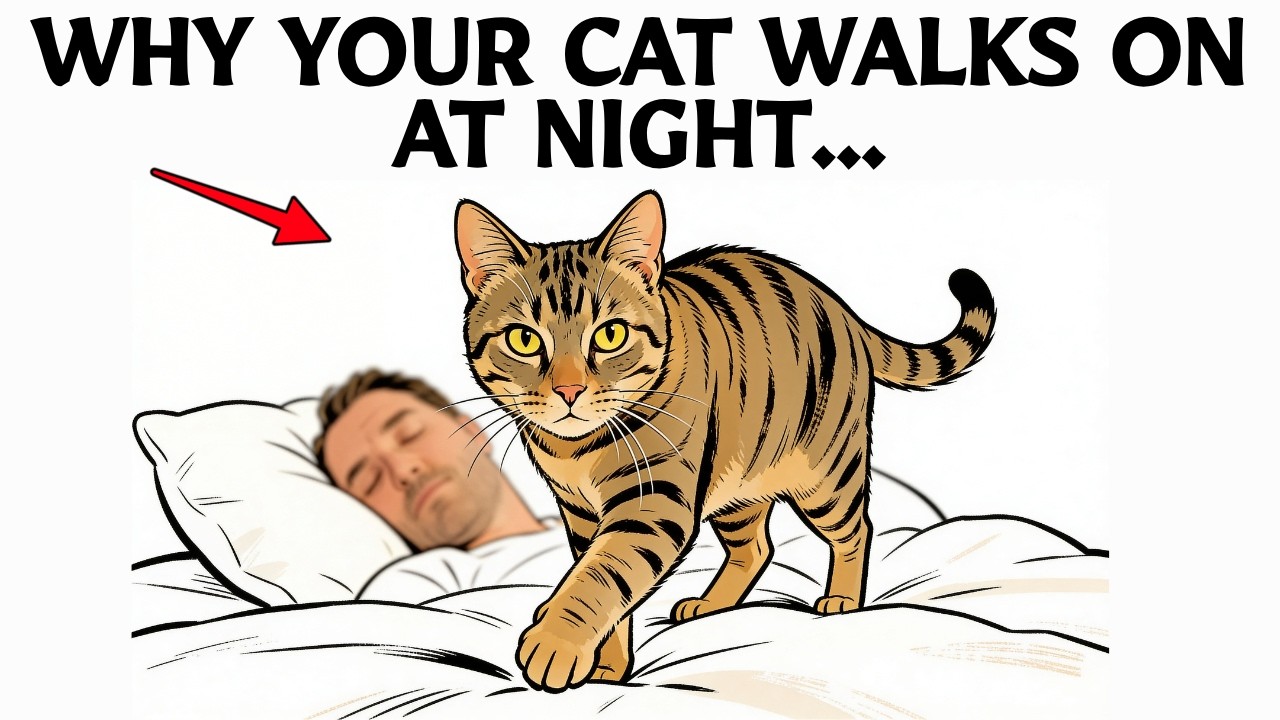
It is 3:17 in the morning. The room is dark, the whole house is quiet, and you suddenly wake up because four small paws are carefully stepping across your chest.
Your cat pauses, looks at your face, then continues toward the warm space beside your pillow. Maybe they curl up against your neck, meow directly into your ear, or jump down the moment you open your eyes.
It is easy to feel as though your cat is trying to communicate something personal. Are they looking for affection, asking for breakfast, trying to alert you, or simply using your body as a bridge to the other side of the bed?
The truth is that there is rarely one explanation that fits every cat. This behavior may involve warmth, habit, curiosity, attention, or a routine your cat has developed while living with you.
The best clue is often not the fact that your cat stepped on you, but what they do immediately afterward.
You May Simply Be the Warmest Place in the Room

Cats are remarkably good at finding the warmest, most comfortable spot available. At night, that place may be your chest, stomach, the backs of your knees, or the space between your neck and the pillow.
The human body offers warmth, softness, and a familiar scent. As the room cools overnight, a sleeping person may become far more appealing than an empty section of mattress.
Sometimes your cat walks across you simply because you are lying between them and the place they want to reach. They may step over your legs to get to the pillow, cross your stomach to change sides, or pause on your chest while deciding where to settle.
Sometimes the simplest explanation is the most reasonable: you are warm, soft, and directly in the middle of your cat’s route.
That does not make the moment meaningless. Your cat may be looking for warmth while also feeling safe and comfortable near someone familiar.
Your Cat May Have Learned That This Works
Think about what you usually do when your cat steps on you.
You open your eyes, say their name, pet them, move the blanket, or shift over to make room. If it is close to morning, you may get up and feed them.
From your cat’s point of view, walking across you is a very effective way to get a response.
Cats can learn that certain behaviors lead to useful results. If four paws on your chest regularly bring food, attention, conversation, or play, your cat has a reason to repeat the behavior.
That does not mean they are manipulating you. They are simply using a method that has worked before.
To your cat, your body may be the most dependable alarm clock in the house.
Over time, the two of you may accidentally create a ritual: your cat steps on you, you react, and the morning begins.
Your Cat May Be Ready for Activity While You Still Want to Sleep
Cats are often described as nocturnal, but household cats do not all follow the same schedule.
Many are more active in the evening or early morning. Others adjust much of their routine around meals, daylight, household activity, and the habits of the people they live with.
So while you are still sleeping deeply, your cat may already be ready for another round of exploring.
They may look out the window, move from room to room, visit the feeding area, carry a toy, or suddenly race down the hallway. Your bed may simply be one stop along the way.
Sometimes your cat is not walking across you because they have a secret message. Their day has simply started, while yours has not.
Your Cat May Be Looking for Closeness
Some cats do not just walk across their owners. They stop and stay.
They may settle beside you, tuck their paws underneath themselves, begin to purr, or press their body against your chest. In this situation, closeness may be part of the behavior.
For some cats, your warmth, scent, breathing, and familiar presence make the bed a comfortable place to rest.
Still, it is best not to assume that every cat is expressing love in exactly the same way. One cat may be seeking physical contact. Another may simply want the warmest cushion available. A third may arrive for the heat and stay because they also feel secure.
Look at the whole body. A cat who lies down with loose muscles is communicating something different from one who remains stiff, scans the room, or quickly jumps away.
You do not need to believe the theory that your cat is checking whether you are still alive for the moment to feel meaningful. Your cat is still choosing a familiar person as part of the place where they want to be.
A Sound You Did Not Hear May Have Woken Them

Cats can notice sounds and movements that sleeping humans completely miss.
A pipe may make a noise inside the wall. A branch may touch the window. Another pet may move through the hallway. Your cat wakes, investigates, then returns to the bed or heads toward a familiar resting place.
That does not automatically mean your cat is frightened or trying to warn you.
A relaxed cat may listen briefly and then lie down. An alert cat may rotate their ears, stare toward the door, or focus on one particular spot. A playful cat may move quickly and turn your blanket into a hunting ground.
Sometimes you were not the reason your cat woke up. You were simply where they decided to go afterward.
When Your Cat Starts Kneading
The most unforgettable version is when your cat stands on your stomach or chest and begins pressing their front paws down one after the other.
Kneading begins in kittenhood, when kittens press against their mother while nursing. Many cats continue this motion as adults, especially on blankets, beds, clothing, or other soft surfaces.
However, this does not prove that your cat thinks you are their mother. It is also not always definitive proof of love.
The soft surface, warmth, and familiar scent may create a situation that feels comfortable to your cat.
If their claws hurt, place a folded blanket between their paws and your skin. You can also gently reposition them instead of scolding them or pushing them away suddenly.
The Most Important Clue Is What Happens Next
Instead of only asking why your cat walked on you, watch what happens over the next thirty seconds.
If they lie down and go back to sleep, warmth and closeness may be part of the answer.
If they jump down, walk to the door, and look back, they may want you to follow.
If they head straight toward the food bowl, the visit may be connected to breakfast.
If they bring you a toy or begin running around the room, they may be looking for activity.
If they leave the moment you move over, they may simply have wanted your spot.
Timing matters too. A behavior that happens at nearly the same time every morning is often connected to routine. A single nighttime visit during cold weather, a storm, or a change in the home may have a different explanation.
What your cat does next often reveals more than the footsteps themselves.
The 5 A.M. Walk Across Her Stomach
One woman said her cat walked across her stomach at nearly the same time every morning.
He moved from one side of the bed to the other, paused near her shoulder, and stared at her face. She used to think it was a sign of affection and even joked that he was checking to make sure she was all right.
Then she noticed what happened when she did not respond.
The cat walked to the bedroom door, looked back, returned to the bed, and crossed her stomach again. If that still did not work, he meowed.
She also realized that she usually got up and fed him immediately afterward.
The mystery suddenly became much simpler. Her cat had learned that walking across her was how the morning began.
That did not make the ritual cold or impersonal. Breakfast may have been the goal, but she was still the familiar person he trusted and relied on every day.
When Does This Behavior Deserve More Attention?
A familiar habit is different from a sudden change.
Consider speaking with a veterinarian if your cat unexpectedly becomes much more active at night and the change is accompanied by persistent vocalizing, confusion, restlessness, changes in appetite or thirst, changes in litter box habits, difficulty jumping, trouble settling down, or signs of pain.
This is especially important in older cats. Changes in sleep, mobility, or awareness should not automatically be dismissed as normal aging.
The goal is not to worry about every set of midnight footsteps. It is simply to notice when a familiar routine becomes something unusual.
You Have Become Part of Your Cat’s Night
A cat walking across you at night does not carry one secret message.
They may be looking for warmth, food, attention, play, or simply trying to reach the other side of the bed. Sometimes several reasons may be true at once.
What makes the behavior meaningful is not that it proves a dramatic theory. It is that your cat has included you in one of their familiar routines.
You are the warm place, the person who responds, the obstacle in the middle of the mattress, and sometimes the companion they choose to lie beside.
Your cat may not be checking whether you are alive or declaring ownership of you. But at three in the morning, when there are easier paths to take and quieter places to sleep, they still choose to make you part of their night.
What does your cat usually do right after walking across you at night?